

Summary
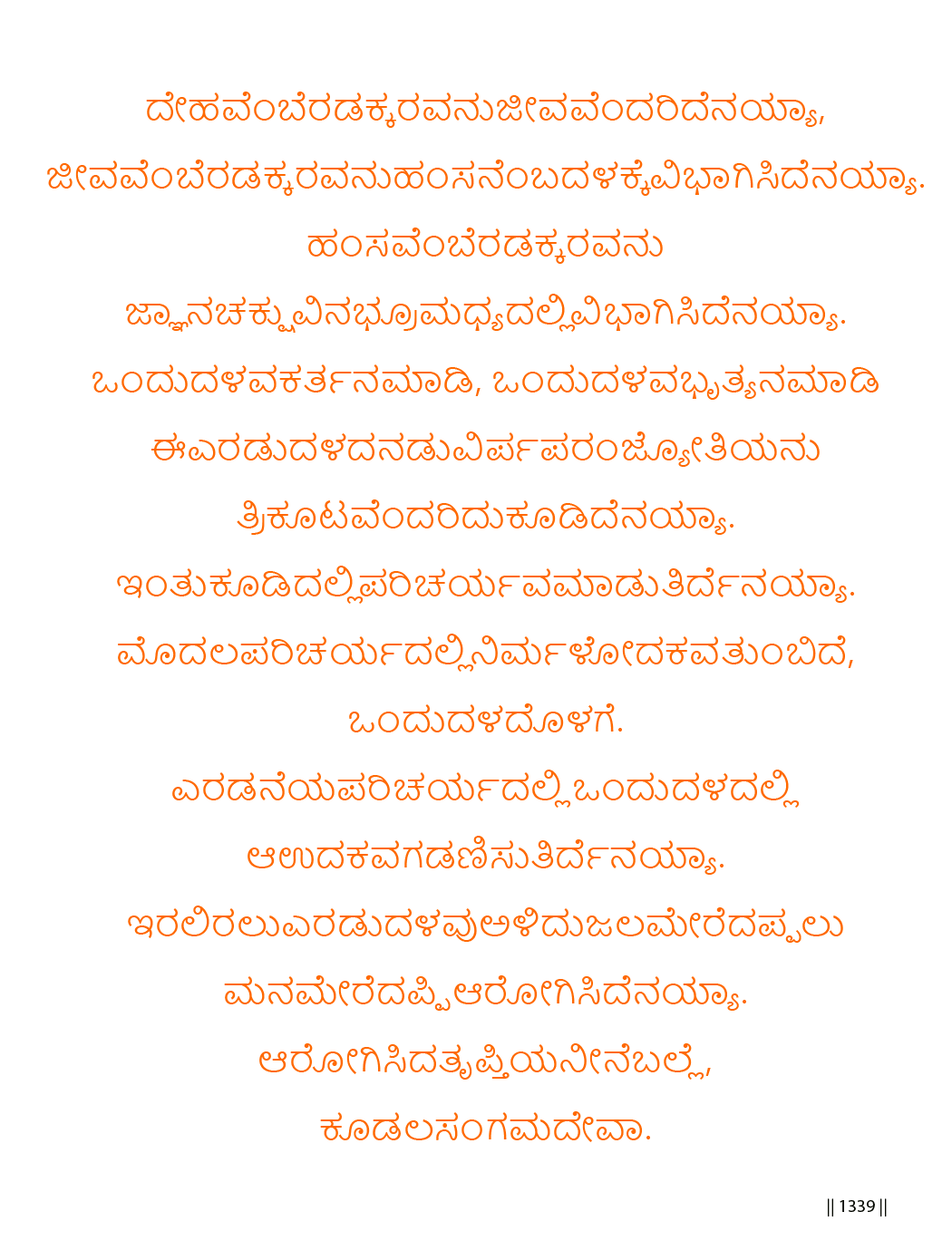
Basavanna begins with the two-syllabled expressions Deha, Jiva, and Hamsa and moves progressively inward through them.
At the brow-centre of the eye of knowledge, Hamsa is divided into two petals. One petal is established as Karta, the Master, and the other as Bhṛtya, the servant. Between them abides Paranjyoti, the Supreme Light. Basavanna recognizes this gathered centre as Trikuta and joins it.
Within this union, he performs twofold paricharya. Pure water is first filled into one petal and then gathered within the other. As the worship continues, both petals disappear. The water crosses its boundary, the mind passes beyond its limit, and Basavanna partakes of the resulting condition.
Kudalasangama Deva alone knows the fulfilment of that partaking.
Imagery & Symbolic Relevance
The vachana opens with three two-syllabled expressions:
Deha;
Jiva;
Hamsa.
Basavanna first knows Deha as Jiva. The body is understood through the living principle present within it.
Jiva is then carried inward toward Hamsa. Hamsa prepares the movement into the subtle two-petalled field described at the brow-centre of the eye of knowledge.
The Two Petals
Basavanna divides Hamsa into two petals at the bhrumadhya, the middle of the brows associated here with the eye of knowledge.
The two petals receive distinct sacred roles:
one petal becomes the Karta, the Master or directing agent;
the other becomes the Bhṛtya, the servant.
The relation between Master and servant is preserved as the foundation of the inward worship.
Between these two petals abides Paranjyoti, the Supreme Light. The two relational positions and the Light between them form the gathered centre Basavanna recognizes as Trikuta.
Basavanna then joins this centre. The joining is followed by worship and service; it is not merely an intellectual recognition.
The Twofold Paricharya
Within the joined condition, Basavanna performs paricharya—sacred attendance, service, and worship.
During the first paricharya, he fills one petal with Nirmalodaka, pure and unstained water.
During the second paricharya, the same water is gathered and ordered within the other petal.
The water therefore passes through both relational fields. It belongs neither exclusively to the Master-petal nor exclusively to the servant-petal.
The Disappearance of the Petals
As the paricharya continues, both petals disappear.
The divisions required for the earlier worship have completed their function. The water is no longer confined by their former boundaries and passes beyond its measure.
The mind follows the same movement. Its established boundary is crossed.
The movement proceeds from distinction, through sacred relationship and service, into a condition beyond the former limits of division and mind.
Partaking and Fulfilment
Basavanna then partakes of what has arisen through this completed paricharya, meaning sacred service, attendance, or worship.
The experience is inwardly received and assimilated rather than merely observed from outside.
Basavanna leaves the measure of its fulfilment entirely with Kudalasangama Deva:
You alone know the satisfaction of what I partook.
The final authority therefore remains with the Lord. Basavanna undergoes the experience, while Kudalasangama Deva alone knows its complete fulfilment.
Lingayoga Relevance
The vachana presents Lingayoga as an ordered inward process:
Deha is known through Jiva.
Jiva is refined toward Hamsa.
Hamsa is divided at the brow-centre of the eye of knowledge.
One petal is established as Karta.
The other is established as Bhṛtya.
Paranjyoti is recognized between them.
The gathered centre is known as Trikuta.
Paricharya is performed.
Nirmalodaka passes through the two petals.
The petals disappear.
Water and mind cross their former limits.
The resulting condition is inwardly partaken.
The Master–servant relationship remains central during the practice. The servant does not claim the position of the Master, and the Master is not reduced to the servant.
Both are gathered around Paranjyoti. Through completed service, the divisions that contained the earlier movement cease to remain.
The passage beyond mind is therefore reached through relationship, purity, worship, and inward assimilation.
Even at the culmination, Basavanna does not claim ownership over the experience. Its fulfilment remains known to Kudalasangama Deva alone.
Lingayoga
Lingayoga Relevance
The vachana presents Lingayoga as an ordered inward process:
Deha is known through Jiva.
Jiva is refined toward Hamsa.
Hamsa is divided at the brow-centre of the eye of knowledge.
One petal is established as Karta.
The other is established as Bhṛtya.
Paranjyoti is recognized between them.
The gathered centre is known as Trikuta.
Paricharya is performed.
Nirmalodaka passes through the two petals.
The petals disappear.
Water and mind cross their former limits.
The resulting condition is inwardly partaken.
The Master–servant relationship remains central during the practice. The servant does not claim the position of the Master, and the Master is not reduced to the servant.
Both are gathered around Paranjyoti. Through completed service, the divisions that contained the earlier movement cease to remain.
The passage beyond mind is therefore reached through relationship, purity, worship, and inward assimilation.
Even at the culmination, Basavanna does not claim ownership over the experience. Its fulfilment remains known to Kudalasangama Deva alone.
Editorial Commentary
Eraḍakkara means two letters or two syllabic units. The Deha–Jiva–Hamsa sequence forms the opening progression.
Jñāna-chakshu means the eye of knowledge.
Bhrumadhya means the middle of the brows or brow-centre.
Karta is the Master, doer, or governing agent.
Bhṛtya is the servant. These two roles establish the relational field of the inward paricharya.
Paranjyoti is the Supreme Light abiding between the two petals.
Trikuta names the gathered conjunction of the two petals and the Supreme Light between them.
Paricharya means sacred service, attendance, or worship.
Nirmalodaka means pure and unstained water.
The disappearance of the petals marks the ending of their separate containing function.
The water crossing its boundary and the mind crossing its limit indicate movement beyond their former measures.
Ārogisidenu means that Basavanna partook of, inwardly received, or assimilated the resulting condition.
The satisfaction of that partaking is known completely by Kudalasangama Deva.
Related Vachana
Supporting Vachana
Sharana Sthala Vachana 1392 — The Washing of the Inner Cloth
Sharana Vachana 1392 presents Madivala Machideva cleansing the stains of Basavanna’s body and mind.
The cloth is washed with the pure water of knowledge associated with the five senses. It is then divided into three portions and offered to Guru, Linga, and Jangama. Finally, the three portions are gathered into one cloth in which Basavanna abides through Madivala’s grace.
This prepares Vachana 1224 through three related movements:
the embodied and mental condition is purified;
pure water becomes the means of sacred refinement;
what is initially divided and separately ordered is finally gathered into unity.
In Sharana Vachana 1392, the movement is expressed through washing, threefold offering, and the restored single cloth.
In Aikya Vachana 1224, it becomes an inward Lingayoga movement through Deha, Jiva, Hamsa, the two petals, Paranjyoti, Nirmalodaka, and the disappearance of the former divisions.
Advancing Vachana
Aikya Sthala Vachana 1225 — The Fivefold Offering Beyond Ego
Aikya Vachana 1225 examines offering through wealth and grain, hand, sight, speech, mind, and Bhava.
Each medium of offering is progressively carried beyond personal possession. What is given can no longer be preserved as the achievement of an independent giver.
Vachana 1224 concludes by leaving the fulfilment of the inward partaking entirely to Kudalasangama Deva’s knowledge.
Vachana 1225 advances this movement by examining and exhausting every remaining claim connected with offering:
the possession offered;
the hand that gives;
the eye that witnesses;
the speech that names;
the mind that interprets;
the Bhava that claims experience.
The inward partaking of Vachana 1224 thus deepens into freedom from the presumption that the devotee can measure or possess Kudalasangama Deva’s satisfaction.
