

Summary
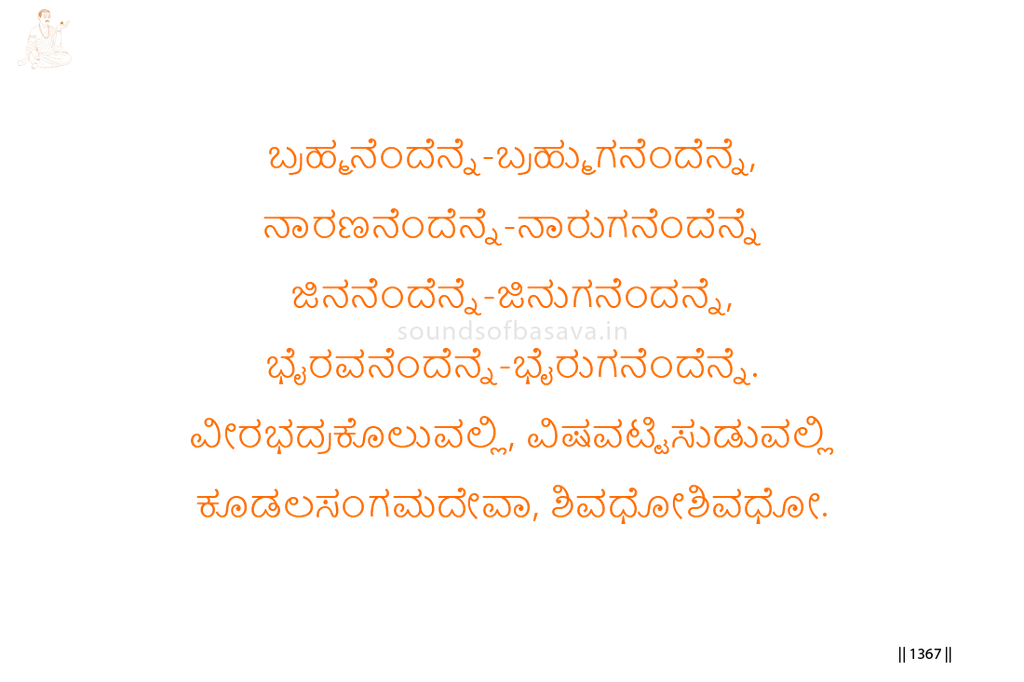
Basavanna refuses to confine Kudalasangama Deva within the names Brahma, Narayana, Jina, Bhairava, or their paired forms.
When Veerabhadra strikes and poison burns, conceptual distinctions collapse. What remains is the immediate cry:
“Shivadhō! Shivadhō!”
The vachana moves from defining the Divine through names to directly invoking Him in surrender.
Imagery & Symbolic Relevance
The opening consists of four paired names:
Brahma and Brahmaga;
Narayana and Naruga;
Jina and Jinuga;
Bhairava and Bhairuga.
Basavanna does not select one name as the complete truth. Each may indicate a sacred understanding, but none can contain Kudalasangama Deva.
The repetition exposes the limitation of naming itself. A name may guide devotion, yet it becomes restrictive when the mind assumes that the Reality has been fully grasped by the word.
The vachana then shifts abruptly from theological designation to crisis.
Veerabhadra striking represents overwhelming destructive force. Poison burning represents affliction that consumes from within. Before such immediacy, formal definitions no longer provide refuge.
The repeated cry “Shivadhō! Shivadhō!” is not another definition. It is direct invocation. The speaker no longer discusses what the Divine should be called; he turns wholly toward Shiva.
Kudalasangama Deva is still directly addressed. The distinction is therefore not between using a name and remaining silent, but between:
naming in order to define;
calling in order to surrender.
Lingayoga
In Lingayoga, sacred names must lead awareness toward Linga rather than become objects of intellectual or sectarian possession.
The test of remembrance comes when security and argument fail. At that moment, the Name must function as living refuge, not merely as learned terminology.
The practitioner therefore receives the sacred Name without claiming that the Reality named has been fully contained.
Editorial Commentary
The paired forms must be retained without assigning unsupported meanings to their linguistic variations.
The vachana does not reject Brahma, Narayana, Jina, or Bhairava. It rejects the limitation of Kudalasangama Deva to any single designation.
Shivadhō is an urgent invocation arising from suffering and surrender, not a calm doctrinal statement.
Related Vachana
Supporting Vachana
Sharana Sthala Vachana 13 — Caught in the Net
In Sharana Vachana 13, Basavanna, caught in the net of Samsara, cries to Kudalasangama Deva for protection and concludes:
“Shivadhō! Shivadhō!”
This prepares Vachana 1287 by establishing invocation as refuge. In the present vachana, the same cry remains after every conceptual name has proved inadequate.
Advancing Vachana
Aikya Sthala Vachana 1291 — Beyond Kailāsa
Aikya Vachana 1291 rejects the attempt to confine the Divine within a distant sacred location. Kailāsa, the mountain, the earth, and its waters are all subject to dissolution.
Vachana 1287 moves beyond confinement by name; Vachana 1291 moves beyond confinement by place. Kudalasangama Deva exceeds both theological designation and sacred geography.
