

Summary
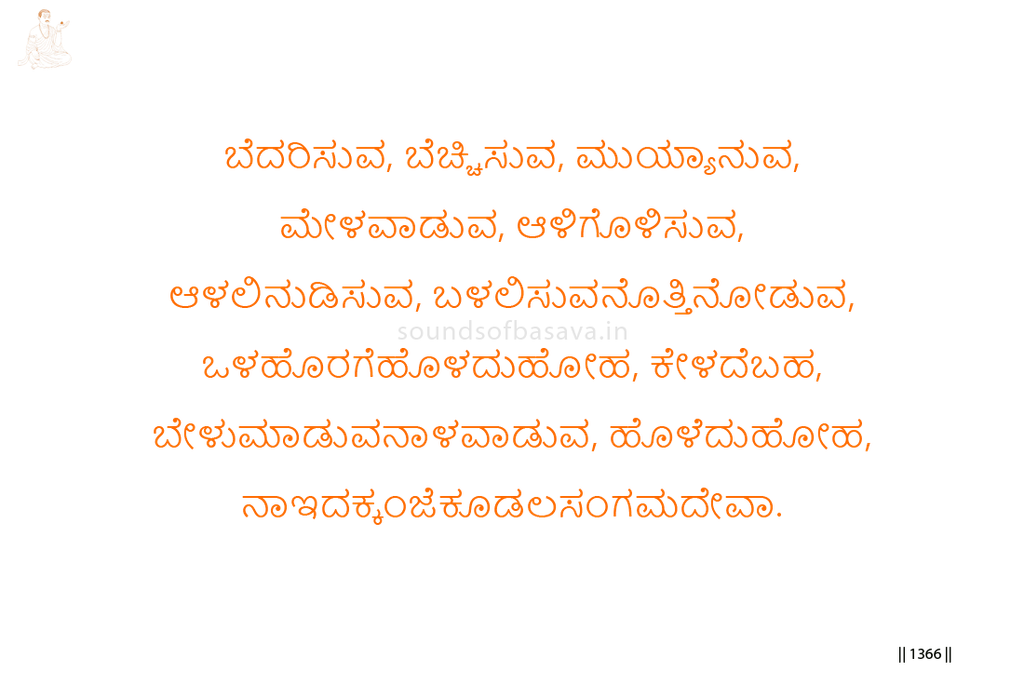
The world may frighten, intimidate, entice through affection, gather in apparent companionship, deceive, speak with hidden intention, exhaust, test, praise, abandon, arrive uninvited, and bring sorrow, delusion, or attachment. What appears may also disappear.
Basavanna does not deny that these movements occur. He declares that none of them governs him through fear.
His fearlessness does not arise from control over people or circumstances. Addressing Kudalasangama Deva, he reveals that his inward ground no longer depends upon threat or comfort, hostility or affection, acceptance or rejection.
Imagery & Symbolic Relevance
The vachana contains no single material image. Its force lies in the rapid succession of actions through which the world attempts to move the individual.
Frightening and Terrifying
The opening words name direct pressure: frightening and terrifying.
These are the obvious forms of influence. Fear attempts to make the individual surrender discernment before anything has actually been understood.
Basavanna does not say that threats have ceased. He says that they no longer determine his inward position.
Affection and Companionship
The movement then changes unexpectedly. Affection and companionship are placed beside fear and intimidation.
This contrast is central. The seeker may recognize danger when it comes as hostility, yet fail to recognize attachment when it comes as warmth, inclusion, friendship, or emotional reassurance.
Basavanna does not reject genuine affection. He refuses to let affection become another means by which his relation with Kudalasangama Deva is redirected.
The world may try to move the seeker with two opposite instruments:
fear that pushes away;
affection that draws near.
Neither is allowed to become the governing centre.
Deception and Controlled Speech
The vachana then names deception and speech shaped by another’s intention.
Companionship may conceal domination. Pleasant language may carry an unspoken motive. A person may appear to speak freely while actually speaking under pressure, dependency, or the desire to please.
Basavanna’s fearlessness therefore includes freedom from being inwardly ruled by the expectations of those who surround him.
He does not become cynical or declare every relationship false. He remains discerning without allowing suspicion itself to become another fear.
Weariness and Examination
The next movement concerns being worn down, watched, tested, and examined.
Not every attempt to control the seeker comes as one dramatic threat. Continuous scrutiny, repeated questioning, public judgment, and slow exhaustion may weaken steadiness more effectively than open hostility.
The vachana recognizes this gradual pressure. Basavanna may be examined, but he does not permit the examiner’s judgment to become the truth of his being.
Outward Brightness and Inward Withdrawal
The source explanation draws attention to the instability of those who may appear favourable outwardly and then withdraw.
Praise may be visible and public, while abandonment remains hidden. A person may shine inwardly and outwardly for a time and then pass away.
Basavanna therefore does not build his spiritual position upon public approval. What is loudly offered today may silently disappear tomorrow.
The instability belongs to the changing relationship, not to Kudalasangama Deva.
The Uninvited Arrival
The phrase “without asking, they may come” removes the assumption that disturbance appears only when chosen or invited.
Threat, attachment, sorrow, confusion, expectation, and judgment may enter suddenly. Basavanna does not claim that he can prevent their arrival.
His freedom lies elsewhere: arrival does not become authority.
Sorrow, Delusion, and Attachment
The pleasant and unpleasant movements of the world may produce inner consequences. They may make the individual fall into sorrow, confusion, dependence, or attachment.
This is the deepest danger named by the vachana. External action becomes bondage only when it is allowed to establish an inward centre.
Basavanna’s declaration means that these conditions cannot finally uproot his relation with Kudalasangama Deva.
Appearance and Disappearance
The final movement before the conclusion is appearance followed by disappearance.
People, judgments, alliances, fears, pleasures, and disturbances arise and pass. Basavanna neither gives permanent reality to what appears nor allows disappearance to destroy him.
The passing nature of these forces exposes their inability to become the foundation of life.
“Do I Fear This?”
The concluding question is not a boast of personal courage.
Basavanna does not say, “I am stronger than all of them.” He addresses Kudalasangama Deva. His fearlessness exists within that relation.
The question means: can any of these changing forces become final while Kudalasangama Deva remains the abiding ground?
The implied answer is no.
Lingayoga
In Lingayoga, both attraction and aversion can draw the Anga away from Linga.
Fear may make the seeker retreat. Praise may make the seeker seek recognition. Affection may create dependency. Criticism may provoke anger. Examination may produce self-defence. Abandonment may produce despair.
Though these reactions differ, each gives the changing world the power to determine the inward state.
The discipline is not emotional numbness. Basavanna does not say that pain is not felt, affection is not received, or deception should be ignored.
The practice is to distinguish experience from inward subjection:
fear may arise without becoming the master;
affection may be received without becoming bondage;
criticism may be heard without becoming identity;
praise may be accepted without becoming self-importance;
abandonment may occur without destroying Divine belonging.
The seeker must also examine the hidden desire for favourable treatment. Dependence upon praise is another form of fear—the fear of losing praise.
Fearlessness becomes possible when the Anga no longer asks the world to provide the permanence found only in Linga.
Editorial Commentary
The vachana presents a sequence of influences rather than a description of one specific enemy. The subject may be society, individuals, circumstances, or the inner reactions produced through them.
The pleasant actions must remain beside the unpleasant ones. Affection, companionship, and praise are not automatically condemned, but they can bind when the seeker depends upon them.
The conclusion does not state that these experiences cease to occur. Basavanna asks whether he fears them.
This distinction is essential:
the world may continue its movements;
fear no longer governs Basavanna’s centre.
Fearlessness should not be interpreted as aggression, carelessness, denial of danger, or refusal to accept truthful correction.
Kudalasangama Deva is the directly addressed Lord and the ground of the final declaration.
Related Vachana
Supporting Vachana
Sharana Sthala Vachana 1113 — The One Protected by the Lord Need Fear Nothing
Sharana Vachana 1113 declares that one held in the Lord’s protection need not let harm, place, circumstance, or worldly authority determine his deepest belonging.
Town and forest may carry opposite meanings of safety and danger. A ruler may exercise outward authority. Yet none of these can become the final refuge or final threat of the one who belongs to Kudalasangama Deva.
This prepares Vachana 1285 directly.
In the Sharana vachana, fearlessness arises because refuge is no longer placed in location, political power, or circumstance.
In Aikya Vachana 1285, that fearlessness enters the full complexity of human relationship. Threat, affection, companionship, deception, examination, praise, abandonment, sorrow, and attachment may all arise, but none can displace Basavanna’s inward ground.
The movement is from being protected within changing circumstances to remaining ungoverned by every pleasant and unpleasant force that acts upon the self.
Advancing Vachana
Aikya Sthala Vachana 1322 — Gently, Gently Beyond Even the Six Sthalas
Aikya Vachana 1322 moves gently through Bhakta, Maheshwara, Prasadi, Pranalingi, Sharana, and Aikya, and then crosses even these recognized identities into Niravaya Sthala, the fearless state.
Vachana 1285 declares freedom from fear before the changing actions of the world. Vachana 1322 advances further by removing dependence even upon sacred stage-identity.
The seeker may cease to fear hostility yet still depend upon the thought:
“I am a Bhakta”;
“I am a Sharana”;
“I have reached Aikya.”
Such claims can become subtler forms of security and vulnerability. The fear of losing worldly approval is replaced by the fear of losing spiritual position.
Vachana 1322 carries the movement into the state where neither worldly reaction nor spiritual designation governs identity. Fearlessness becomes complete when even the stages through which one has ripened are crossed before Kudalasangama Deva.
