

Summary
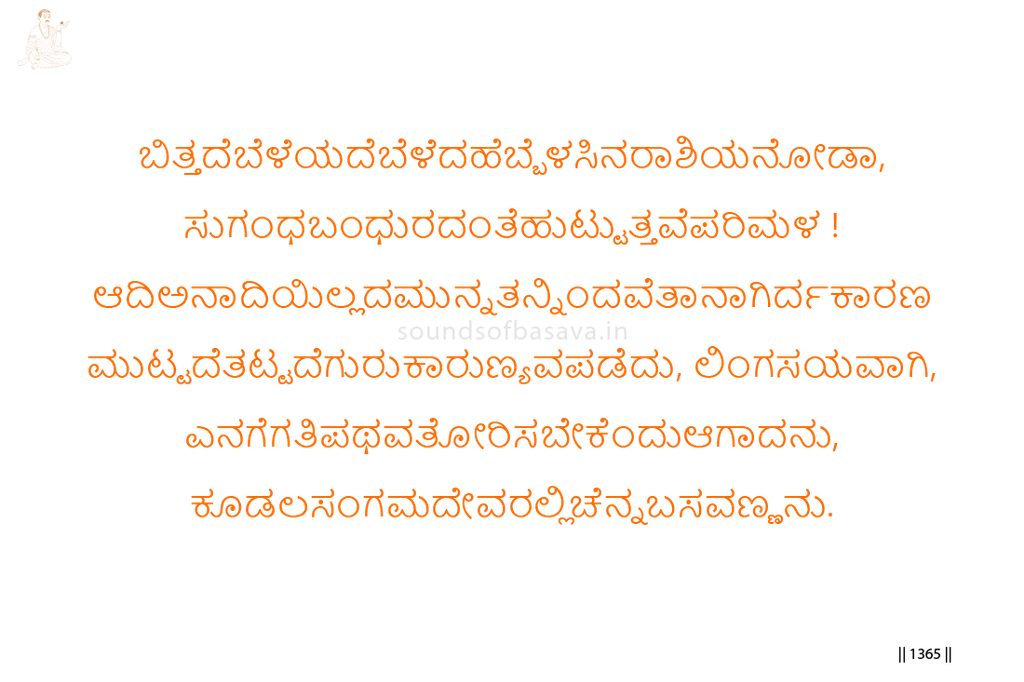
Basavanna asks us to behold a great harvest that has grown without being sown and fragrance arising before the flower. Through these reversals, he points to the Reality that is not produced by any prior cause, practice, or process.
Before both beginning and beginninglessness, it existed by itself.
Without touching or striking, Chennabasavanna received the compassion of Guru, became one with Linga, and became the revealer of the path of true attainment to Basavanna within Kudalasangama Deva.
The vachana distinguishes clearly between Reality, which is self-existent, and recognition, which becomes possible through Guru’s grace.
Imagery & Symbolic Relevance
The Harvest Without Sowing
A harvest ordinarily presupposes seed, cultivation, growth, and time. Basavanna removes that entire sequence and asks us to behold a great yield that has arisen without being sown.
The image does not merely describe an unusual miracle. It overturns the assumption that the Divine is the eventual product of spiritual effort.
Practice may prepare, purify, and remove obstruction, but it does not manufacture the Reality toward which it turns. The harvest is already present before the seeker claims to have produced it.
The command “behold” is important. Basavanna does not ask the seeker to create the harvest. He asks the seeker to recognize what is already there.
Fragrance Before the Flower
Ordinarily the flower appears first and its fragrance follows. Here fragrance arises before the flower.
Fragrance is subtle. It can announce the presence of something before its visible form is found. In the seeker, this may appear as longing before understanding, attraction toward truth before its source is recognized, or grace before one knows how it has entered.
The fragrance is therefore the intimation of the Divine before realization has taken visible form.
The image also prevents the seeker from dismissing longing as mere absence. The call toward the Divine may itself be evidence of a Presence that has not yet fully flowered in understanding.
Yet fragrance and flower must not be separated into two unrelated realities. The prior fragrance belongs to the same hidden life that later blossoms as recognition.
Before Beginning and Beginninglessness
Basavanna does not say only that the Reality existed before creation or before a particular beginning. He places it before both Adi and Anadi—before beginning and before the idea of beginninglessness.
Beginning and beginninglessness are both concepts through which the mind attempts to describe time. The self-existent Reality cannot be confined by either.
The phrase “by itself it became itself” indicates that it does not depend upon another source, agent, or preceding condition.
It is not an effect whose cause can be traced. It is the ground before the distinction between cause and effect arises.
Without Touching or Striking
The Kannada next removes forceful acquisition:
without touching;
without striking.
The Reality is not seized through physical contact, compelled through effort, or opened by violence against the self.
The sole positive movement named is Guru-Karunya—the compassion of Guru.
This does not make discipline meaningless. It establishes that discipline cannot claim to be the producer of realization. The decisive unveiling is received through grace.
Chennabasavanna as the Revealer
Chennabasavanna receives Guru’s compassion and becomes established in unity with Linga.
He does not retain this realization as private attainment. He becomes the one through whom the Gati-patha—the path toward the true or final state—is shown to Basavanna.
His role is therefore neither that of an independent creator of the path nor merely that of a verbal teacher. He is the living Sharana in whom the self-existent Reality has become recognizable.
The final phrase, “in Kudalasangama Deva, Chennabasavanna,” keeps Chennabasavanna’s realization and revelatory function grounded in Kudalasangama Deva.
Lingayoga
In Lingayoga, the seeker must distinguish between producing an experience and recognizing the Linga that was never produced.
Effort may discipline the senses, steady conduct, deepen worship, and prepare the Anga. But when effort claims, “I have created union,” it turns even practice into an obstruction.
The seedless harvest teaches that Linga precedes the seeker’s effort.
The fragrance before the flower teaches that grace may already be active before the seeker possesses a clear concept of realization.
Guru-Karunya removes the belief that attainment belongs solely to personal capacity. Through Guru and the living Sharana, the seeker is made able to recognize what self-effort could neither create nor grasp.
Chennabasavanna’s role also shows that the path is transmitted through realized life. Lingayoga is not completed by private inward experience alone. What has become one with Linga must also become a living way by which another seeker is guided.
The practical movement is therefore:
practise without claiming to produce the Divine;
attend to the subtle fragrance of grace;
receive the revelation transmitted through Guru and Sharana;
allow recognition to mature into Linga-union;
let realized life become a path for others.
Editorial Commentary
The opening image is a harvest or great yield without sowing. Its purpose is to deny production through ordinary causation, not to describe agricultural abundance literally.
The fragrance precedes the flower. This may clarify longing or grace appearing before fully formed realization, but it should not be converted into an independent metaphysical substance.
Adi and Anadi must both be retained. The Reality is said to precede beginning as well as beginninglessness, thereby exceeding both temporal categories.
Guru-Karunya is the governing agent in the realization described. The Kannada does not authorize replacing Guru’s grace with self-generated attainment.
Linga-saya indicates becoming one with, assimilated into, or established in Linga. It should not be interpreted as acquiring ownership of Linga.
Gati-patha is the path toward the true destination, final state, or spiritual fulfilment. Chennabasavanna becomes its revealer to Basavanna.
Kudalasangama Deva remains the Divine ground. Chennabasavanna is the realized Sharana through whom that ground becomes living revelation.
Related Vachana
Supporting Vachana
Sharana Sthala Vachana 1355 — The Linga Placed in My Hand
In Sharana Vachana 1355, the Sadguru places directly in Basavanna’s Karasthala the incomparable Linga that cannot be reached by Veda or Vedanta, divided by Nada and Bindu, or grasped by speech and mind.
Basavanna does not say that he discovered or produced this Linga. It is brought and placed in his hand by the Sadguru. His response is fulfilled gratitude: the longed-for Reality has been directly received, and he says that now he has truly lived.
This prepares Vachana 1283 by establishing the limit of all ordinary means. Scripture, subtle categories, speech, and thought cannot manufacture or contain the Linga.
Vachana 1283 reveals why: the Reality exists before causation itself. The seedless harvest is not produced by practice, and the fragrance does not wait for the visible flower. Guru’s grace makes recognizable what was already self-existent.
The progression is from receiving the ungraspable Linga as Sadguru’s gift to recognizing the primordial Reality through Chennabasavanna’s realized revelation.
Advancing Vachana
Aikya Sthala Vachana 1287 — Beyond All Names
Aikya Vachana 1287 refuses to confine Kudalasangama Deva within the names Brahma, Narayana, Jina, Bhairava, or their derivative forms. When destruction strikes and poison burns, conceptual naming falls away, leaving only the immediate cry, “Shivadho! Shivadho!”
Vachana 1283 establishes that the Reality exists before beginning, beginninglessness, cause, and effect.
Vachana 1287 advances this by showing that what precedes causation also exceeds every theological designation. The self-existent Reality cannot be produced by action, and it cannot be contained by a name.
The progression is from Reality before process to Reality beyond definition. What Guru’s grace reveals cannot finally be reduced to the concepts through which the mind attempts to possess it.
