

Summary
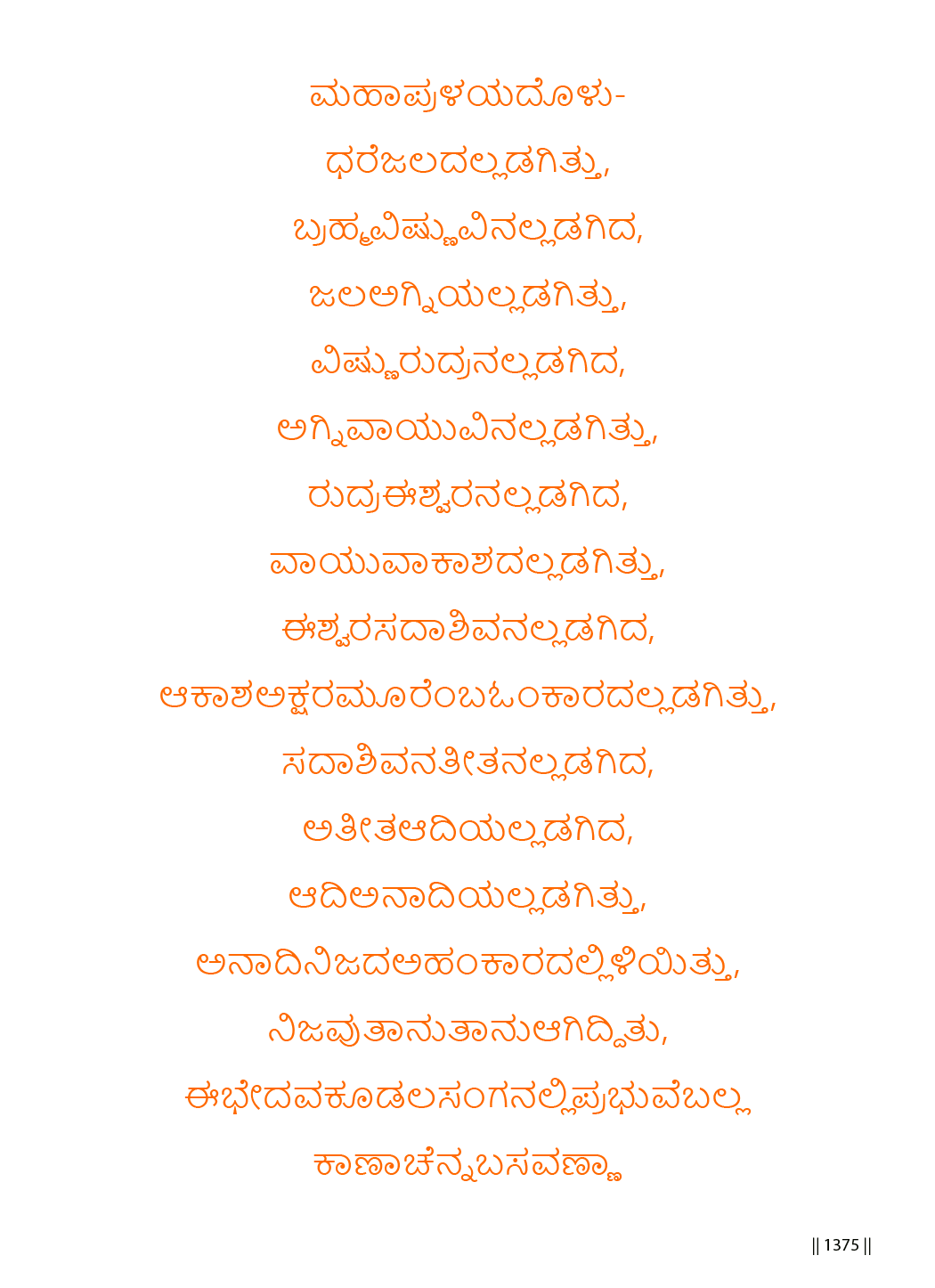
During the Great Dissolution, earth subsides into water, water into fire, fire into air, and air into space. Alongside this elemental return, Brahma subsides into Vishnu, Vishnu into Rudra, Rudra into Ishvara, and Ishvara into Sadashiva.
Space enters the three-letter Omkara; Sadashiva enters the Transcendent; the Transcendent enters the Primordial; and the Primordial enters the Beginningless. The Beginningless finally subsides into true Self-awareness, while Nija—the Real—remains as itself alone.
Addressing Chennabasavanna, Basavanna says that only Prabhu, Kudalasangama Deva, knows the mystery of these distinctions and their dissolution.
Imagery & Symbolic Relevance
The Great Dissolution
The vachana presents Mahapralaya not as sudden destruction, but as successive inward absorption. Each manifested level returns to the subtler ground from which it arose:
earth into water;
water into fire;
fire into air;
air into space.
The formed does not vanish into meaningless nothingness. It returns through increasingly subtle levels toward its source.
The Divine Sequence
A parallel movement unfolds among the divine functions:
Brahma into Vishnu;
Vishnu into Rudra;
Rudra into Ishvara;
Ishvara into Sadashiva.
Creation, preservation, dissolution, governance, and higher Divine manifestation do not remain independent final realities. Each is absorbed into what exceeds it.
The two sequences—elements and Divine forms—show that both the material world and the theological hierarchy belong to the field of differentiation.
Beyond Space and Sadashiva
Space enters the three-letter Omkara, while Sadashiva enters Atita, the Transcendent.
Even space, the widest field of manifestation, is not final. Omkara too does not become the ultimate stopping point. The movement continues beyond Sadashiva, beyond the Transcendent, and beyond the Primordial.
The vachana refuses to convert any exalted principle into the final Reality merely because it appears subtler or higher than what preceded it.
Adi, Anadi, and Nija-Ahamkara
Atita enters Adi, the Primordial; Adi enters Anadi, the Beginningless.
Anadi then subsides into Nija-Ahamkara. Here Ahamkara must not be read as ordinary ego, pride, or the personal claim “I am this body.” Joined with Nija, it indicates the primal Self-awareness in which Reality knows itself.
When even Beginninglessness has returned to this true Self-awareness, no further level is named.
The Real Remaining as Itself
The central declaration is:
“Nija itself remained as itself.”
Reality does not become another substance at the end of dissolution. It does not emerge as the product of the preceding stages. When every dependent distinction has returned to its source, the Real simply stands in its own nature.
The successive levels therefore reveal not the manufacture of unity, but the withdrawal of differentiated appearance into what was always self-existent.
The Mystery Known by the Lord
Basavanna does not claim mastery over this vast sequence. Addressing Chennabasavanna, he places the mystery before Prabhu, Kudalasangama Deva.
The distinction between the many levels, their arising, and their return into the One cannot be possessed merely as cosmological knowledge. Its truth is known by the Lord alone.
Lingayoga
Lingayoga must not stop at any experience, category, sacred sound, subtle principle, or claimed spiritual level as though it were final.
The practitioner allows bodily identity, conceptual distinction, and the pride of knowing to return to their source. The discipline is not to imitate cosmic dissolution, but to cease establishing an independent centre within what belongs to the One Reality.
The final posture is humility: the Real remains itself, while its mystery is left to Kudalasangama Deva.
Editorial Commentary
Mahapralaya is the Great Dissolution in which manifested levels return successively to their source.
Akshara mūru emba Omkara refers to Omkara constituted by its three letters or sound-elements.
Atita means that which is beyond or transcendent.
Nija-Ahamkara is true or primordial Self-awareness. It must be distinguished from personal egoism.
The final Prabhu refers to the Lord, Kudalasangama Deva. Chennabasavanna is the person directly addressed.
Related Vachana
Supporting Vachana
Sharana Sthala Vachana 1311 — Come Having Won Through the Weapon of Divine Feeling
Sharana Vachana 1311 says that the excessively clever mind cannot seize the boundless Bayalu. The seeker must relinquish intellectual possession and approach through living Bhava.
It prepares Vachana 1312 by removing the mind’s claim to grasp Reality. Here, the very categories through which the mind measures existence are absorbed, and Nija alone remains.
Advancing Vachana
Aikya Sthala Vachana 1313 — The Mahalinga Is Not Other Than Its Manifestations
Vachana 1313 declares that the forms of Mahalinga are not separate from Mahalinga and that Linga is not other than embodied or living manifestation.
Vachana 1312 resolves differentiated existence into the Real; Vachana 1313 reveals the complementary vision that whatever manifests is not outside that one Mahalinga.
