

Summary
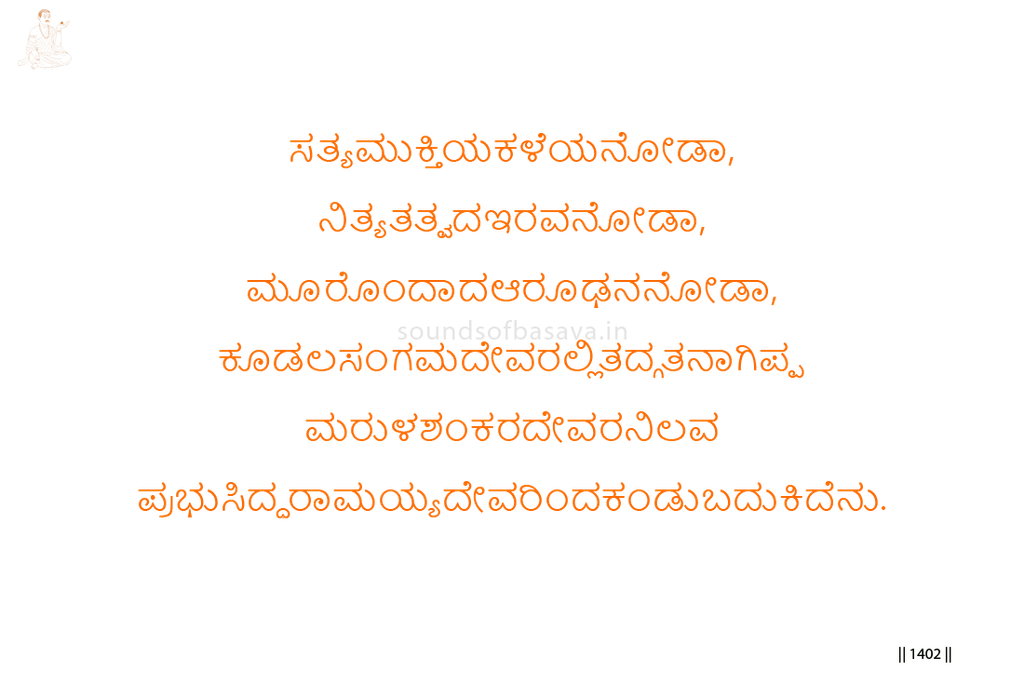
Basavanna calls upon the seeker to behold the radiance of true liberation, the abiding state of eternal truth, and the realised one in whom the three—Anga, Linga, and Jangama—have become one.
He then identifies this realised state in Marulashankara Deva, who abides wholly absorbed in Kudalasangama Deva.
This was not known through description alone. Through Prabhu Siddharamayya Deva, Basavanna directly beheld Marulashankara Deva’s state and lived through that recognition.
Liberation is therefore revealed as a living radiance embodied in the Sharana and made known through another realised Sharana.
Imagery & Symbolic Relevance
The Vachana contains no material comparison. Its movement is created through three calls to behold, followed by Basavanna’s testimony of direct seeing and transformed living.
The Radiance of True Liberation
Basavanna first says: behold the kale of true liberation.
Kale is the radiance, beauty, manifested quality, or visible splendour through which an inward state becomes recognisable.
True liberation is therefore not left as a future promise or an invisible doctrine. It shines through the realised being’s presence, conduct, balance, and freedom from separation.
The radiance does not belong to the person as private greatness. It is the visible expression of liberation established within life.
The Abiding State of Eternal Truth
Basavanna next asks the seeker to behold the iravu of the eternal principle.
Iravu indicates presence, abiding, or established existence. What is eternal is not merely believed or remembered; it has become the realised one’s settled condition.
The first line concerns radiance—how liberation becomes visible. The second concerns abiding—how eternal truth remains steadily established.
Radiance without abiding could be a passing experience. Here the radiance arises from an enduring state.
The Realised One
The word ārūḍha indicates one who has become firmly established in the realised condition.
The realised one is not merely approaching unity, discussing it, or experiencing it for a moment. He abides in it.
Basavanna therefore asks the seeker to behold a living person in whom eternal truth has become established and visible.
The Three Becoming One
In the realised one, the three have become one:
Anga—the embodied individual;
Linga—the Divine Reality;
Jangama—the living movement and manifestation of that Reality.
Their distinct functions remain meaningful, but they are no longer experienced as separate or competing realities.
Anga does not stand outside Linga as an independent possessor. Jangama does not stand outside Linga as merely another person. The realised life becomes the field in which embodied existence, Divine presence, and living revelation move without division.
This is the heart of the radiance Basavanna asks the seeker to behold.
Marulashankara Deva’s State
Basavanna then identifies the realised one: Marulashankara Deva.
His nilavu, or established state, is not described abstractly. He has become tadgata in Kudalasangama Deva—wholly absorbed, established, and inseparable in orientation from the Lord.
Marulashankara Deva remains the Sharana whose state is being witnessed. Kudalasangama Deva remains the Divine ground in whom that state is established.
His liberation becomes visible because his life no longer proceeds from an independent centre.
Prabhu Siddharamayya Deva
Basavanna declares that he saw this state through Prabhu Siddharamayya Deva.
Siddharamayya Deva does not manufacture Marulashankara Deva’s realised condition. He reveals it and enables Basavanna to recognise what is present.
The relationship is one of living transmission:
Marulashankara Deva embodies the realised state;
Prabhu Siddharamayya Deva reveals that state;
Basavanna beholds it and lives through the recognition;
Kudalasangama Deva is the Divine ground of the entire revelation.
“I Saw and Lived”
The conclusion joins seeing and living.
Basavanna does not say merely, “I saw and understood.” The seeing changes the condition of his life.
To behold true liberation in the realised Sharana is to receive a living measure of truth. What was previously teaching becomes directly recognisable presence.
The Vachana therefore moves from invitation to testimony:
behold the radiance;
behold the eternal state;
behold the one in whom the three are one;
I beheld that state through the realised Sharana and lived.
Lingayoga
Lingayoga must move from hearing about realization to recognising it through living presence.
The practitioner begins through Ishtalinga worship, remembrance, conduct, surrender, and reverence for Jangama. These prepare the vision through which the realised state can be recognised without reducing it to appearance, reputation, or doctrine.
The three becoming one is not an idea to be repeated prematurely. Anga, Linga, and Jangama must become one continuous sacred relation in worship, embodied life, and recognition of the living Sharana.
The practical movement is therefore from instruction to seeing and from seeing to transformed living. The realised Sharana becomes the living evidence by which the seeker understands what liberation means.
Editorial Commentary
Satya-mukti means true liberation—freedom established in truth rather than imagined, claimed, or postponed.
Kale indicates radiance, manifested quality, splendour, or the visible expression of an inward state.
Nitya-tattva means the eternal principle or enduring truth.
Iravu means presence, abiding, or established existence.
Ārūḍha means one who has become firmly established in realization.
The three becoming one refers to Anga, Linga, and Jangama becoming one realised sacred relation.
Tadgata means wholly absorbed, established, or entered into the condition of another. Marulashankara Deva’s state is established in Kudalasangama Deva.
Prabhu Siddharamayya Deva is the realised Sharana through whom Basavanna beholds this state.
Related Vachana
Supporting Vachana
Sharana Sthala Vachana 5 — The Eye-Opening Conduct
In Sharana Vachana 5, Basavanna asks why Kudalasangama Deva sent His Sharana into the mortal world. By repeatedly observing the Sharana’s lived conduct, his eye opens.
This prepares Vachana 1377 directly. The Sharana stage establishes that spiritual sight is awakened through the living presence and conduct of the Sharana.
In Vachana 1377, the opened eye beholds the radiance of true liberation itself. Through Prabhu Siddharamayya Deva, Basavanna recognises Marulashankara Deva’s established state in Kudalasangama Deva and lives through that revelation.
Advancing Vachana
Aikya Sthala Vachana 1380 — One Vessel, One Offering
Vachana 1377 reveals the realised one in whom Anga, Linga, and Jangama have become one.
Vachana 1380 unfolds the lived consequence of that recognition. It rejects the division that assigns separate vessels, status, or sacred identity to Bhakta and Jangama. Bhakta is not separate from Linga, Bhakta is not separate from Jangama, and Guru does not stand outside that same sacred reality.
The unity beheld as radiance in Marulashankara Deva thus expands into shared sacred life. When Guru, Linga, Jangama, and Bhakta receive and offer within one indivisible relation, separation and impurity lose their ground.
Vachana 1377 presents liberation embodied in the realised Sharana. Vachana 1380 shows how that realization transforms fellowship, receiving, offering, and the whole relation among Guru, Linga, Jangama, and Bhakta.
