Poetic Rendering

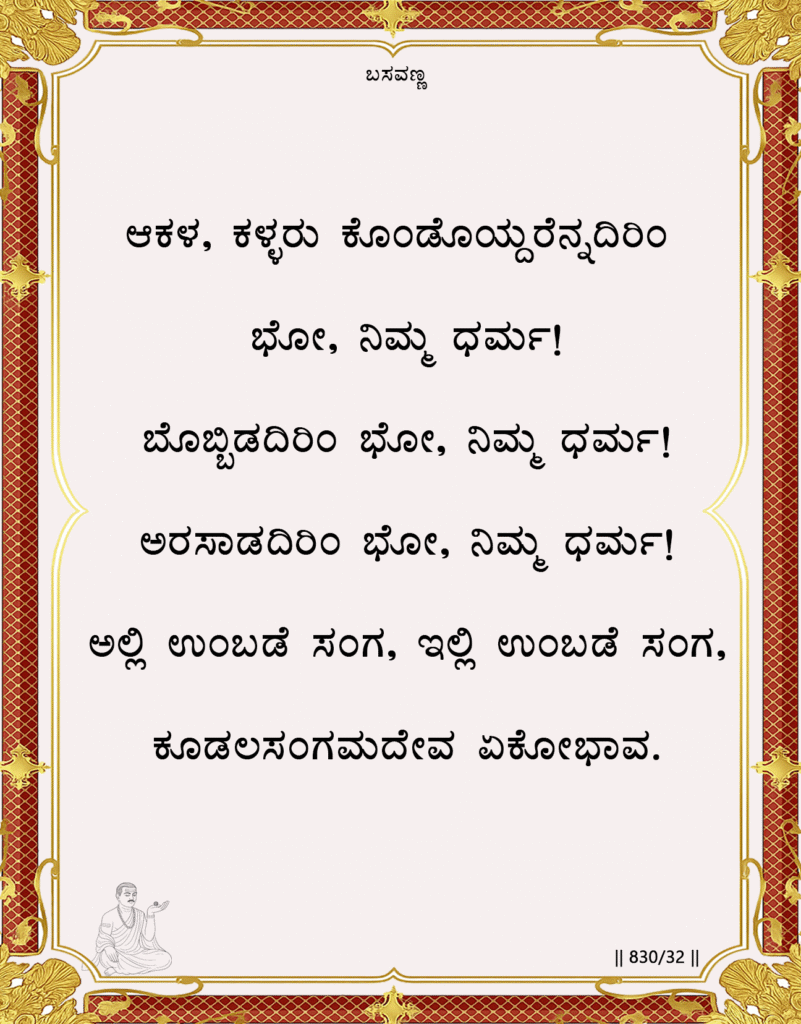
When cattle are stolen,
do not cry aloud, “My dharma is lost!”
When enemies rage,
do not wail, “My dharma is broken!”
Here a gathering, there a gathering
dharma is one essence everywhere,
says Koodalasangamadeva.
Basavanna commands: when cattle are stolen or enemies rage, one should not cry that their dharma is lost. He declares that dharma is not an external possession to be lost, but a single, pervasive essence that is the same “here” and “there,” in all circumstances.
Spiritual Context
Core Spiritual Principle: True Dharma is not a set of external rules or social conditions, but an inner state of conscious alignment with the universal, divine order. It is the stability of the soul that remains constant, regardless of gain or loss, praise or blame. External events cannot touch it.
Cosmic Reality Perspective: The Linga is the singular, non-dual reality that pervades all existence. Dharma is the principle of this unity in action. To believe that a change in external circumstances (theft, conflict) can affect this fundamental reality is a profound error born of identifying with the transient world (Maya) instead of the eternal base (Linga).
Historical Reality (Anubhava Mantapa context):This vachana was a revolutionary social doctrine. In a feudal society where a person’s wealth (cattle) and honor (enemies not daring to attack) defined their social and religious standing, Basavanna severs the link between external status and internal worth. It empowered the common person, declaring that their spiritual core was inviolable, no matter their worldly fate.
Interpretation
1. “When cattle are stolen… do not cry…” : Cattle represent material wealth and livelihood. The common belief was that protecting one’s property was a dharmic duty. Basavanna reframes this: losing property is a worldly event; it does not equate to losing one’s spiritual center or ethical integrity.
2. “When enemies rage… do not wail…” : Enemies represent adversity, conflict, and social shame. The typical response is to see this as a failure of one’s protective dharma. Basavanna teaches that how one responds to adversity with fear or with equanimity is the real test of dharma, not the presence of adversity itself.
3. “Here a gathering, there a gathering…” : This refers to the fluctuating nature of worldly life sometimes you are with a supportive community (“here”), sometimes you are isolated or opposed (“there”). Dharma is not dependent on which group you are with.
4. “…dharma is one essence everywhere.” : This is the core revelation. Dharma is the Sanatana Dharma the eternal, universal principle of righteousness and cosmic order. It is the conscious recognition of the one Linga in all situations. This inner realization is what remains unshaken when the outer world is in turmoil.
Practical Implications: The seeker must learn to differentiate between the external event and their internal response. Spiritual practice is the cultivation of an inner citadel of peace and right understanding that cannot be breached by worldly fortune or misfortune. The goal is to act rightly in every situation, but to remain detached from the outcome.
The Cosmic Reality
Anga (Human Dimension): The human being experiencing the dualities of the world: gain and loss, friendship and hostility. The untrained Anga identifies with these fluctuations and believes its core self is affected.
Linga (Divine Principle): Kudalasangama Deva as the eternal, unchanging essence (Sat) and the very substance of Dharma. The Linga is the still point in the turning world.
Jangama (Dynamic Interaction): The Jangama is the practice of maintaining steady awareness (Sthitaprajna). It is the dynamic application of the understanding that the Linga is the same “here and there,” allowing the Anga to navigate life’s changes without losing its spiritual equilibrium.
Shata Sthala
Primary Sthala: Maheshwara. This vachana calls for the fierce, warrior-like stability of the Maheshwara, who remains steadfast in their inner truth while the battles of life rage around them.
Supporting Sthala: Aikya. The perception of the “one essence everywhere” is the vision of Aikya, the stage of non-dual union where all apparent distinctions dissolve into the one reality.
Practical Integration
Arivu (Awareness): In moments of loss or conflict, practice this awareness: “This is an external event. My true Self, my dharma, is the witness consciousness that is untouched by this. How can I respond from this center of peace?”
Achara (Personal Discipline): Cultivate equanimity (Samatvam). Practice accepting favorable and unfavorable outcomes with the same peace of mind. Let your ethical code be guided by inner truth, not by social pressure or fear of loss.
Kayaka (Sacred Action): Perform your duty without attachment to the result. Do not let the success or failure of your endeavors determine your sense of self-worth or spiritual standing.
Dasoha (Communal Offering): Be a pillar of stability for your community. In times of collective crisis, remind others of the eternal truths that remain when worldly structures shake. Your calm presence is a Dasoha of peace.
Modern Application
Our self-worth is catastrophically tied to external markers: our financial portfolio, our job title, our social media following, our public reputation. A market crash, a job loss, or a viral negative comment can feel like an existential crisis, as if our very “dharma” or reason for being has been destroyed.
This vachana liberates by decoupling our identity from the rollercoaster of external events. It teaches that our true value is intrinsic and unassailable. It allows us to engage fully in the world to work, to build, to relate without being destroyed by the inevitable setbacks. This is the foundation of resilience, mental peace, and authentic power.
Essence
The world may take your wealth and land,
And hostile armies take their stand.
But what you are, at core, divine,
Is the one true, unshaken line.
Metaphysically, this vachana distinguishes between Vyavaharika Satta (relative reality) and Paramarthika Satta (absolute reality). The stolen cattle and raging enemies belong to the relative, transactional plane. Dharma, as the “one essence,” belongs to the absolute plane it is the principle of order inherent in consciousness itself. The cry of “my dharma is lost” is the error of superimposing the absolute upon the relative (Adhyasa). The realized state is to engage in the relative world (Vyavahara) while being firmly established in the absolute understanding (Paramartha), thus making one’s actions a perfect expression of dharma, regardless of the outcome.
Your character is not defined by what happens to you, but by how you respond from your deepest core. Cultivate an inner life so strong and true that no external event can compromise your integrity or your peace. This unshaken core is your greatest possession and your ultimate freedom.

Views: 16