Poetic Rendering

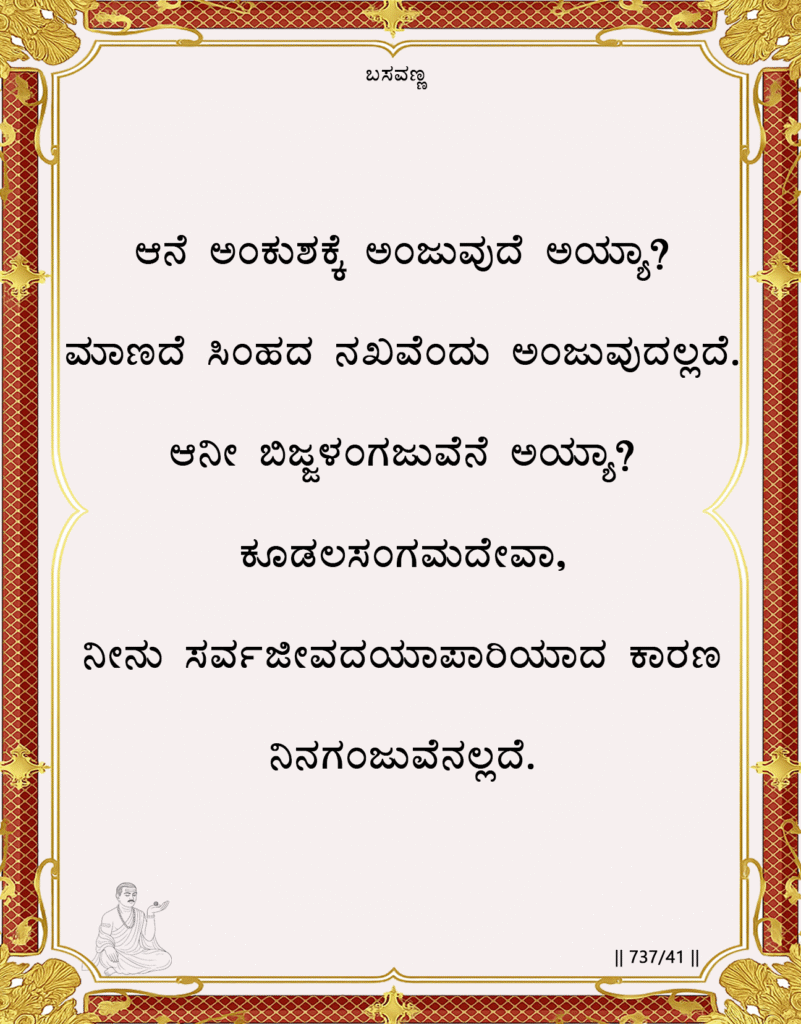
Does the elephant fear the mahout’s goad?
No though mighty, it bears him lightly
and obeys without trembling.
But before the lion, it quakes.
So too, O Kudalasangamadeva:
I do not fear the king,
nor his command, nor his punishments.
The only fear I know
is the awe of standing before You
the One who dwells in all beings,
whose truth strips me bare
and makes pretence impossible.
Basavanna explains that worldly power like the mahout’s control over the elephant does not evoke real fear. True fear, a sacred awe, is reserved only for the Divine. The śharaṇa does not fear kings or earthly authority, but stands humbled before the all-pervading Kudalasangamadeva, whose presence alone commands genuine reverence.
Spiritual Context
Core Spiritual Principle: The ultimate reorientation of a spiritual life is to transfer one’s fundamental fear the instinct for self-preservation from worldly authorities to the Divine itself. This “fear of God” is not a cowering terror but a profound, liberating awe (Bhaya) that puts all temporal power in its proper, limited place.
Cosmic Reality Perspective: The Linga is the only true sovereign, the substratum of all existence. Worldly kings and laws are transient, conditional powers within this reality. To fear them more than the source of reality itself is a fundamental error in spiritual perception, a case of mistaking the shadow for the substance.
Historical Reality (Anubhava Mantapa context): This vachana is a powerful political and social statement. It grants the individual spiritual autonomy from feudal and royal authority. A Sharana’s primary allegiance is to God, making them fearless in the face of temporal punishment, which can only affect the body, not the soul aligned with the eternal.
Interpretation
1. The Elephant and the Mahout: The “elephant” is the individual with immense potential strength. The “mahout’s goad” represents worldly authority kings, laws, social norms. The relationship is one of conditioned obedience, not true fear. The elephant obeys out of habit and training, not because its core being is threatened.
2. The Elephant and the Lion: The “lion” represents a natural, existential threat. The elephant’s fear here is instinctual and profound because the lion challenges its very existence. This analogy establishes a hierarchy of fear.
3. The Application: “I do not fear the king…”: The poet places worldly power in the category of the “mahout.” He will obey civil laws as a social contract, but he does not fear the king, as the king’s power is limited to the external, temporal world.
4. The Sacred Fear: “the awe of standing before You…”: This is the pivotal declaration. God is the “lion” the ultimate, existential reality. The “fear” or “awe” (Bhaya) here is the soul’s recognition of its own fragility before the infinite, its awareness of being utterly known and seen, with all pretenses rendered useless. This fear is liberating because it dissolves all lesser fears.
Practical Implications: The seeker must consciously perform this transfer of fear. When faced with a difficult choice between truth and social convenience, between integrity and safety the question must become: “Do I fear the consequence from the world more than I stand in awe of the Divine truth?” Cultivating this “fear of God” is the practice of cultivating ultimate courage.
The Cosmic Reality
Anga (Human Dimension): The individual soul navigating the world of dualities (praise/blame, gain/loss). The untrained Anga fears the opinions and powers of the world.
Linga (Divine Principle): Kudalasangama Deva as the absolute, non-dual reality before which all illusions of separate power dissolve.
Jangama (Dynamic Interaction): The Jangama is the perspective of sacred awe. It is the active, moment-to-moment choice to see the Linga in all situations, which dynamically reconfigures the Anga’s relationship with the world, replacing worldly anxiety with divine-centered courage.
Shata Sthala
Primary Sthala: Maheshwara. This vachana exemplifies the Maheshwara’s quality of spiritual fearlessness (Nirbhayatva). Having realized the source of true power, they are unshaken by worldly threats.
Supporting Sthala: Bhakta. The feeling of “awe” and reverential fear is a key characteristic of a sincere Bhakta, who relates to God as the ultimate, beloved authority.
Practical Integration
Arivu (Awareness): In moments of social anxiety or fear of consequences, practice this awareness: “This worldly power is the ‘mahout.’ The only reality is the divine presence, the ‘lion,’ before whom I stand in awe. This worldly fear is an illusion.”
Achara (Personal Discipline): Let your discipline be to act according to your conscience and spiritual principles, even when it is socially or professionally risky. Let your only “fear” be of compromising your integrity before God.
Kayaka (Sacred Action): Perform your work with the consciousness that your ultimate employer and judge is the Divine, not your human boss. This grants the freedom to work with integrity without fear of unfair treatment.
Dasoha (Communal Offering): Help build a community (Sangha) that reinforces this value. Support fellow seekers who are facing persecution or difficulty for their righteous stance, reminding them of the higher fear that liberates.
Modern Application
We live in a state of chronic, low-grade anxiety fueled by “mahouts”: fear of losing our job, fear of social media cancellation, fear of not being liked, fear of economic instability. We are constantly managing these external fears, which leads to inauthenticity, stress, and a life lived according to others’ expectations.
This vachana offers profound liberation from the tyranny of social anxiety. It invites us to perform a “fear audit”: What are you truly afraid of? By transferring that fundamental fear to a sacred awe of truth and consciousness, we become invincible. We can engage with the world honestly, speak truth to power, and live authentically, because the worst the world can do (the “goad”) is insignificant compared to the peace of living in alignment with the Divine (the “lion”).
Essence
The goad may prick, the king may frown,
Their power cannot strike me down.
But in Your light, my soul laid bare,
I find the only truth to fear.
Metaphysically, this vachana deals with the concept of Bhaya and Abhaya (fear and fearlessness). Worldly fears are products of Dvandvas (dualities) and attachment to the body-mind complex. The “fear of God” is the Sattvic fear that arises from Viveka (discernment) the clear understanding of the difference between the eternal (Linga) and the transient (worldly power). This Sattvic fear is the doorway to Abhaya , true fearlessness, because one who fears only the eternal has nothing left in the transient world to be afraid of. The lion represents the Jnana (knowledge) of the true Self, which devours the elephant of the ignorant ego.
To be truly fearless, you must find the one thing worthy of your fear: the consequence of betraying your own soul, your deepest values, and the fundamental truth of existence. When you answer to a higher authority, all lower authorities lose their power over you. The path to courage is through reverence.

Views: 4