Poetic Rendering

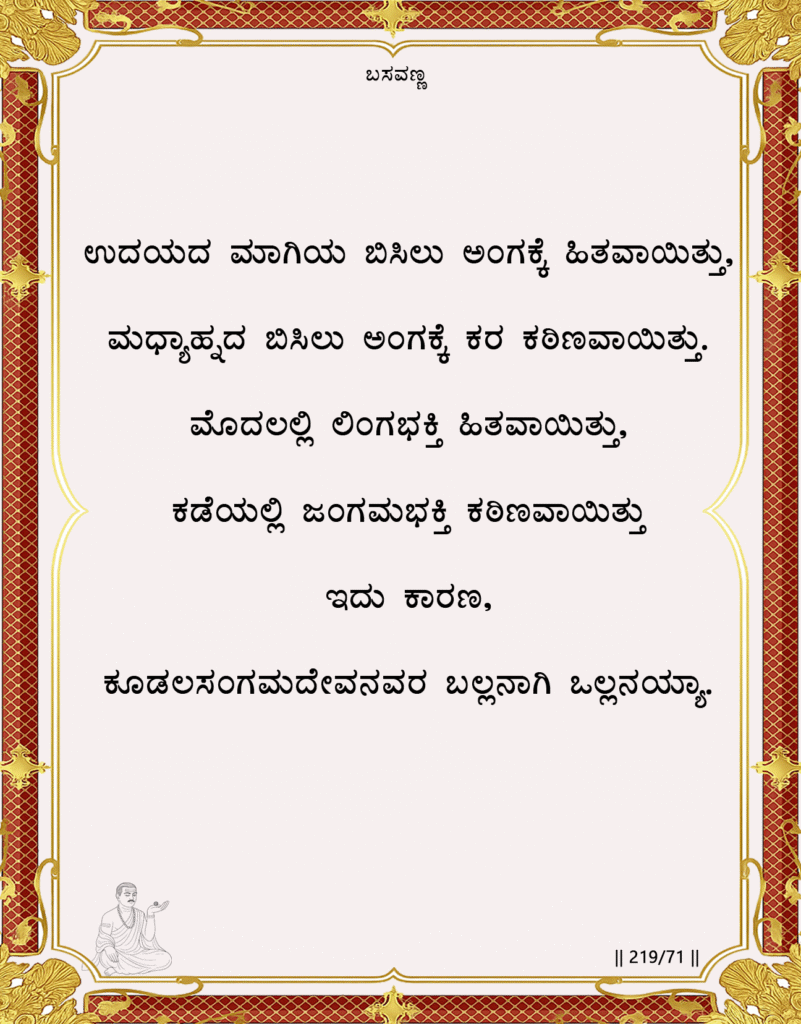
The morning sun warms the skin
the noon sun scorches it.
So it is with devotion, O Lord:
worship of the Linga begins soft and sweet,
but service to the jangama
burns away every hidden stain.
Only those who endure this fierce light
stand firm in Your truth,
O Kudalasangamadeva;
the rest turn back, unable to bear the heat.
Basavanna compares spiritual growth to the rising sun. Early devotion feels gentle and comforting, but deeper service especially to the jangama becomes demanding and transformative. Only those willing to withstand this intense purification can remain steadfast on the path.
Spiritual Context
Core Spiritual Principle: The spiritual path has stages of intensity. Initial devotion is comforting, but mature spirituality requires a fiery purification that burns away the ego, a process often catalyzed by selfless service to the living embodiment of the Divine (Jangama).
Cosmic Reality Perspective: The Divine (Linga) is both the gentle, nourishing light of dawn and the fierce, purifying fire of midday. Both are essential aspects of the same reality. The seeker must be prepared to move from the comfort of theoretical worship to the challenging reality of embodied service, where the ego’s hidden attachments are exposed and incinerated.
Historical Reality (Anubhava Mantapa Context): This Vachana provides a crucial map for the psychological journey within the Lingayat community. It prepares devotees for the transition from personal, private worship to the demanding, interpersonal dynamics of community life and service (Dasoha). It explains why some seekers flourish while others fall away, attributing it not to a lack of initial faith, but to an inability to withstand the necessary “heat” of ego dissolution that comes with true commitment.
Interpretation
1. “The morning sun warms the skin the noon sun scorches it.” The central, powerful analogy. The “morning sun” represents the initial stages of devotion: it is pleasant, encouraging, and provides the warmth of spiritual consolation. The “noon sun” represents the advanced stage: it is intense, uncompromising, and its purpose is not to comfort but to purify and burn away impurities.
2. “worship of the Linga begins soft and sweet, but service to the jangama burns away every hidden stain.” This applies the analogy to the Lingayat path. Worship of the Ishtalinga (personal Linga) is often a private, contemplative practice that provides solace and connection. However, service to the Jangama (the moving, human manifestation of the Divine) is the real test. It demands humility, patience, and the surrender of personal preferences, thereby “scorching” the ego’s subtle attachments that private worship alone cannot reach.
3. “Only those who endure this fierce light stand firm in Your truth… the rest turn back, unable to bear the heat.” This is a stark and honest assessment of spiritual maturity. “Enduring the fierce light” means accepting the discomfort, challenges, and humiliations that come with sincere service without becoming resentful or quitting. Those who “turn back” are those who wanted spirituality as a comfort, not as a total transformation.
Practical Implications: The seeker is guided to: Understand that spiritual challenges are not signs of failure but signs of progression to a more intense and purifying phase. Embrace service to the community and the Guru (Jangama) as the primary means for burning away the ego. Develop resilience and steadfastness (sthithaprajna), understanding that the path will demand everything.
The Cosmic Reality
Anga (Human Dimension): The Anga is the seeker who must willingly expose themselves to both the “morning sun” of initial devotion and the “noon sun” of demanding service. Their spiritual fortitude is tested and forged in this process.
Linga (Divine Principle): The Linga is the one sun the source of both gentle grace and fierce, transformative power. It is the ultimate truth that the seeker must “stand firm” in.
Jangama (Dynamic Interaction): The Jangama is the “noon sun” the active, demanding, and purifying aspect of the Divine encountered in the world. The dynamic interaction is the act of selfless service to the Jangama, which is the crucible where the Anga is purified and prepared for union with the Linga.
Shata Sthala
Primary Sthala: Maheshwara Sthala. This stage is characterized by intense inner purification (virakti), which aligns perfectly with the “scorching” heat of the noon sun and the demanding nature of true service. It is the stage where the devotee actively “burns away every hidden stain.”
Supporting Sthala: Bhakta Sthala is the “morning sun” phase of soft and sweet devotion. Prasadi Sthala is the grace and stability that is the result of having “endured the fierce light.”
Practical Integration
Arivu (Awareness Practices): Sun Meditation: Meditate on the sun’s journey. In the morning, feel its gentle, nourishing energy. At noon, contemplate its fierce, purifying power. Ask for the strength to welcome both aspects in your spiritual life.
Embracing Heat: When faced with interpersonal difficulties or challenges in service, reframe them as the “noon sun” at work, burning away a specific egoic attachment (e.g., pride, impatience, judgment).
Achara (Personal Discipline): Commit to a practice of service (seva) that is personally challenging, moving beyond your comfort zone to where the “heat” of transformation is found.
Kayaka (Sacred Action): Use your daily work as the field for this purification. The difficulties and demands of your job are your “noon sun,” burning away the stains of laziness, resentment, or attachment to results.
Dasoha (Communal Offering): Support fellow seekers when they are going through their own “noon sun” phases. Offer encouragement and remind them of the transformative purpose of the heat they are enduring.
Modern Application
“Spiritual Bypassing and Comfort Seeking.” Much of modern spirituality is marketed as a source of comfort, stress relief, and self improvement the “morning sun.” Many seekers abandon paths or teachers when they become demanding, challenging, or require real sacrifice when the “noon sun” appears.
This Vachana provides a necessary corrective. It honestly prepares seekers for the full journey, warning that true transformation is demanding. It helps individuals discern between a path that merely comforts the ego and one that truly liberates them from it. It validates the struggle and the feeling of being “scorched” as signs of authentic progress, not failure.
Essence
The dawn light kisses, the noon fire brands.
One coaxes the seed, the other demands
the shell crack open, the husk turn to dust.
Many love the promise of the gentle dawn;
few can bear the forge where the Self is reborn.
This Vachana presents a developmental metaphysics of the spiritual path. It maps the evolution of the seeker’s relationship with the Divine from a dualistic, comforting connection (Bhakti) to a non dual, purifying identification (Jangama Seva). Its multidimensional impact is to frame spiritual maturity not in terms of pleasant experiences, but in terms of increased capacity to withstand the transformative fire of truth. It positions the Jangama as the essential, active agent of this alchemical process, the “noon sun” without which the gold of the soul cannot be purified of its dross.
Any real transformation requires a death of the old. If your spiritual path is always comfortable and never challenges your deepest attachments, it may be soothing your ego, not liberating your soul. Welcome the heat. The times when you feel stretched, tested, and purified are not signs that you are off path, but that you are on the very path that leads to authentic freedom. Do not turn back at the threshold of your own transformation.

Views: 6