Poetic Rendering

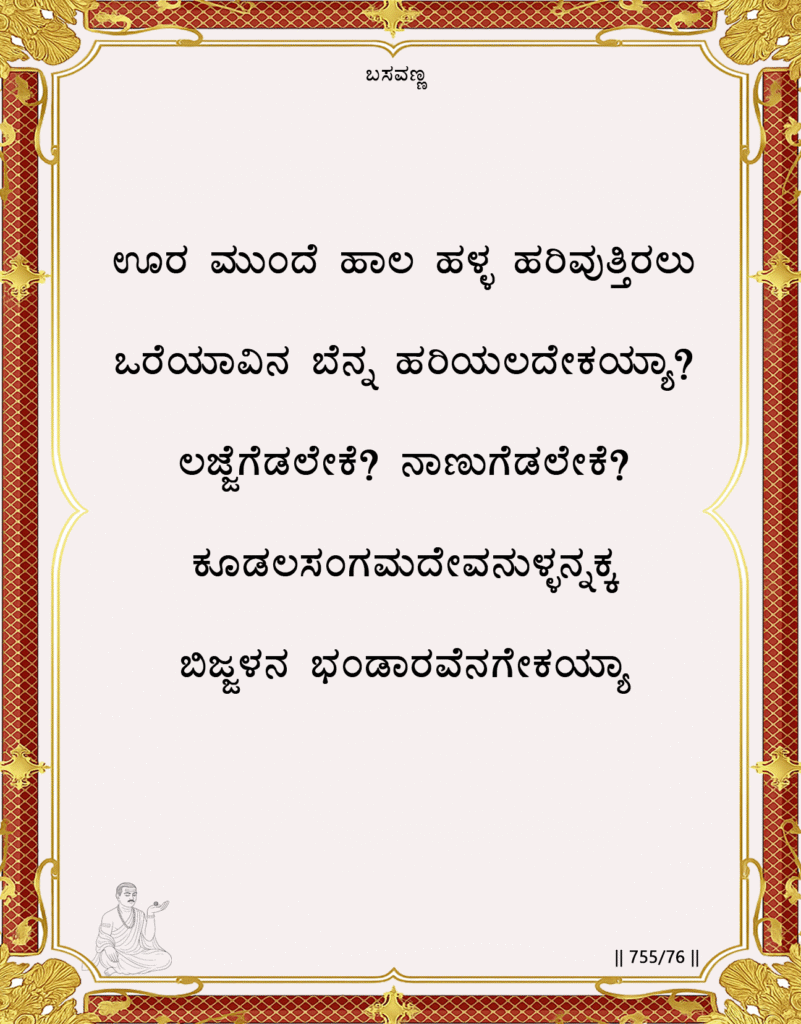
When milk flows freely in the village stream,
why should the calf hide to drink in shame?
Why barter grace for greed,
bow to thrones for a coin?
O Koodalasangama, Your presence overflows
in my heart, across the land
why seek the king’s treasury
when the wealth of truth is already mine, radiant and free?
Basavanna presents a vision of inner abundance so complete that external authority and material hoarding become unnecessary. When spiritual plenitude (“milk”) flows freely within and throughout society, there is no need for greed, shame, or subservience. The Vachana emphasizes that true wealth is consciousness based and accessible to all; recognizing this inner abundance dissolves artificial hierarchies and creates a society governed by conscience rather than coercion. The teaching is both historical and timeless: the kingdom of truth and generosity arises when each individual acknowledges the ever present divine fullness within.
Spiritual Context
Core Spiritual Principle: The realization of inner divine abundance (purnatva) naturally leads to the dissolution of scarcity based behaviors like greed, hoarding, and subservience. A society rooted in this awareness functions on sharing and conscience, not on coercion and commerce.
Cosmic Reality Perspective: The Divine (Linga) is infinite, unconditional abundance. The universe is an expression of this overflowing generosity. The feeling of scarcity is a fundamental ignorance (avidya) that creates the ego’s need to acquire, control, and submit to worldly power. When this ignorance is dispelled by grace, one perceives the “milk” of divine presence flowing everywhere.
Historical Reality (Anubhava Mantapa Context): This Vachana is the socio economic manifesto of the Sharana revolution. Basavanna, who was himself a minister, critiques the very foundations of state power (the “king’s treasury”) and the economics of scarcity. He envisions and enacts an alternative: a spiritual community (Sangha) where the recognition of shared divine wealth makes greed obsolete and fosters a natural, voluntary socialism based on Dasoha (sharing).
Interpretation
1. “When milk flows freely in the village stream, why should the calf hide to drink in shame?” The opening metaphor is revolutionary. The “village stream” represents the community or society itself. “Milk” symbolizes spiritual and material sustenance, grace, and abundance. If this abundance is communal and freely available, the “calf” (the individual) has no need for the shame of stealing or the anxiety of lack. It can drink openly and without fear. This describes a society without poverty or the stigma of need.
2. “Why barter grace for greed, bow to thrones for a coin?” This directly attacks two pillars of the old order: the priestly class that “barters grace” (selling rituals and blessings) and the political power that demands obeisance for material security (“a coin”). Basavanna declares that in the new consciousness, both are rendered meaningless.
3. “O Koodalasangama, Your presence overflows in my heart, across the land ” The source of this new reality is identified. It is not a political ideology but an experienced spiritual truth: the pervasive presence of the Divine within (heart) and without (across the land). This perception transforms one’s entire relationship with the world.
4. “why seek the king’s treasury when the wealth of truth is already mine, radiant and free?” The logical conclusion. The “king’s treasury” represents all external sources of security, status, and power. The “wealth of truth” is the inner realization of oneness with the abundant Divine. Once this inner wealth is secured, the pursuit of external wealth loses its compulsive force. This is the foundation of true freedom (moksha).
Practical Implications: The seeker is guided to: Cultivate the direct experience of inner fulfillment through spiritual practice, reducing dependency on external validation and material possessions. Actively participate in creating economies of sharing and communities of mutual support. Question and relinquish behaviors rooted in scarcity, fear, and the need for hierarchical approval.
The Cosmic Reality
Anga (Human Dimension): The Anga is the individual who has realized their own inner “treasury” and thus relates to the world from a state of fullness, not lack. They are the “calf” that drinks freely and without shame.
Linga (Divine Principle): The Linga is the source of the “milk” the infinite, overflowing abundance of consciousness and grace that permeates creation.
Jangama (Dynamic Interaction): The Jangama is the “village stream” the community and society that is organized around the free flow of this divine abundance. It is the dynamic, living expression of a shared spiritual and material economy.
Shata Sthala
Primary Sthala: Prasadi Sthala. The experience of inner abundance and the dissolution of scarcity consciousness is a direct fruit of divine grace.
Supporting Sthala: Aikya Sthala. The vision of a unified society where all drink from the same stream is the social expression of the non dual realization that all is One.
Practical Integration
Arivu (Awareness Practices): Contemplation on Abundance: Meditate on the “stream of milk.” Feel the grace and abundance of the universe flowing to you and through you. Recognize that your essential nature is this abundance itself.
Mindfulness of Scarcity: Notice when thoughts of lack, jealousy, or greed arise. See them as illusions that obscure the ever present “stream” of divine provision.
Achara (Personal Discipline): Practice generosity as a spiritual discipline. Give freely of your time, resources, and energy, trusting in the inner “treasury” that cannot be depleted.
Kayaka (Sacred Action): Engage in work that contributes to the common good, helping to create the “village stream” of shared abundance in your professional sphere.
Dasoha (Communal Offering): Dedicate yourself to building and sustaining communities and systems that ensure no one has to “drink in shame.” Make the principle of open sharing the core of your communal life.
Modern Application
“The Scarcity Mindset and Hyper Consumerism.” Modern capitalist culture is engineered to foster a perpetual sense of lack that we are not enough, do not have enough, and must constantly acquire more. This leads to anxiety, environmental destruction, and profound social inequality.
This Vachana is a radical antidote to the scarcity mindset. It offers a vision of a post capitalist, soul based economy. It liberates the individual from the treadmill of consumerism by revealing that the security we seek in wealth is already present within as “the wealth of truth.” It provides the spiritual foundation for a sharing economy, environmental sustainability, and a society where human dignity is not tied to material possession.
Essence
The river of grace runs through every street.
The beggar and the king drink from the same beat.
Why dig a well in a desert of fear,
when an ocean of love is already here?
Let the old gods of gold and throne turn to dust.
In the heart that is full, the world can be trusted.
This Vachana presents a spiritual theory of value and social organization. It posits that the root of all socio economic injustice is the perceived separation from the Source (Linga), which generates a consciousness of scarcity. The solution is therefore not merely political reform but a mass mystical awakening to the inherent abundance of the Real. Its multidimensional impact is to fuse economics with spirituality, making enlightenment the prerequisite for a just society. It positions the Jangama as the prototype of the new human one who, being rooted in inner abundance, naturally creates systems of sharing and erodes the very foundations of coercive power.
The world you see of competition, greed, and inequality is a projection of a mind that feels separate and poor. The real world, the true creation, is one of limitless generosity and shared abundance. You have a choice: you can continue to fight for a bigger share of the illusion, or you can wake up to the fact that you are the ocean, not a separate drop fighting for survival. Your inner fulfillment is the most revolutionary force in the world. From it, a new society can be born.

Views: 11