
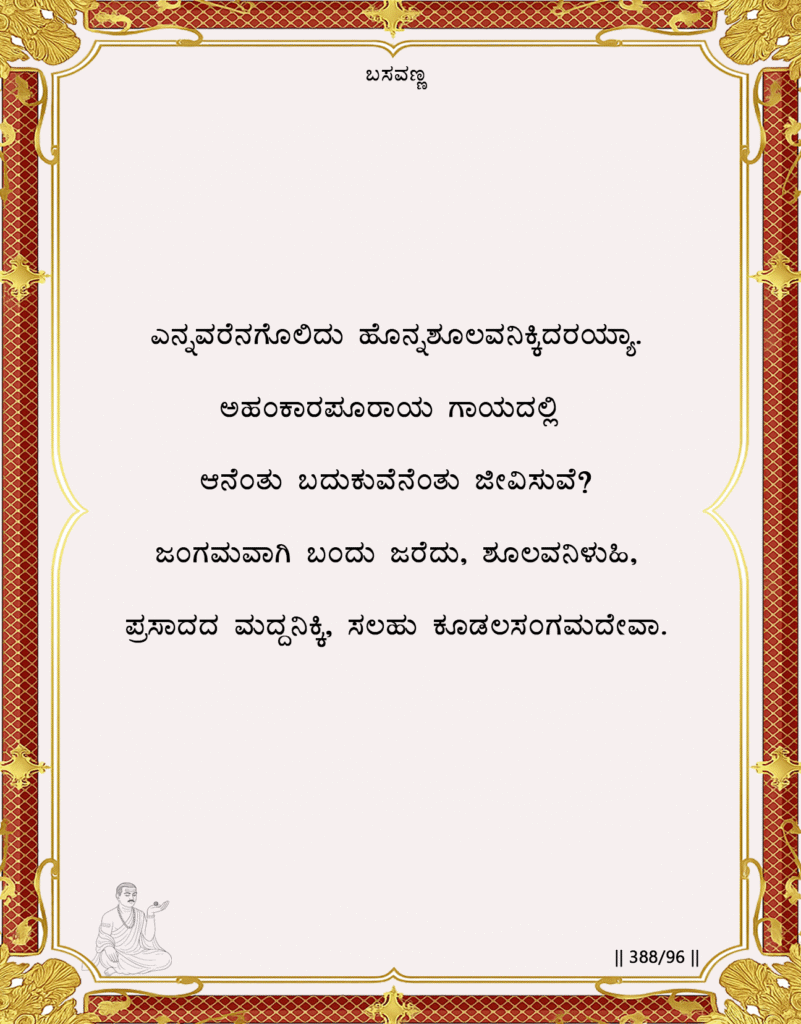
Poetic Rendering
They raised me high with their flowery words
but every blossom hid a thorn.
Their praises were knives of gold,
glittering, yet cutting deep.
They crowned me with applause,
clapped their hands around me
and my heart trembled,
for I knew the wound beneath the wreath.
O Koodalasangamadeva,
if I am truly Yours,
shield me from such praise
You who are the very measure of truth and justice.
Basavanna warns that praise is often more dangerous than criticism. Words of admiration may look like garlands, but they can pierce like hidden thorns, feeding ego and weakening devotion. True safety lies not in public honor but in humility before God. Basavanna begs Koodalasangamadeva to protect him from the seduction of acclaim, declaring that a devotee belongs only to the Lordnot to the world’s applause.
Spiritual Context
Core Spiritual Principle: The most insidious obstacle on the path is not blame but praise, for it directly strengthens the ego, the very root of separation from the Divine. True devotion requires a humility that is immune to the seductive poison of social acclaim.
Cosmic Reality Perspective: In the non-dual view, the ego (ahamkara) is a false center of gravity that claims ownership of qualities that inherently belong to the Divine. Praise reinforces this illusion, misattributing the flow of divine grace (Linga) as a personal accomplishment of the individual (Anga). This creates a dangerous spiritual inflation.
Historical Reality (Anubhava Mantapa Context): As a revered leader, Basavanna was acutely aware of the corrupting influence of power and status. This Vachana is a radical critique of the human tendency to create hierarchies and gurus, asserting that a true Sharana must remain a humble servant, deflecting all honor back to the one true source, Koodalasangamadeva.
Interpretation
1. “flowery wordsbut every blossom hid a thorn.”: Praise appears beautiful (a flower) but its true nature is to bind and injure (a thorn). The “thorn” is the subtle inflation of the ego, which creates a sense of separation and pride.
2. “knives of gold, glittering, yet cutting deep.”: This metaphor reveals the deceptive nature of praise. Its value (gold) is illusory, and its function is to “cut” the devotee from their anchor in the Divine by fostering attachment to a personal self-image.
3. “my heart trembled, for I knew the wound beneath the wreath.”: This demonstrates Basavanna’s profound self-awareness. He does not enjoy the praise; he fears it. He recognizes that the “wreath” of public honor is a binding that wounds the spirit by reinforcing a false identity.
4. “if I am truly Yours, shield me from such praise…”: This is the core of the prayer. He defines his true identity solely in relation to the Linga. His plea for protection is an active practice of surrender, asking the Divine to do for him what he cannot do alone: maintain the integrity of his humility.
The Cosmic Reality
Anga (Human Dimension): The Anga is the vulnerable human heart, which naturally craves validation and recognition. In its purified state, it recognizes this craving as a trap and trembles at its own susceptibility.
Linga (Divine Principle): The Linga is “the very measure of truth and justice.” It is the objective standard against which all falsehood, including the inflated self-image offered by praise, is measured. It is the only source of validation that does not corrupt.
Jangama (Dynamic Interaction): The Jangama is the protective, intervening grace of the Linga. It is the divine activity that actively “shields” the devotee. This can manifest as external circumstances that humble the seeker or as an internal grace that creates instant discernment and disgust toward the intoxicating effect of praise.
Shata Sthala
Primary Sthala: Maheshwara Sthala. This stage involves the purification of the inner being to make it a fit temple for the Divine. A key part of this purification is scrubbing away the ego. This Vachana is a advanced practice for the Maheshwara: maintaining inner purity amidst the polluting influence of social honor.
Supporting Sthala: Bhakta Sthala. The prayer itselfthe act of seeking refuge from a spiritual pitfallis the essence of the Bhakta’s dependent relationship on the Divine. The mature Bhakta learns that dangers include not just sin, but also spiritual success.
Practical Integration
Arivu (Awareness Practices): Cultivate a witness consciousness when receiving compliments. Observe the pleasant sensation and the rising thought “I am good” without identifying with it. Immediately, inwardly, offer the compliment and the good feeling back to the Divine: “This is Your grace, not my doing.”
Achara (Personal Discipline): Practice conscious humility. Deliberately avoid seeking recognition. In conversation, deflect praise toward others or toward the divine source of your abilities. Make a discipline of acknowledging your mistakes more readily than your successes.
Kayaka (Sacred Action): Perform your duty so excellently that it invites praise, but do not perform it for praise. Let the quality of your work be an anonymous offering. If praise comes, let it be a test of your detachment, not the goal of your action.
Dasoha (Communal Offering): Use your influence to praise the divine in others. Create a community culture that values sincerity over flattery and collective upliftment over individual glorification. The greatest Dasoha is to help others remain free from the snare of ego.
Modern Application
The Culture of Personal Branding and Validation-Seeking. Social media and the “influencer” economy are built on the currency of praise (likes, shares, followers). This creates an epidemic of externalized self-worth, where identity becomes a product to be marketed and validated by public opinion, leading to anxiety, inauthenticity, and a fragile sense of self.
This Vachana is an urgent antidote to the modern identity crisis. It liberates one from the exhausting performance of maintaining a personal brand. It offers the profound peace that comes from having a single, unwavering source of identity and validation: one’s relationship with the Divine/Truth. It allows one to act in the world without being psychologically enslaved by its opinions.
Essence
The golden knife, the flowery chain,
That seeks to feed the self’s vain reign.
I tremble not at blame or slight,
But at the praise that shines so bright.
O Truth, my only measure be,
And from this sweet poison, set me free.
1. The Energetics of Inflation: Praise is not just words; it is an energetic charge directed at the individual. This charge seeks to enlarge the psychic space occupied by the ego (Anga). If accepted, it creates a localized energy vortex of “self-importance” that disrupts the receptive, humble posture required for the free flow of grace from the Linga. The “cut” is the severing of this energetic connection through the inflation of the recipient.
2. The Alchemy of True Identity: The plea, “if I am truly Yours,” is a statement of ontological fact. It asserts that the Anga’s fundamental reality is not a standalone self but a dependent aspect of the Linga. Praise is dangerous because it presents a compelling, alternative identitya “social self” built on the perception of others. The prayer for protection is a request for the Linga’s energy to maintain a coherent spiritual identity, repelling the foreign energy of flattery that would cause a pathological split in consciousness.
3. Jangama as a Reflective Shield: The functioning Jangama here is not a bridge but a shield. It is the dynamic, active principle of the Linga’s grace that manifests as Vairagya (dispassion) and Viveka (discernment) within the devotee. This grace allows the praised individual to perceive the “thorn” within the “flower” instantly, transforming what would be a poison for the ego into a reaffirmation of their total dependence on the Divine.
The desire for approval is a deep human vulnerability. However, seeking your identity in the mirror of others’ opinions is a recipe for existential slavery. True freedom and integrity are found by anchoring your sense of self in an internal, unwavering truth that is beyond all praise and blame. The most dangerous chains are those woven from the flowers of flattery.

Views: 16