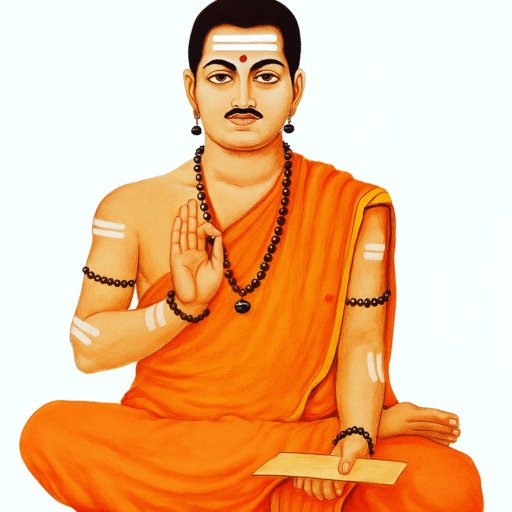

Poetic Rendering

None is smaller than I am,
none greater than the devotees of Shiva.
Your feet bear witness to this,
and my own heart affirms it.
This alone is truth,
O Koodalasangamadeva.
Basavanna declares the highest humility: he places himself beneath all and raises every devotee above himself. This is not self-belittlement but a deliberate dissolving of the ego. By emptying himself completely, he becomes a vessel for divine fullness. By honoring all sharanas as greater, he transforms every meeting into worship. Thus the world becomes a moving temple, and humility becomes the gateway to Koodalasangamadeva’s grace.
Spiritual Context
Core Spiritual Principle: The final obstacle to union is the subtle, comparative ego. The ultimate spiritual practice is to see oneself as the lowest and to see the Divine in all others. This conscious inversion of the ego’s natural hierarchy is the direct path to realizing the equality of all souls in Shiva.
Cosmic Reality Perspective: In the non-dual reality, all is Shiva. The feeling of being a separate, significant self is the primary illusion. By systematically placing himself below everyone, Basavanna is not cultivating low self-esteem but actively eradicating the very standpoint of the “self” that can be either high or low. He is aligning with the objective truth that the One Consciousness (Linga) is the only reality, and all individual forms (Angas) are equal expressions of it.
Historical Reality (Anubhava Mantapa Context): This Vachana is the social and spiritual manifesto of the Anubhava Mantapa. It codifies the radical equality and anti-hierarchical spirit of the community. If even the foremost leader places himself beneath the newest devotee, no hierarchy of caste, class, or spiritual seniority can stand.
Interpretation
1. “None is smaller than I am…”: This is the practice of nirahara (fasting from the ego). It is a deliberate, active stance of taking the lowest seat. This is not a thought but a lived orientation toward every being, constantly draining the energy from the ego’s sense of self-importance.
2. “…none greater than the devotees of Shiva.”: This is the complementary practice. By seeing every Sharana as a manifestation of the Divine, the entire world becomes a congregation of sacred beings. This transforms perception itself into a continuous act of worship (pratikulya), where every encounter is with the Linga.
3. “Your feet bear witness to this, and my own heart affirms it.”: This statement grounds the realization in direct experience, not theory. The “feet” of the Linga symbolize the foundational, supporting truth. His “heart” is the inner chamber where this truth is felt and validated. This union of outer truth and inner conviction is the mark of authentic realization.
4. “This alone is truth…”: This is a declaration of supreme knowledge. In the economy of the spirit, this humble orientation is not a virtue but the fundamental law, as real as gravity.
The Cosmic Reality
Anga (Human Dimension): The Anga has become a perfect vessel of emptiness. It is a “zero” that, by being nothing, can contain the “everything” of the Divine. Its identity is solely defined by its relationship to the Linga and its reverence for that same Linga in all other Angas.
Linga (Divine Principle): The Linga is the ultimate Truth and Witness. It is not a separate observer but the very substance of the truth being witnessed. The statement “none greater than the devotees of Shiva” is true because the devotees are, in their essence, the Linga itself.
Jangama (Dynamic Interaction): The Jangama is the perpetual flow of reverence. It is the dynamic where the empty Anga (Basavanna) constantly recognizes and honors the Linga in every other Anga (the devotees). This creates a sacred circuit of energy where humility generates grace, and grace deepens humility.
Shata Sthala
Primary Sthala: Aikya Sthala. This state of consciousness is the fruit of the entire path. The separate self is gone. What remains is a pure, functional vehicle that perceives only the Divine in all directionsabove, below, and within.
Supporting Sthala: Sharana Sthala. This Vachana is the ultimate expression of what it means to be a Sharanaone who has taken refuge. The refuge is so complete that the individual will has been entirely replaced by the divine perspective.
Practical Integration
Arivu (Awareness Practices): Practice “reversing the gaze.” In every interaction, consciously think: “This person is a devotee of Shiva, worthy of my highest reverence. I am here to learn from them and serve the Divine in them.” Use this to cut through judgments and comparisons.
Achara (Personal Discipline): Make a discipline of seeking the lowest placeliterally and metaphorically. Let others go first. Prefer the least honorable seat. Actively listen more than you speak. See criticism as a gift from a divine messenger.
Kayaka (Sacred Action): Perform all work as a service to the community of devotees. See your labor as an offering to the Divine that resides in your colleagues, customers, and everyone affected by your work.
Dasoha (Communal Offering): The most profound Dasoha is to uphold the dignity of every member by seeing them as greater than yourself. This creates a powerful field of mutual reverence and respect that elevates the entire community, making it a true living temple (Anubhava Mantapa).
Modern Application
The Epidemic of Narcissism and Status Anxiety. Modern culture, driven by social media and hyper-competition, glorifies self-promotion, personal branding, and the relentless pursuit of being “better than.” This creates isolation, envy, and a deep-seated sense of inadequacy.
This Vachana offers liberation from the exhausting race for status. It provides a revolutionary model of self-worth that is not based on being above others, but on a profound connection to the sacredness in all. It replaces anxiety with reverence, competition with service, and isolation with a deep sense of belonging to a sacred community.
Essence
I am the dust at every door.
Every devotee, I bow before.
This is the truth, my only creed:
To be the lowest, is to be freed.
1. The Geometry of Consciousness: Egoic consciousness is a pyramid, with the self at the apex. The consciousness expressed here is an inverted pyramid, where the self becomes the foundational base that supports and elevates all others. This inversion is not a moral posture but a reconfiguration of the psychic structure to align with the actual nature of reality, where Consciousness is one and undivided.
2. The Quantum Field of Reverence: In a quantum model, the observer influences the observed. By consistently adopting the “state vector” of being the “smallest,” Basavanna collapses the wavefunction of his interactions into experiences of unity and reverence. He is not seeing others as greater; he is actualizing their divine nature by interacting with them from that assumption. His humility is a creative, world-shaping force.
3. Jangama as the Engine of Ego-Dissolution: The ongoing Jangama here is a self-reinforcing loop of self-emptying. The act of seeing the Linga in another devotee further empties the self. This emptiness, in turn, creates a purer capacity to see the Linga everywhere. This loop continues until the point of observation (the self) and the object observed (the other) merge into the single, unified field of the Linga. The statement “This alone is truth” is the final output of this processthe recognition that this humble, unified perception is the fundamental and only reality, with the separate ego being the transient illusion.
Your true power and peace are found not in rising above others, but in grounding yourself so deeply in humility that you see the same sacred essence in everyone you meet. The path to the highest unity is through the deepest respect for all beings. When you make yourself nothing, you become a vessel for everything, and the whole universe becomes your family, your temple, and your teacher.

Views: 3