

Summary
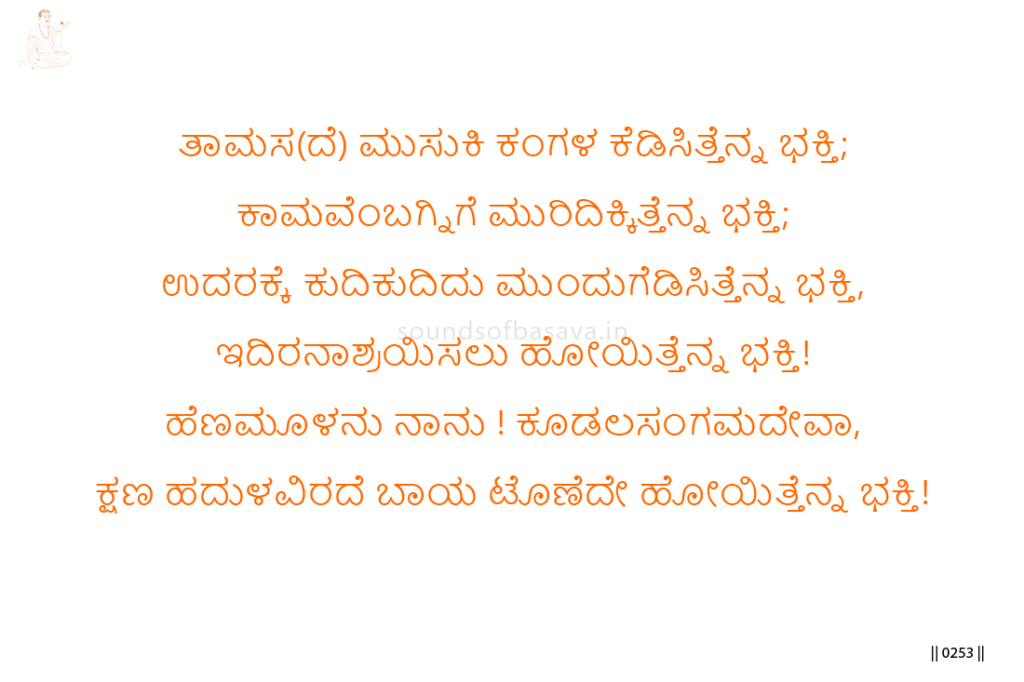
In this vachana, Basavanna examines what he calls bhakti during the very performance of Lingayoga. Tamas covers the eyes, and he says, “bhakti.” Desire burns like fire, and he says, “bhakti.” Belly-hunger drives him forward, and he says, “bhakti.”
He then shows further disturbance. Dependence on others pulls him outward, and still he says, “bhakti.” The body is made of perishable matter, and the mouth keeps speaking without steadiness, and still he says, “bhakti.”
The refrain is therefore not simple confidence in devotion. It is painful self-examination: if these forces still govern the seeker during practice, can this truly be called bhakti before Kudalasangama Deva?
Imagery & Symbolic Relevance
The first image is tamas covering the eyes. The eyes are present, but seeing is darkened. In Lingayoga, this means the gaze and awareness lose clarity during practice.
The second image is the fire of desire. Desire is not passive; it burns and unsettles the inner state. Yet the seeker still calls the condition bhakti.
The third image is belly-hunger. The pressure of bodily need drives the seeker into restless movement. This exposes how survival-pressure can disturb devotion even while practice continues.
The fourth image is dependence on others. The seeker moves outward for support, and bhakti becomes mixed with external reliance.
The fifth image is the perishable body. Basavanna names himself as bound to the body made of matter. This body cannot itself guarantee steadiness.
The final image is the mouth speaking without even a moment’s steadiness. Speech continues, but the inner state is not stable. The word “bhakti” is spoken, yet the condition behind it is unsettled.
Together, these images expose the danger of naming practice as devotion when the inner current remains governed by tamas, desire, hunger, dependence, body-identification, and unstable speech.
Lingayoga
In Lingayoga, this vachana is a direct examination of practice while it is being performed. The issue is not merely whether the seeker practices, but what is happening within the practice.
The eyes may be present before the Linga, the mouth may speak, and the outer form may continue. Yet if tamas covers the gaze, desire burns within, belly-pressure drives action, and the speech lacks steadiness, the practice has not yet become true bhakti.
The practical movement here is honest discrimination. Basavanna asks the seeker not to name every act of practice as bhakti, but to examine whether the inner state has become steady before Kudalasangama Deva.
Editorial Commentary
This vachana should be read as a correction of premature devotional naming. Basavanna does not deny bhakti. He questions whether what is being called bhakti has truly become bhakti when the inner field remains disturbed. The refrain exposes the gap between the word and the lived state.
Related Vachana
Supporting Vachana
Bhakta Sthala Vachana 220 — Flicker to Flame
Bhakta Sthala Vachana 220 supports this vachana by showing that devotion can begin with reverence and then decline into dullness, habit, and loss of wakefulness. Vachana 272 carries that concern into the performance of Lingayoga itself: tamas covers the eyes, desire burns, belly-hunger drives, and speech continues, yet the seeker must ask whether this can truly be called bhakti.
Advancing Vachana
Prasadi Sthala Vachana 511 — Practice Goes On, Yet Devotion Is Not Attained
Prasadi Sthala Vachana 511 advances this movement by showing that practice may continue, yet devotion may still not be attained. Vachana 272 questions the condition that is being called bhakti during practice. Vachana 511 carries this into Prasadi Sthala, where the seeker recognizes that practice alone cannot steady bhakti unless Kudalasangama Deva gathers and turns the mind by grace.
