

Summary
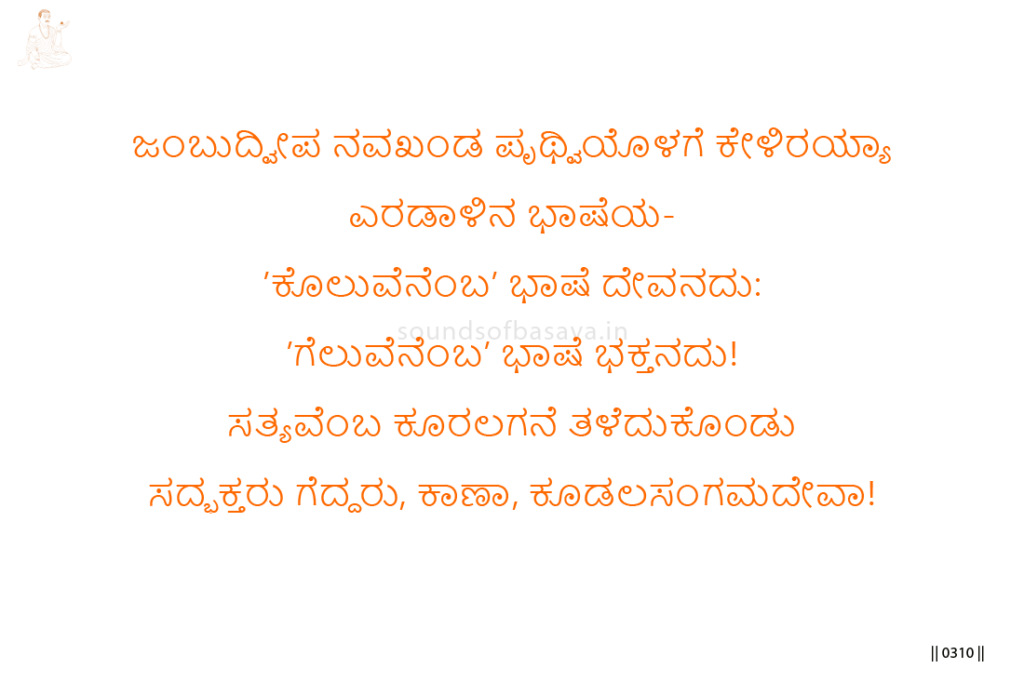
In this vachana, Basavanna asks the listener to hear the two kinds of speech spread across Jambudweepa and the ninefold earth. The field is wide; the teaching is not confined to one place or one group.
One speech says, “I shall destroy”; this is named as the speech of Deva. Another says, “I shall win”; this is named as the speech of the Bhakta.
Basavanna then shows how the true devotees win. They do not win through noise, force, or empty claim. They win by taking up the sharp edge called truth. Before Kudalasangama Deva, the Sadbhakta’s victory belongs to truth.
Imagery & Symbolic Relevance
Jambudweepa and the ninefold earth give the opening image. Basavanna widens the vachana to the whole human field, where speech reveals the direction in which the being moves.
The first speech says, “I shall destroy.” This speech carries the force of cutting down, ending, or overcoming.
The second speech says, “I shall win.” This belongs to the Bhakta, but Basavanna does not leave victory undefined. He immediately connects true victory with truth.
The sharp edge called truth is the central image. Truth is not treated as soft opinion or pleasing speech. It is sharp because it cuts through falsehood.
The Sadbhaktas take up this sharp truth and win. Their victory is not shown as domination over others. It is victory through the force of truth before Kudalasangama Deva.
Lingayoga
In Lingayoga, this vachana asks the seeker to examine speech and inward direction. The question is not only what is spoken, but what kind of movement the speech carries.
Speech that seeks destruction moves away from steadiness. The Bhakta’s speech must be joined to truth. When truth becomes the measure, speech is no longer scattered, reactive, or merely forceful.
The practical movement is discrimination. The seeker must know whether his words arise from the wish to destroy or from the courage to stand in truth. Bhakti matures when speech, intention, and conduct gather around truth before Kudalasangama Deva.
Editorial Commentary
The phrase “Jambudweepa and the ninefold earth” broadens the scope of the vachana. Basavanna is asking the listener to hear two kinds of speech wherever human life unfolds.
The phrase “sharp edge called truth” controls the meaning of victory. The Sadbhakta does not win by becoming destructive. He wins because truth itself cuts through falsehood before Kudalasangama Deva.
Related Vachana
Supporting Vachana
Bhakta Sthala Vachana 240 — The Word as the Bridge to Heaven
Vachana 240 supports this teaching by showing that speech itself carries spiritual consequence. Reverent words such as Deva, Bhakta, Jaya, and Jeeya open the way toward Kailasa, while careless speech turns downward. Vachana 678 carries the same concern into Maheshwara Sthala: speech must be tested by truth, and the Sadbhakta wins only by holding the sharp edge of truth before Kudalasangama Deva.
Advancing Vachana
Prasadi Sthala Vachana 943 — The Grace Beyond All Division
Vachana 943 advances this teaching by showing the Prasadi state in which falsehood is removed and truth remains. Vachana 678 presents truth as the sharp edge by which the Sadbhakta wins. Vachana 943 carries this movement into Prasadi Sthala, where truth is no longer only the weapon of victory but the remaining state after falsehood has fallen away before Kudalasangama Deva.
