

Summary
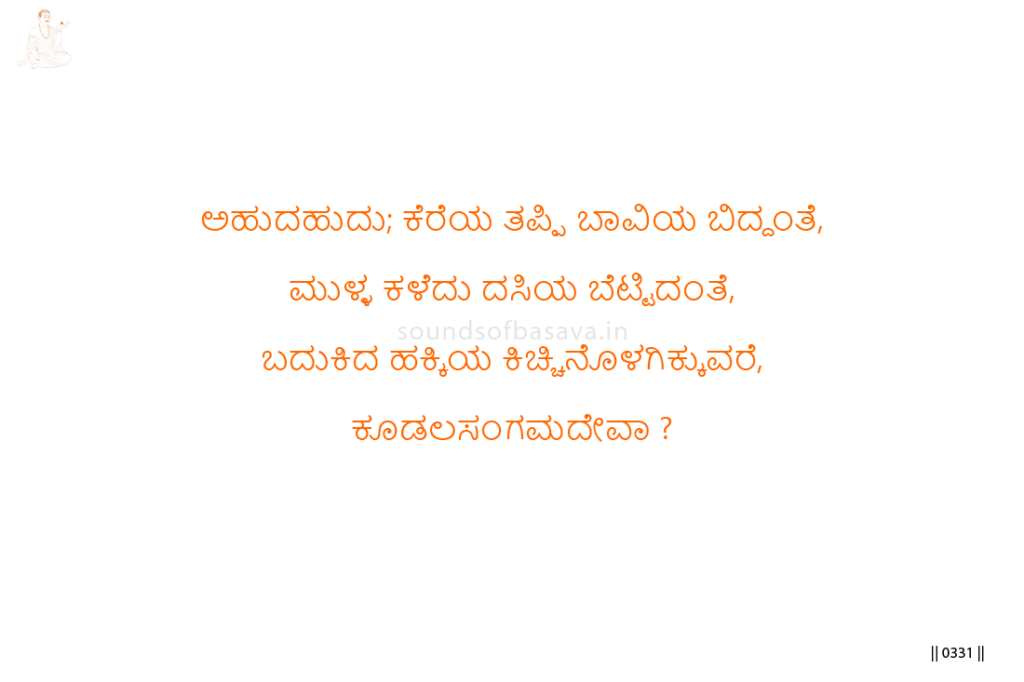
In this vachana, Basavanna asks three self-answering questions. Who would leave a lake and fall into a well? Who would leave a flowering grove and climb into thorns? Who would drive a living bird into fire?
Each image exposes the same error: abandoning what is open, living, and nourishing for what is narrow, painful, or destructive.
Before Kudalasangama Deva, the teaching is direct. The seeker must not turn away from what sustains life and fall into what diminishes it.
Imagery & Symbolic Relevance
The lake and the well form the first contrast. The lake is open and abundant; the well is narrow and confined. To leave the lake and fall into the well is to abandon spacious nourishment for limitation.
The flowering grove and the thorn hedge form the second contrast. The grove suggests shade, beauty, and natural flourishing. The thorn hedge brings injury and obstruction. To leave the grove for thorns is to exchange ease for needless suffering.
The living bird and the fire form the strongest image. A living bird carries breath, movement, and freedom. To drive it into fire is to destroy what is alive by one’s own action.
Basavanna is not asking for information. He presents choices so unreasonable that the listener must immediately recognize the folly.
Together, the images teach discernment. No one knowingly leaves fullness for confinement, flowering for thorns, or life for fire; yet this is what happens when the seeker turns away from the sustaining presence of Kudalasangama Deva.
Lingayoga
In Lingayoga, this vachana teaches discrimination in movement. The seeker must know what nourishes the path and what harms it.
The danger is not always absence of grace. It may be the failure to remain with what has already been given.
The path requires guarding the living source. The seeker must not wander into narrower, harsher, or destructive alternatives when the life-giving way already stands before him.
Editorial Commentary
The force of the vachana lies in its obviousness. Basavanna does not argue; he places the wrong choice before the reader until its absurdity becomes clear.
The lake, grove, and living bird should be read together. Each represents what is alive or sustaining. The well, thorns, and fire represent the loss created by wrong turning.
Related Vachana
Supporting Vachana
Bhakta Sthala Vachana 127 — The Withered Flower, the Dried Stream
Vachana 127 supports this teaching by warning that living nearness must not be lost while it is still present. A withered flower cannot regain fragrance, and a dried stream cannot carry the river. Vachana 1030 carries the same warning into Maheshwara Sthala: one must not abandon the lake, the grove, or the living bird for what confines, wounds, or destroys before Kudalasangama Deva.
Advancing Vachana
Prasadi Sthala Vachana 200 — The Taste Beyond Measure
Vachana 200 advances this teaching by showing the positive movement beyond wrong turning. It teaches that realization must be tasted directly; one who has tasted knows, while one who has not tasted remains in doubt.
Vachana 1030 warns the seeker not to leave what is living and nourishing for what is narrow and destructive. Vachana 200 carries this into Prasadi Sthala by showing what must be done instead: do not merely stand near the living source, speak about it, or move around it; enter it through direct taste.
The movement is from discernment to direct experience. Vachana 1030 says, “Do not abandon the living source.” Vachana 200 says, “Taste it for yourself before Kudalasangama Deva.”
