
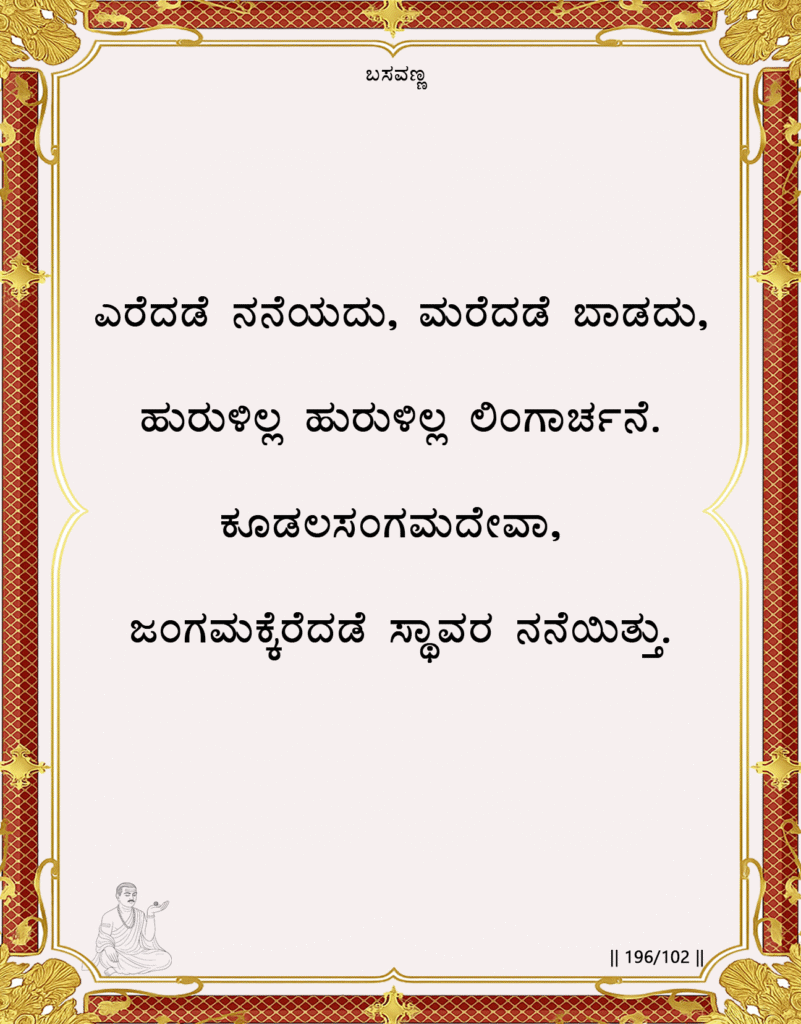
Poetic Rendering

Rain may fall on stone it will not wet;
if forgotten, it remains unfazed, unchanged.
No matter how much one prays or devotes to the Linga,
it continues beyond accounting, eternal and infinite.
O Koodalasangamadeva,
when You awaken the living consciousness within,
even the false, lifeless, stationary forms
rituals, shrines, and hollow acts
become touched, softened, and alive.
Basavanna emphasizes the eternal and self-sufficient nature of the divine: it is unaffected by our attention or neglect. Human devotion alone cannot “enhance” the eternal Linga. True transformation occurs when the divine awakens consciousness within the living then even inert rituals, temples, and external forms are enlivened and made meaningful. The vachana highlights that the power of God’s grace, not ritual alone, brings spiritual vitality.
Spiritual Context
Core Spiritual Principle: The Divine is absolute and unconditioned. Spiritual practice does not change God; it changes us. The ultimate value of any ritual or form is not inherent, but is bestowed by the awakened consciousness that performs it. Grace precedes and empowers authentic devotion.
Cosmic Reality Perspective: The Linga represents pure, unconditioned Consciousness. It is the uncaused cause, the eternal subject. The world of forms (rituals, temples) are objects within this consciousness. To believe that an object can affect the subject is a fundamental error. The subject must first illuminate the object for it to have any sacred meaning.
Historical Reality (Anubhava Mantapa Context): This is a direct critique of ritualistic Hinduism that prioritized external worship in stone temples over internal transformation. Basavanna asserts that a stone temple is inert without an awakened devotee, and conversely, an awakened devotee can transform any place into a sacred space.
Interpretation
1. “Rain may fall on stoneit will not wet…”: The “stone” is the unawakened heart, hardened by dogma, ritualism, and ego. The “rain” is the external performance of devotion. Without inner receptivity, the divine grace (symbolized by rain) runs off without effect.
2. “No matter how much one prays… it continues beyond accounting…”: This establishes the transcendence and self-sufficiency of the Linga. It is a declaration of God’s absoluteness, free from any transactional relationship with devotees.
3. “when You awaken the living consciousness within…”: This is the pivotal event. The “awakening” is the descent of grace (Shaktipata), which softens the stony heart and makes it porous to the divine. The individual is “turned on” from within.
4. “even the false, lifeless, stationary forms… become touched, softened, and alive.”: This is the result. The awakened consciousness (Jivanmukta) imbues the external world with sacred significance. Rituals are no longer hollow but become expressions of inner joy; physical temples are no longer just stone but are seen as manifestations of the cosmic body of God.
The Cosmic Reality
Anga (Human Dimension): The Anga has two potential states: the “stone” (inert, unreceptive, identified with form) and the “awakened consciousness” (living, receptive, identified with the witness). Its transformation is the entire purpose of the path.
Linga (Divine Principle): The Linga is the constant, unwavering source of both the “rain” (grace) and the power of “awakening.” It is the absolute reality that remains unchanged, whether recognized or not.
Jangama (Dynamic Interaction): The Jangama is the moment of awakening itself. It is the dynamic process where the Linga’s grace activates the latent consciousness within the Anga, transforming it from a passive object in the world into an active participant in the divine play, capable of seeing the Linga in all things.
Shata Sthala
Primary Sthala: Prasadi Sthala. The entire Vachana describes the mechanics of grace. The awakening is the Prasada, and the resulting transformation of perception is the fruit of that Prasada.
Supporting Sthala: Maheshwara Sthala. The “awakened living consciousness” is the individual who has become a true Maheshwaraa purified being in whom the divine resides, for whom every action becomes worship.
Practical Integration
Arivu (Awareness Practices): In meditation, practice receptivity. Instead of “doing” a meditation, invite the “rain” of grace. Be the soft earth, not the hard stone. Inquire: “Am I performing this practice from a stony habit, or from a living, awakened sincerity?”
Achara (Personal Discipline): The core discipline is to cultivate a “soft heart.” Practice empathy, active listening, and vulnerability. Let your spiritual practice be about breaking down inner walls of rigidity, not building new ones of dogma.
Kayaka (Sacred Action): Do not just perform your job. Bring awakened consciousness to it. Let your presence infuse your work with life and meaning, transforming a mundane task into a “stationary form” that has been “touched and softened” by your awareness.
Dasoha (Communal Offering): Share the spirit of awakening, not just ritual knowledge. A community’s role is to help soften each other’s “stony” aspects through compassion and support, creating an environment where grace can flow and awaken everyone.
Modern Application
Empty Ritualism in Modern Wellness and Religion. Many people go through the motions of spiritual practice yoga, meditation, church attendance as a checklist item, without inner transformation. This leads to “spiritual materialism,” where the form is worshipped but the essence is missed, leaving the heart unchanged and life unfulfilled.
This Vachana liberates one from the burden of empty ritual. It shifts the focus from “doing spiritual things” to “being a awakened being.” It assures that when one is truly touched by grace, every action, no matter how small or mundane, becomes sacred and alive. It calls for depth over breadth, and presence over performance.
Essence
The rain of grace on stone will run,
Its work is not yet done.
But when You stir the heart awake,
The driest ritual, for compassion’s sake,
Becomes a living, sacred art,
A testament of Your soft heart.
1. The Principle of Subjective Sacralization: Nothing is inherently sacred or profane. Sacredness is a quality of relationship and perception. A stone temple is profane to a stonecutter and sacred to an awakened devotee. The difference lies not in the object but in the consciousness of the subject. The Linga’s grace performs the ultimate alchemy: it transforms the subject, thereby transforming the subject’s entire universe.
2. The Twofold Nature of Grace: The “rain” is grace in its general, pervasive formit falls on all. But the “awakening” is grace in its specific, transformative formit is the lightning strike that ignites the potential within the individual. The first is universal potential; the second is particular actualization.
3. Jangama as the Transfigurative Loop: The functioning Jangama here creates a self-reinforcing loop of meaning. The awakened consciousness (Anga) perceives the Linga in all forms. This perception is an act of worship. This worship further deepens the awakening. In this state, the seeker understands that the prayer did not change God, but God’s grace enabled the prayer, which in turn revealed God in everything. The world itself becomes a continuous, dynamic Jangamaa moving, living relationship with the Divine.
Do not mistake the map for the territory, or the ritual for the reality. The forms of spirituality are empty until your own consciousness is awakened and fills them with meaning. The transformation you seek is not about changing God or earning favor; it is about allowing a divine intelligence to soften your own heart so that you can perceive the sacredness that was always there. True religion is not about building temples of stone, but about becoming a living temple of awareness.

Views: 19