Poetic Rendering

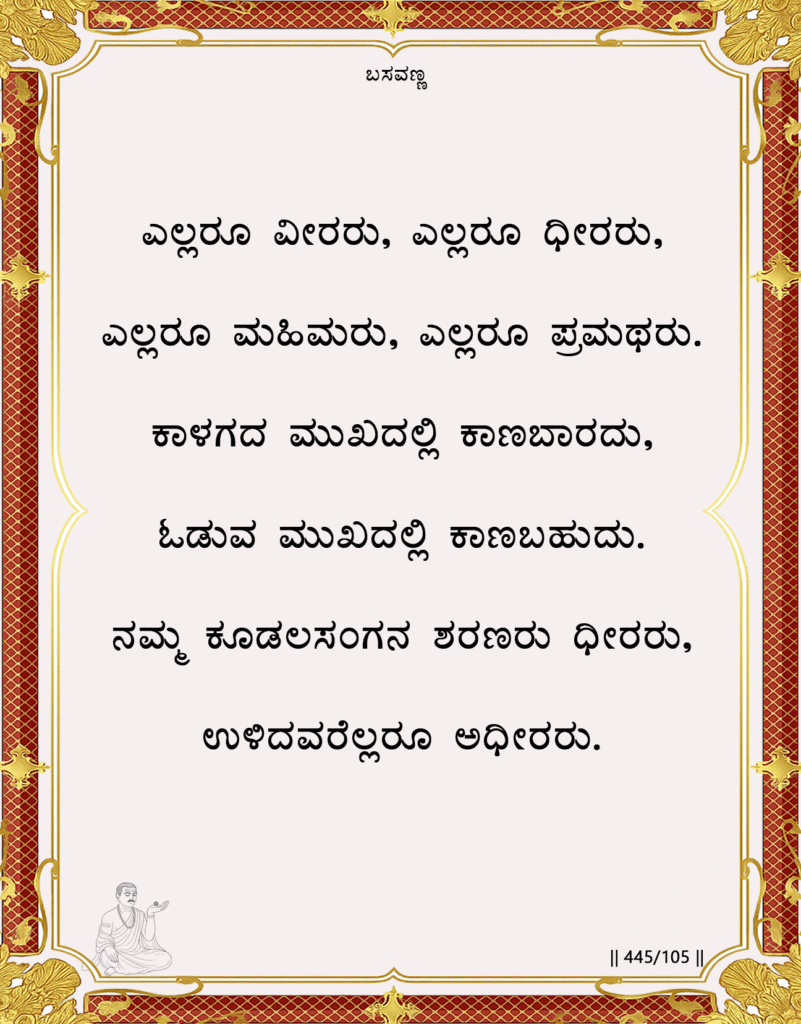
Everyone claims to be brave,
everyone claims to be wise
heroes, thinkers, the famed and the fearless.
But when measured against the vast face of Time,
their greatness thins, their courage fades.
They scratch a mark upon history,
then vanish like dust in wind.
Only the sharanas of Koodalasangamadeva
are truly brave
for they stand in the knowledge of the Eternal.
All other courage is only noise.
Basavanna challenges worldly definitions of bravery and intelligence. Human achievements, fame, and strength appear impressive, yet dissolve when placed before the immensity of Time. True courage, he says, belongs only to the sharanas those who anchor themselves in the Eternal. Their bravery is not momentary or performative; it arises from knowing and surrendering to the Divine. All other forms of courage are fleeting displays with no lasting substance.
Spiritual Context
Core Spiritual Principle: Worldly valor and intellect are rooted in the ego and are therefore finite and doomed to be erased by time. The only true, imperishable courage is that which is required to surrender the ego and abide in the awareness of the Eternal. This is the courage to be nothing in the world’s eyes in order to be everything in God.
Cosmic Reality Perspective: The Linga is the Eternal, the timeless substratum of all existence. Time (Kala) is a power that governs the phenomenal realm but is itself a manifestation of the Linga. To stand with the Linga is to stand at the source of Time itself, making one impervious to its ravages. The Sharana doesn’t defeat time; they transcend it by aligning with its source.
Historical Reality (Anubhava Mantapa Context): This Vachana continues the social critique, contrasting the fleeting heroism of kings and warriors with the enduring, revolutionary courage of the Sharanas. The Sharanas’ bravery was not in battle, but in defying the entire social and religious order of their time to establish a path of direct, personal devotion.
Interpretation
1. “Everyone claims to be brave, everyone claims to be wise…”: This exposes the universal pretense of the ego. The ego’s very nature is to claim qualities (bravery, wisdom) to fortify its sense of separate existence.
2. “when measured against the vast face of Time, their greatness thins…”: Time is the ultimate refutation of the ego. All worldly achievements, no matter how grand, are temporary. This is not a nihilistic statement but a sober assessment of reality (Satya).
3. “They scratch a mark upon history, then vanish like dust in wind.”: Even historical legacy is an illusion of permanence. History itself is a story written on water, constantly changing and eventually forgotten.
4. “Only the sharanas… are truly bravefor they stand in the knowledge of the Eternal.”: This redefines courage. It is not an aggressive quality but the profound strength that comes from knowing what is real. Their “standing” is an unshakeable abidance in this knowledge. The object of their knowledge the Eternalis the source of their fearlessness.
5. “All other courage is only noise.”: “Noise” is a perfect metaphor. It is sound without substance, a temporary disturbance in the silence. Worldly courage is a dramatic but empty display that adds nothing to the eternal silence of Truth.
The Cosmic Reality
Anga (Human Dimension): The Anga has a choice: to identify with the temporary persona (the hero, the scholar) and partake in its inevitable dissolution, or to identify as a Sharana, whose identity is rooted in the Linga and is therefore deathless.
Linga (Divine Principle): The Linga is the Eternal, the silent, unchanging background against which the “noise” of the world plays out. It is the ultimate reality that confers reality upon anything that partakes of it.
Jangama (Dynamic Interaction): The Jangama is the process of “standing in the knowledge.” It is the dynamic, moment-to-moment practice of referring all experiences back to the Eternal. This practice transforms the individual’s consciousness from being time-bound to being time-transcending, which is the essence of true courage.
Shata Sthala
Primary Sthala: Sharana Sthala. This Vachana provides the ultimate definition of this stage. A Sharana is not defined by what they do, but by where they stand. Their refuge in the Linga is so total that it becomes their sole source of strength and identity.
Supporting Sthala: Aikya Sthala (Stage of Union). The “knowledge of the Eternal” is not an intellectual concept but a state of union where the knower and the known are one. The Sharana’s courage is a manifestation of this non-dual state.
Practical Integration
Arivu (Awareness Practices): When you feel fear or a need to prove yourself, ask: “What is it that I am afraid of losing? Is it a reputation, a possession, a status?” Then contemplate: “Can this thing survive the ‘face of Time’?” Anchor yourself in the felt sense of the eternal presence of the Linga, which can never be lost.
Achara (Personal Discipline): Practice “egoless courage.” Perform the right action not for recognition or out of fear, but because it is true, even if it leads to worldly loss or ridicule. The discipline is to act from inner integrity, not external validation.
Kayaka (Sacred Action): Do your work as an offering to the Eternal. Let the quality of your work be your “mark,” not the fame or profit it brings. A job done with sincerity and offered to the Divine has an eternal value, even if it is forgotten by history.
Dasoha (Communal Offering): Build a community that values this spiritual courage. Honor those who are humble, truthful, and steadfast in their devotion over those who are merely successful or powerful by worldly standards. Support each other in remembering the eternal perspective.
Modern Application
The Performance of “Grit” and “Influence.” Modern culture, especially in the realms of business and social media, glorifies a performative kind of courage hustle culture, relentless self-promotion, and the pursuit of being an “influencer” or “thought leader.” This is often a mask for deep insecurity and a fear of irrelevance, creating burnout and existential anxiety.
This Vachana liberates one from the exhausting performance of being “great.” It offers a profound, unshakeable self-worth that is not contingent on likes, sales figures, or legacy. It allows one to act in the world with authentic power and peace, free from the fear of failure or obscurity, because one’s identity is secured in the Eternal.
Essence
The hero’s boast, the scholar’s claim,
Are kindling for Time’s silent flame.
But one who stands where Time is born,
Finds a courage not to be worn,
Or lost, or praised, or left behind
The fearless, eternal, steadfast mind.
1. The Thermodynamics of Egoic Courage: Worldly courage is a high-energy, low-entropy state. It requires constant effort to maintain the fragile, ordered structure of the ego against the relentless, disordering force of Time (which increases entropy). This is why it eventually “fades” and becomes “noise”it dissipates.
2. The Synergy of Spiritual Courage: The Sharana’s courage is a low-energy, high-entropy state in terms of the ego, but a high-coherence state in terms of consciousness. The ego is allowed to dissolve (high entropy), but the consciousness that remains is perfectly ordered (coherent) because it is aligned with the fundamental order of the universethe Linga. This state is self-sustaining and requires no effort to maintain; it is simply the natural state of being in truth.
3. Jangama as the Alignment with the Eternal Now: The functioning Jangama here is the alignment of the individual’s consciousness with the “Eternal Now.” Time, as a linear phenomenon of past and future, is the domain of the ego (regret and anxiety). The Eternal is the perpetual present. By “standing in the knowledge of the Eternal,” the Sharana’s Jangama is a continuous residence in the Now. In this state, the very concept of courage becomes redundant, as there is no future threat to be brave against. One simply is, in perfect, fearless harmony with what is.
Do not waste your life building a monument to your ego; time is the ocean that will inevitably wash away every sandcastle. Invest instead in the one act of true courage: to surrender your small self to the vastness of the Eternal. The bravery required to let go of your story, your achievements, and your self-importance is the only bravery that endures. It is the courage to be nothing, and in being nothing, to become one with Everything. This is the silent, unshakeable victory that no power in the universe can ever take from you.

Views: 19