Poetic Rendering

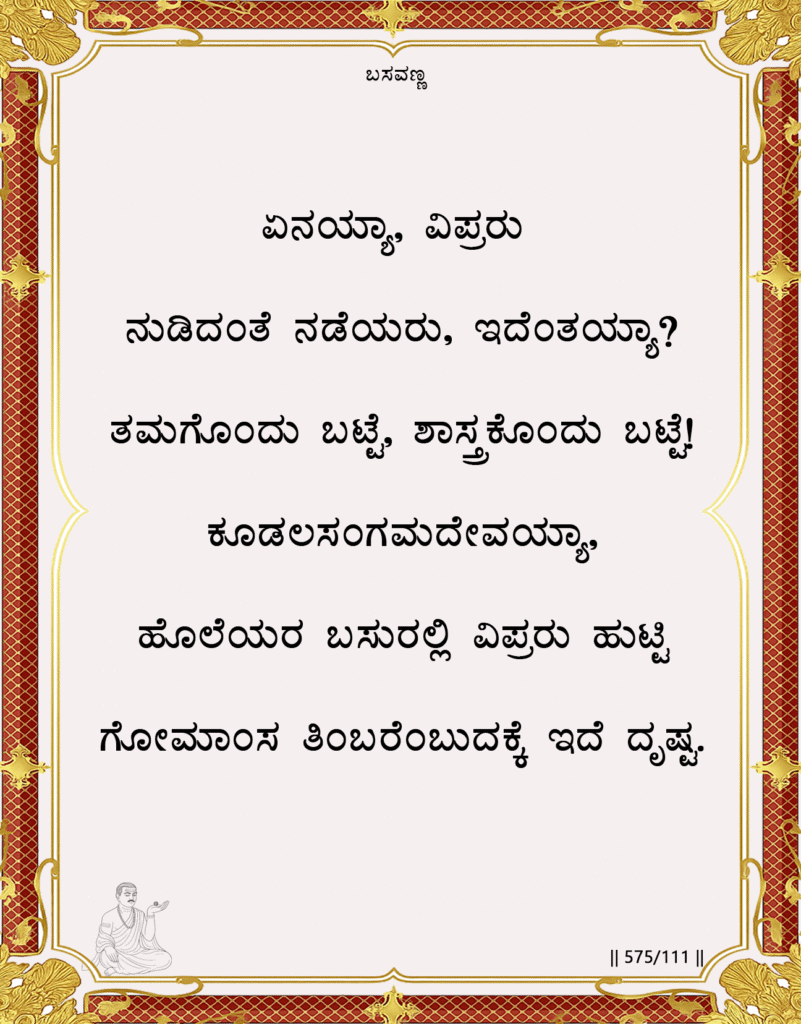
Why, O Lord, do the learned and the priests
speak one thing yet live another?
One garment for their conduct,
another for the scriptures they preach!
Climbing the ladder of divided desires,
feeding on the very cravings they condemn
their duplicity stands exposed.
But before You, Koodalasangamadeva,
the truth is simple and unmistakable:
without the single, sincere glance of integrity,
all their claims fall apart.
Basavanna uses sharp, uncompromising imagery to reveal the hollowness of spiritual hypocrisy. Those who preach purity but live in contradiction fracture themselves into two garmentsone for public display and one for private indulgence. Such duality, he says, is the root of all moral and spiritual decay. True spirituality requires a single, unified lifewhere thought, speech, and action flow from the same inner truth. Before the living Lord, Koodalasangamadeva, only sincerity, transparency, and inner consistency carry weight. All external learning and ritual lose meaning when the heart is divided.
Spiritual Context
Core Spiritual Principle: Integrity is the foundation of spirituality. A divided life, where one’s inner reality contradicts one’s outer expression, is a state of profound spiritual falsehood (asatya). Truth (satya) is not a concept to be preached but a state of being to be lived in seamless unity.
Cosmic Reality Perspective: The Linga is absolute, non-dual Reality (Sat). Duality is the nature of the manifested world, but spiritual hypocrisy is a moral and conscious duality where the individual willingly perpetuates a split between their professed truth and their lived reality. This active duality is a direct affront to the non-dual nature of the Divine.
Historical Reality (Anubhava Mantapa Context): This is a direct and scathing critique of the Brahmin priests and scholars of Basavanna’s time, who upheld rigid codes of ritual purity and scriptural authority while often being accused of moral and ethical corruption. It establishes the Anubhava Mantapa’s core value: that inner character outweighs external religious status.
Interpretation
1. “One garment for their conduct, another for the scriptures they preach!”: The “garment” is a powerful symbol for the persona. The hypocrite maintains two separate identities: the public, spiritual self (the scripture garment) and the private, self-serving self (the conduct garment). This is a conscious fragmentation of the soul.
2. “Climbing the ladder of divided desires…”: This reveals the motivation. The “ladder” is the religious hierarchy. They are climbing not for God, but for social power and status (“divided desires”). Their spiritual authority becomes a tool to satisfy the very cravings they publicly denounce.
3. “feeding on the very cravings they condemn”: This is the height of hypocrisy. They derive their sustenance (power, wealth, adulation) from the system they ostensibly critique, making their entire position a self-serving illusion.
4. “the single, sincere glance of integrity”: This is the antidote. The “glance” (drishti) signifies a unified state of perception and being. It is a consciousness where the inner thought, the spoken word, and the enacted deed are all one single, coherent expression. There is no gap, no division.
The Cosmic Reality
Anga (Human Dimension): The Anga is called to a state of radical integration. It must tear down the wall between the inner and outer self. Its spiritual work is to become transparent, where its external life is a perfect mirror of its internal state.
Linga (Divine Principle): The Linga is “Koodalasangamadeva” as the ultimate principle of Truth and Integrity. It is the cosmic standard of non-duality against which all duplicity is measured and found wanting.
Jangama (Dynamic Interaction): The Jangama is the courageous act of self-examination and alignment. It is the dynamic process of constantly bringing one’s actions into congruence with one’s professed beliefs, and vice-versa, until the two become indistinguishable. This is the living practice of truth.
Shatsthala
Primary Sthala: Maheshwara Sthala. This stage involves the purification of the individual to make them a temple. A temple cannot have a sacred facade and a profane interior; it must be holy throughout. This Vachana is the blueprint for that inner/outer purification.
Supporting Sthala: Bhakta Sthala. The “sincere glance” begins with the Bhakta’s simple, honest heart. A true devotee may be flawed, but they are not a hypocrite; their devotion is a sincere offering, not a performance.
Practical Integration
Arivu (Awareness Practices): Practice a daily “Integrity Scan.” At the end of the day, reflect: “Where was there a gap between what I believe/know to be right and how I acted? Where did I wear a ‘different garment’?” Do not judge, but observe with the intention to close the gap.
Achara (Personal Discipline): Make a vow of simplicity and transparency. Avoid saying things you do not mean. Practice what you preach, even in small matters. Let your “yes” be yes and your “no” be no. This builds the muscle of integrity.
Kayaka (Sacred Action): Ensure your work is an expression of your values. Do not engage in professional practices that conflict with your spiritual understanding. Let your livelihood be a “single garment” you wear with pride before God.
Dasoha (Communal Offering): Foster a community culture of gentle, loving accountability. Create a space where members can help each other see their blind spots and contradictions without judgment, supporting each other in the pursuit of wholeness.
Modern Application
The Culture of Virtue Signaling and the Personal Brand. In the age of social media, it is easier than ever to craft a “scripture garment” a curated online identity of wellness, spirituality, and social justice that is completely divorced from one’s actual “conduct garment.” This widespread performativity leads to collective cynicism, distrust, and a deep existential dissonance within individuals.
This Vachana is a call to radical authenticity. It liberates one from the exhausting pressure to maintain a spiritual image. It offers the profound peace that comes from being the same person in private, in public, and online. It teaches that true influence comes not from a perfect persona, but from the power of a congruent life. In a world of filters and facades, integrity becomes the most revolutionary act.
Essence
One robe for show, one for the stain,
A life divided, lived in vain.
You climb on words, but acts betray,
The truth you preach, you cast away.
But God sees not the script you read,
But if your heart and hands agree in deed.
1. The Energetics of Hypocrisy: A divided life creates internal psychological friction, which dissipates spiritual energy. The effort required to maintain two separate “garments” is a constant drain on consciousness. This state is one of low coherence, where the energy of thought, speech, and action are out of phase, canceling each other out and resulting in no net spiritual progress.
2. The Unified Field of Integrity: The “single, sincere glance” is a state of high coherence. In this state, the individual’s thoughts, words, and actions are all aligned and vibrating at the same frequencythe frequency of their deepest truth. This creates a powerful, resonant field that can actually effect change in the world and draw the grace of the Linga, which is itself absolute coherence.
3. Jangama as the Coherence Builder: The functioning Jangama here is the moment-to-moment practice of choosing integrity. Each time a person aligns a hidden action with a public principle, or revises a public statement to match a private realization, they are increasing their own coherence. This Jangama is the practical means of building the “Maheshwara” the purified, integrated being. In the presence of Koodalasangamadeva, who is perfect coherence, the incoherent claims of the hypocrite “fall apart” because they cannot resonate with the fundamental vibration of Reality. They are literally deconstructed by the force of truth.
Your life is your most powerful sermon. What you do speaks so loudly that the world cannot hear what you say. Do not worry about constructing a spiritual image; focus on dismantling the inner divisions. Have the courage to live a life where your actions are the authentic echo of your beliefs. In the court of divine truth, a single, sincere act of integrity holds more weight than all the holy scriptures recited by a divided heart.

Views: 69