Poetic Rendering

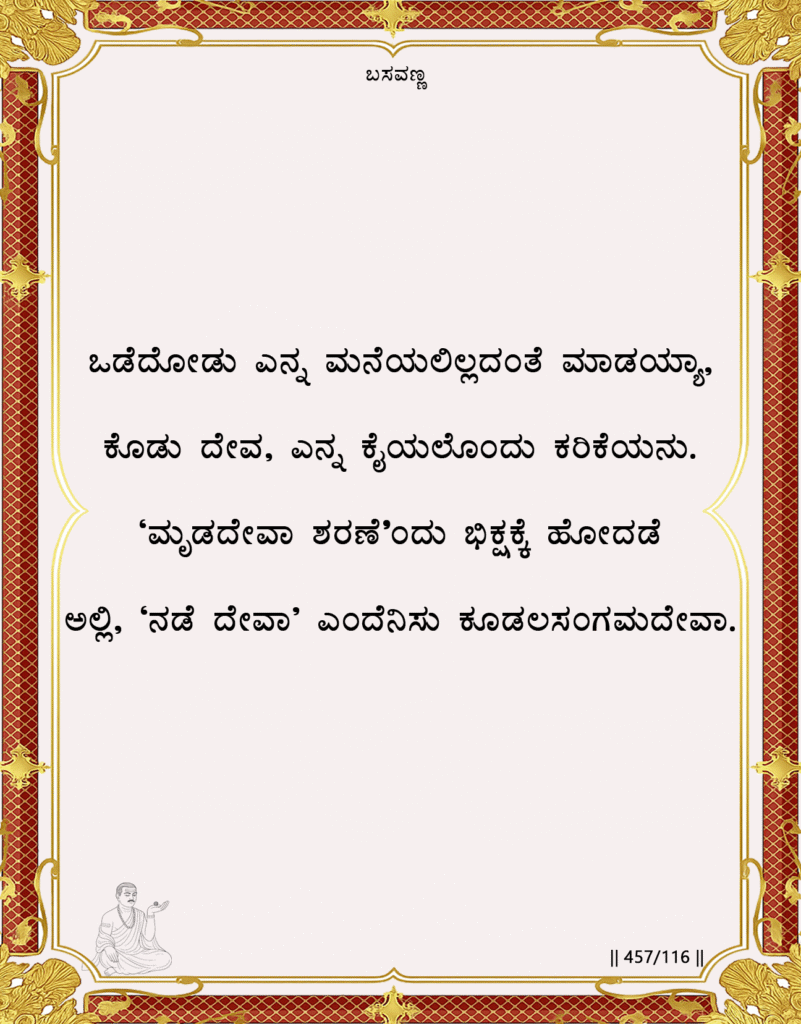
Do not make me two, O Lord
this body as anga and You as Linga apart.
Hold me whole, undivided in Your truth.
Place in my hand a single blade of sacred grass
let even this small, earnest offering be enough.
If like a fool I come begging for alms of divinity,
chanting Your name yet steeped in my old hungers,
give my animal nature only grass
and let its cravings starve.
And if, without inner worth, I still dare seek
the highest secret of Your being,
then at Your very threshold tell me, “Turn back.”
Yessend me away,
O Koodalasangamadeva.
Basavanna asks the Lord not for comfort, but for purification and honesty of being. He pleads that the illusion of separation between anga (the body-self) and Linga (the Divine Self) be dissolved. The simple blade of sacred grass represents sincerity over display, humility over ceremony. He acknowledges that approaching God with ego and desire makes him unfit, like an animal begging for divine alms. Thus he asks that such ego be starved rather than indulged. And finally, in the highest sincerity, he prays that if he seeks the ultimate truth without inner purity, God should turn him away. In this, Basavanna reveals the deepest devotionchoosing truth over acceptance, purification over comfort, and genuine union over the illusion of devotion.
Spiritual Context
Core Spiritual Principle: The highest form of devotion is the love of Truth itself, even more than the desire for God’s presence. A true seeker would rather be turned away by God for being impure than be falsely accepted, thereby perpetuating their own ignorance. This is the ultimate sadhana: prioritizing the integrity of the path over the comfort of the goal.
Cosmic Reality Perspective: The Linga is absolute Truth. To seek union with Truth while clinging to falsehood (the ego, desires) is a metaphysical impossibility. Basavanna’s prayer acknowledges this cosmic law. He asks the Linga to enforce this law upon him, to treat him according to the truth of his being, not the tenderness of his longing. This is aligning his will with divine law.
Historical Reality (Anubhava Mantapa Context): This Vachana sets the highest possible standard for the Sharanas. It is a radical doctrine of spiritual honesty that prevents the community from degenerating into a group that values emotional consolation over genuine transformation. It is the ultimate safeguard against spiritual complacency.
Interpretation
1. “Do not make me two… Hold me whole…”: This is the primary plea for non-dual realization. He is asking not for a relationship, but for an ontological unity where the subject-object distinction between devotee and God collapses.
2. “a single blade of sacred grass…”: This symbolizes the essence of Dasohaan offering made not for its material value but for the sincerity it represents. It is the antithesis of grandiose, ego-driven ritual. It is enough because its value is in its truth, not its size.
3. “give my animal nature only grass and let its cravings starve.”: This is a prayer for ruthless grace. He distinguishes between his true Self (which seeks union) and his “animal nature” (the ego with its desires). He asks that grace nourish the former and actively starve the latter, even if that process is painful.
4. “tell me, ‘Turn back.’ Yes end me away…”: This is the climax of the Vachana. It is the ultimate surrender of the ego’s spiritual ambition. It is the recognition that premature entry into the divine mystery by an unprepared soul is a spiritual catastrophe. He trusts God’s “No” more than his own misguided “Yes.”
The Cosmic Reality
Anga (Human Dimension): The Anga is in a state of supreme surrender and self-awareness. It willingly offers itself up for the harshest spiritual diagnosis and accepts the most severe prescription for its healing, even if that means temporary exile from the Divine presence.
Linga (Divine Principle): The Linga is the gatekeeper of Truth. It is not only love but also rigor. It is the principle that upholds the law that only truth can know Truth. Its compassion is expressed not just in welcome, but also in the protective act of turning away the unready.
Jangama (Dynamic Interaction): The Jangama here is the most profound dialogue of love. It is the dynamic where the seeker’s plea for truthful treatment is met by the Divine’s rigorous adherence to the law of truth. This interaction, which may include the pain of “exile,” is itself the purifying fire that ultimately makes union possible.
Shatsthala
Primary Sthala: Aikya Sthala. This prayer is the final preparation for union. It is the burning away of the last subtle desire the desire for God on one’s own terms. The acceptance of divine exile is the final surrender that makes the ego transparent enough for non-dual merging.
Supporting Sthala: Prasadi Sthala. The entire Vachana is a request for a specific, severe form of grace (Prasada)the grace of truth, the grace of purification, even if it comes as rejection. It understands that true grace is what leads to liberation, not what pleases the ego.
Practical Integration
Arivu (Awareness Practices): Practice “Ruthless Self-Inquiry.” In meditation, ask: “What in me is not ready for truth? What craving, what hidden agenda, am I bringing to my spiritual practice?” Welcome the answers without defense, and offer those parts of yourself to be “starved” by the light of awareness.
Achara (Personal Discipline): Embrace voluntary “exile” from spiritual comforts. If you find yourself using prayer or meditation as an escape from life’s difficulties, take a break and face the difficulty directly. Practice accepting life’s “No’s” as a form of divine guidance steering you toward greater authenticity.
Kayaka (Sacred Action): Let your work be your “blade of grass.” Focus on doing simple, honest work with full sincerity, without seeking recognition or spiritual merit. Let the purity of the action itself be the offering.
Dasoha (Communal Offering): In your community, have the courage to offer truthful, constructive feedback. Do not enable each other’s spiritual delusions. A true community helps its members see their blind spots, even if the truth is initially difficult to hear, embodying the spirit of “turn back” for each other’s ultimate benefit.
Modern Application
Spiritual Bypassing and the “Comfort Zone” Spirituality. Much of modern spirituality is geared toward providing comfort, validation, and stress relief. Seekers often want a God who affirms them as they are, not one who demands radical transformation. This leads to “spiritual bypassing,” where spiritual ideas are used to avoid psychological shadows and unresolved wounds.
This Vachana is the ultimate antidote to spiritual bypassing. It calls for a spirituality of rigor, honesty, and profound transformation. It liberates the seeker from the need for constant spiritual validation and opens them to the transformative power of divine rigor. It teaches that the most loving thing the Universe can do for us is to refuse our ego’s requests, thereby forcing us to grow. It replaces the search for a comfort zone with the pursuit of a truth zone.
Essence
Unmake the two, make me the One,
Before my day in time is done.
And if my heart brings hidden greed,
Starve that beast of its foul seed.
And if I’m unfit, and truth demands,
Point to the door, and wash my hands.
1. The Principle of Energetic Compatibility: For the finite Anga to merge with the infinite Linga, their energetic states must be compatible. The Linga’s state is pure, undifferentiated energy (high coherence, zero entropy). The Anga, clouded by ego and desire, is a state of differentiated, chaotic energy (low coherence, high entropy). The “exile” is the necessary process where the Anga is forced to shed its entropic baggage to achieve the coherence required for merger. The Divine “turning him away” is not rejection, but the enforcement of this cosmic law for the seeker’s own ultimate good.
2. The Alchemy of the “Blade of Grass”: The “single blade of sacred grass” is a symbol of quantum offering. It represents a offering of minimal material value but maximal intentional purity. In the economy of spirit, the value is not in the quantity of the offering but in the quality of the consciousness behind it. A single, sincere thought is of higher spiritual value than a mountain of gold offered with pride.
3. Jangama as the Purificatory Threshold: The functioning Jangama here is the entire dynamic of the “Divine Exile.” It is the loving, severe interaction at the threshold of realization where the Linga acts as a refiner’s fire. The Jangama is the process that tests the Anga’s sincerity to its breaking point. By praying for this rigorous testing, Basavanna is actively participating in his own purification. He is asking for the Jangama relationship to become so authentic that it will destroy the very basis of the relationship (the duality) by destroying the impure Anga, leaving only the true Self, which is one with the Linga. The exile, therefore, is not an end but the most intense phase of the journey home.
The highest love is not afraid of the truth. If you truly love the Divine, you will love its standards more than you love your own spiritual self-image. Have the courage to ask for what you need, not what you want. Pray for purification over comfort, for truth over consolation, and for the rigorous love that makes you whole, even if it feels like exile. For it is only when we stop seeking God as a haven for our brokenness and start seeking God as the truth that incinerates our falsehood, that we find the way home.

Views: 5