Poetic Rendering

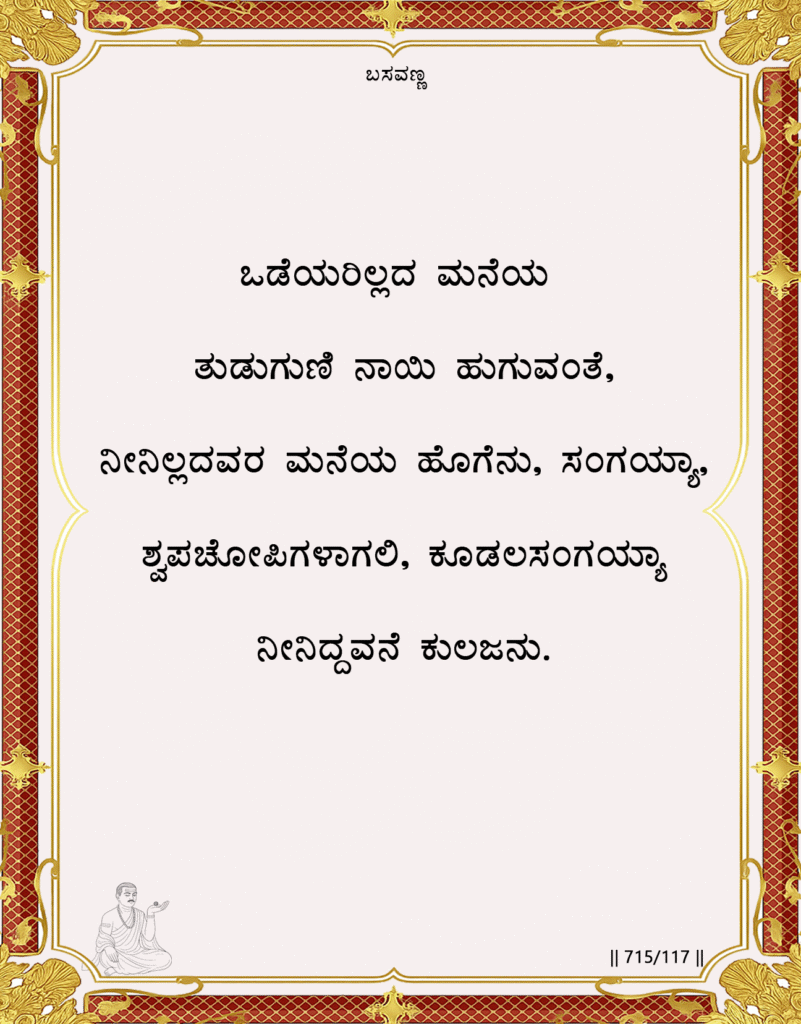
A house abandoned by its master
only a stray dog slips in and out of such a place.
I will not enter any dwelling
where You, O Kudalasangama-deva, do not reside.
This body too is but a sack of flesh
if the Linga is not borne upon it,
and only the righteous one
who holds You outwardly and inwardly
is truly alive and awake.
Basavanna uses a simple, earthy metaphor: a house without its owner becomes a place for stray animals. Similarly, a body without the Linga the living presence of the Divine is empty and directionless. He declares that he will not associate with, or enter into, anything devoid of divine presence. Only those who carry the Linga both on the body and within awareness are truly “inhabited” by the Master; all others are like vacant houses. The vachana teaches that divine presence not mere flesh gives meaning, guidance, and sanctity to human life.
Spiritual Context
Core Spiritual Principle: The human being is a potential abode for the Divine. Without the conscious presence of God, a person is spiritually vacant, subject to the whims of base instincts (the “stray dogs” of desire, ego, and ignorance). True human dignity and purpose are derived from being an occupied temple of God.
Cosmic Reality Perspective: The Linga is the supreme Consciousness, the true “Owner” of all creation, including the individual body-mind complex. The state of spiritual ignorance is one where the Owner is forgotten, and the house is taken over by trespassers (the senses and the ego). Realization is the return of the rightful Owner to His abode.
Historical Reality (Anubhava Mantapa Context): This Vachana provides a clear criterion for association within the Sharana community. It encourages fellowship with those in whom the divine presence is alive and cautions against spiritual environments that are empty of true devotion, reinforcing the community’s role as a collective support for divine indwelling.
Interpretation
1. “A house abandoned by its master only a stray dog slips in…”: The “stray dog” is a potent symbol for the lower, instinctual mind. When the higher consciousness (the Master) is absent, the vacuum is filled by animalistic impulses fear, greed, lust, and aggression that wander in and out unchecked.
2. “I will not enter any dwelling where You… do not reside.”: This is a vow of spiritual discrimination (viveka). It applies not only to physical places but to relationships, conversations, and mental states. Basavanna commits to engaging only with that which is sanctified by the divine presence.
3. “This body too is but a sack of flesh if the Linga is not borne upon it…”: This is the core teaching. The physical body wearing an external Linga is the first step. But if that external symbol is not matched by the internal reality of constant remembrance and surrender, the body remains a mere “sack,” a biological container without spiritual significance.
4. “who holds You outwardly and inwardly is truly alive and awake.”: This defines the Jeevanmukta, the liberated being. “Outwardly” refers to the Istalinga worn on the body and the ethical conduct that reflects divine principles. “Inwardly” refers to the constant, living awareness of the Linga in the heart. This unity of outer practice and inner realization is what constitutes true life, as opposed to a mere biological existence.
The Cosmic Reality
Anga (Human Dimension): The Anga is the “house” or “sack.” Its purpose is fulfilled only when it is occupied and directed by the Linga. It is inert and potential without this indwelling presence.
Linga (Divine Principle): The Linga is the “Master.” It is the animating principle, the source of consciousness, order, and sanctity. It transforms a physical form into a sacred vessel.
Jangama (Dynamic Interaction): The Jangama is the state of being “inhabited.” It is the dynamic, living relationship where the Linga resides within the Anga, not as a passive object, but as the active ruler of the household of the body and mind.
Shatsthala
Primary Sthala: Maheshwara Sthala. This stage is precisely about preparing the “house” (the individual) to be a fit dwelling for the Divine. The Maheshwara is one who has been purified and in whom the Linga resides.
Supporting Sthala: Sharana Sthala. The vow to “not enter any dwelling” without the Divine is an act of taking refuge. It is the Sharana’s conscious choice to live within the sacred enclosure of God’s presence, avoiding all that is profane.
Practical Integration
Arivu (Awareness Practices): Practice the “Master Home” meditation. Sit quietly and visualize your body as a house. Sense the presence of the Linga as the Master in every room (every organ, every limb, every thought). If you find a “stray dog” (a negative thought, a fear), consciously invite the Master’s presence to that area to reclaim it.
Achara (Personal Discipline): Be discerning about your environment. Consciously choose to spend time in places and with people that help you feel connected to the Divine. Withdraw energy from environments that feel spiritually “vacant” or toxic. Let your physical and social space reflect the inner presence of the Master.
Kayaka (Sacred Action): Let your work be an expression of the “Master in the house.” Before acting, ask: “Is this action directed by my higher Self, or by a ‘stray dog’ of impulse, fear, or desire?” Align your actions with the will of the indwelling Divine.
Dasoha (Communal Offering): The role of the community is to be a neighborhood of “inhabited houses.” Support each other in remembering the Master. If a member’s behavior seems to be driven by “stray dogs,” gently remind them of the true Owner, helping to restore the sacred order within their own being.
Modern Application
Existential Emptiness and the “Stray Dog” Culture. Modern life, with its materialism and often shallow pursuits, can lead to a profound sense of existential emptinessa feeling of being a “vacant house.” This vacuum is often filled by the “stray dogs” of consumerism, addictive behaviors, digital distraction, and identity politics, which roam freely in the absence of a central, spiritual purpose.
This Vachana offers a powerful diagnosis and cure for modern alienation. It identifies the root cause as the absence of the “Master”a conscious connection to the Divine or a higher purpose. The solution is to consciously invite that Master to take residence through spiritual practice, thereby evicting the chaotic “stray dogs” and bringing order, meaning, and sacredness to one’s life. It calls for a life of intentional spiritual occupancy.
Essence
A house without its lord and king,
Is where the stray dogs run, a wretched thing.
This body, empty of Your grace,
Is just a sack in time and space.
But worn without and held within,
True life, at last, does then begin.
1. The Energetic Vacuum Principle: A system (the human being) abhors an energetic vacuum. If the high-frequency energy of divine consciousness (the Master) is not present, the system will be filled by lower-frequency energies (the “stray dogs” of primal instincts and egoic drives). The presence of the Linga establishes a high-coherence field that resonates at a frequency incompatible with these lower energies, effectively excluding them.
2. The Isomorphism of Microcosm and Macrocosm: The “house” is a microcosm of the entire manifest universe. Just as the Linga is the sustaining principle of the cosmos, it must become the central, governing principle of the individual microcosm for it to function in harmony with the whole. A body without the Linga is a rogue particle, a dissonant note in the cosmic symphony.
3. Jangama as the State of Divine Governance: The functioning Jangama here is the established state where the Linga’s will is the executive authority in the “house” of the individual. It is not a temporary visit but a permanent residence. In this state, the senses and the mind, which were once “stray dogs,” become trained servants of the Master. Their energy is not suppressed but redirected and sanctified. The individual no longer “has” a spiritual experience; they are a living expression of the Jangama relationshipa continuous, dynamic manifestation of the Divine in human form. This is the realized state of the Sharana, for whom every breath is an affirmation of the Master’s presence in the home of the heart.
You are a dwelling place. The central question of your life is: Whoor what is the master of your house? Are you ruled by the passing stray dogs of fear, desire, and anger, or is your life governed by the timeless presence of a higher, loving consciousness? You have the key. Do not leave your house vacant. Consciously invite the Divine to take up residence, and your life will be transformed from a place of chaos into a sanctuary of peace, purpose, and sacred order.

Views: 13