Poetic Rendering

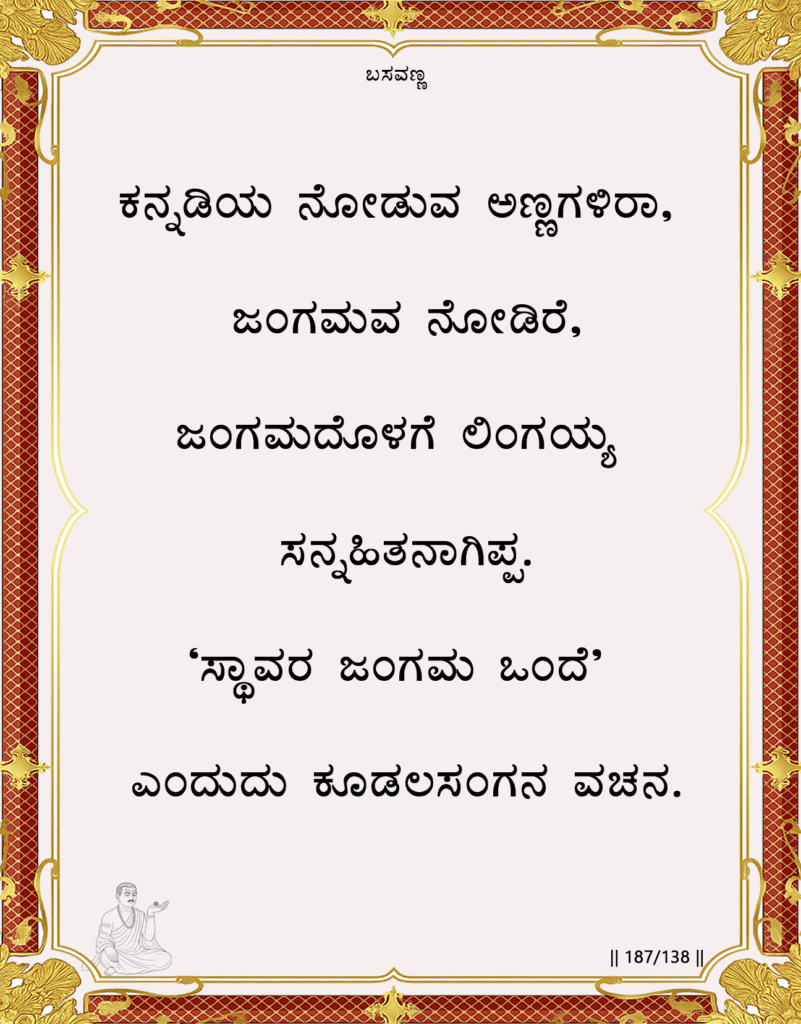
Brothers, why look only
into a Linga polished bright like a mirror?
Seethe Jangama too
shines with the same radiance,
for in the moving form
the Living Lord walks before you.
The still linga in your palm
and the moving linga in the world
know them as one light
of Koodalasangamadeva.
Basavanna redirects the seeker from object-centered worship to life-centered recognition of the Divine. The Linga worn on the body reflects Shiva’s presence, but the Jangamathe realized, wandering devotee embodies it. He teaches that the same consciousness shines in both the still symbol and the living being. True insight arises when one sees no division between the sacred object and the sacred life that moves before us. Through this Vachana, Basavanna affirms the unity of symbol and embodiment, urging us to honor the Divine wherever it breathes.
Spiritual Context
Core Spiritual Principle: The ultimate realization is the non-dual perception of the Divine in all formsboth in the consecrated symbol and in the living, breathing human being. The Jangama is the Linga in motion.
Cosmic Reality Perspective: This Vachana articulates a core tenet of non-dual Shivayoga: the Absolute (Linga) is not separate from its own creative energy (Shakti). The Iṣṭaliṅga is a focal point of the formless Absolute (Shiva), while the Jangama is that same Absolute in its dynamic, manifest aspect (Shakti). To see them as separate is to fail to grasp the wholeness of the Divine.
Historical Reality (Anubhava Mantapa Context): This is a radical theological and social leveler. It elevates the living human beingspecifically the enlightened devotee, often from a lower casteto the same status as the most sacred ritual object. It dismantles the hierarchy that would place priests and temples above the lived experience of divine realization in the common person.
Interpretation
“Brothers, why look only into a Linga polished bright like a mirror?”: Basavanna begins not by condemning the worship of the Iṣṭaliṅga, but by questioning its exclusivity. The Linga is a “mirror” that reflects the Self, but it is not the only one.
“Seethe Jangama too shines with the same radiance…”: This is the pivotal revelation. The Jangama is declared to be an equally valid, equally potent reflector of the Divine. The word “radiance” indicates that the light of consciousness emanating from a realized being is identical to the consciousness invoked in the Linga.
“The still linga in your palm and the moving linga in the worldknow them as one light…”: This is the culminating instruction. “Still” (Sthāvara) and “Moving” (Jangama) are classic categories in Indian philosophy for the entire creation. Basavanna unifies them. The recognition of their essential unity (“one light”) is the mark of true wisdom (Aikya).
Practical Implications: The seeker is taught to cultivate a “double vision”: to see the Linga in the Jangama and the Jangama in the Linga. Reverence for the symbol must be matched, and ultimately surpassed, by reverence for the living embodiment of truth. Spiritual practice moves from the altar into every human interaction.
The Cosmic Reality
Anga (Human Dimension): The seeker whose perception is being refined. The Anga’s task is to purify its vision to see the Linga not just in a stone, but in the complex, moving reality of a human life.
Linga (Divine Principle): Koodalasangamadeva as the one, undivided source of light that is simultaneously focused in the Iṣṭaliṅga and diffused through the being of the Jangama.
Jangama (Dynamic Interaction): The realized human being. They are the living interaction between the Absolute and the relative world. They are the Linga in action, the Divine made visible in time, space, and relationship.
Shatsthala
Primary Sthala: Aikya. This Vachana is a direct expression of the Aikya (Union) stage, where the seeker perceives no separation between God, self, and world. The unity of the still and moving Linga is the perceptual realization of this stage.
Supporting Sthala: Sharana. The Sharana, as one who has taken refuge, naturally extends that reverence to all forms of the Divine. This Vachana provides the philosophical basis for why the Sharana honors the Jangama as profoundly as the Linga.
Practical Integration
Arivu (Awareness Practices): Practice “seeing the Linga” in everyone you meet. In meditation, visualize the Linga within your own heart and then project that same vision onto the people around you, especially those you find challenging.
Achara (Personal Discipline): Cultivate equal reverence. Bow inwardly to the Linga on your altar and then outwardly to the enlightened beings and fellow seekers you encounter, seeing the same sacred principle in both.
Kayaka (Sacred Action): See your service to others, especially to the wise and the needy, as a direct form of worship offered to the “moving Linga.”
Dasoha (Communal Offering): The highest Dasoha is to serve the Jangamathe living presence of the Divine in the community. This service is not secondary to worship; it is worship in its most dynamic form.
Modern Application
Compartmentalization of spirituality, where “sacred” is confined to temples, meditation cushions, or specific rituals, while the rest of lifeespecially interactions with other peopleis considered “profane.” This leads to a fractured consciousness and ethical dissonance.
This Vachana heals this split. It commands us to find the sacred in the human face, in the community, and in the flow of daily life. It makes every moment and every relationship a potential site of worship, transforming the entire world into a temple and every encounter into a spiritual practice.
Essence
The stone reflects a silent, steady flame.
The walking soul burns with the very same.
One light, two lampsthis is the seeing:
The God in stone, the God in being.
The Deeper Pattern (The Subtle Body): This Vachana describes a Holographic Principle of Divinity. In a hologram, every fragment contains the information of the whole. The Iṣṭaliṅga is a deliberately created, high-resolution fragment encoding the information of the Divine Whole. The Jangama is a dynamic, walking hologram of the same Whole. The consciousness that can perceive the unity of the “still” and “moving” linga has understood that they are both interference patterns generated from the same singular sourcethe laser of Koodalasangamadeva’s consciousness. To see this is to perceive the universe’s holographic nature.
In Simple Terms (The Gross Body): The sun in the sky and your reflection of the sun in a puddle are made of the same light. The Linga is like a perfectly crafted, personal mirror reflecting God. The Jangama is like a flowing river that also perfectly reflects the same sky. The wise do not argue whether the mirror or the river is more sacred; they honor the one light shining in both.
The Human Truth (The Causal Body): The divine is not more present in a symbol than it is in a compassionate act or a wise person. The ultimate spiritual skill is to recognize the same sacred essence in the stillness of a stone and the complexity of a human heart. When you learn to see the living God in the people around you, your whole life becomes a prayer.

Views: 1