Poetic Rendering

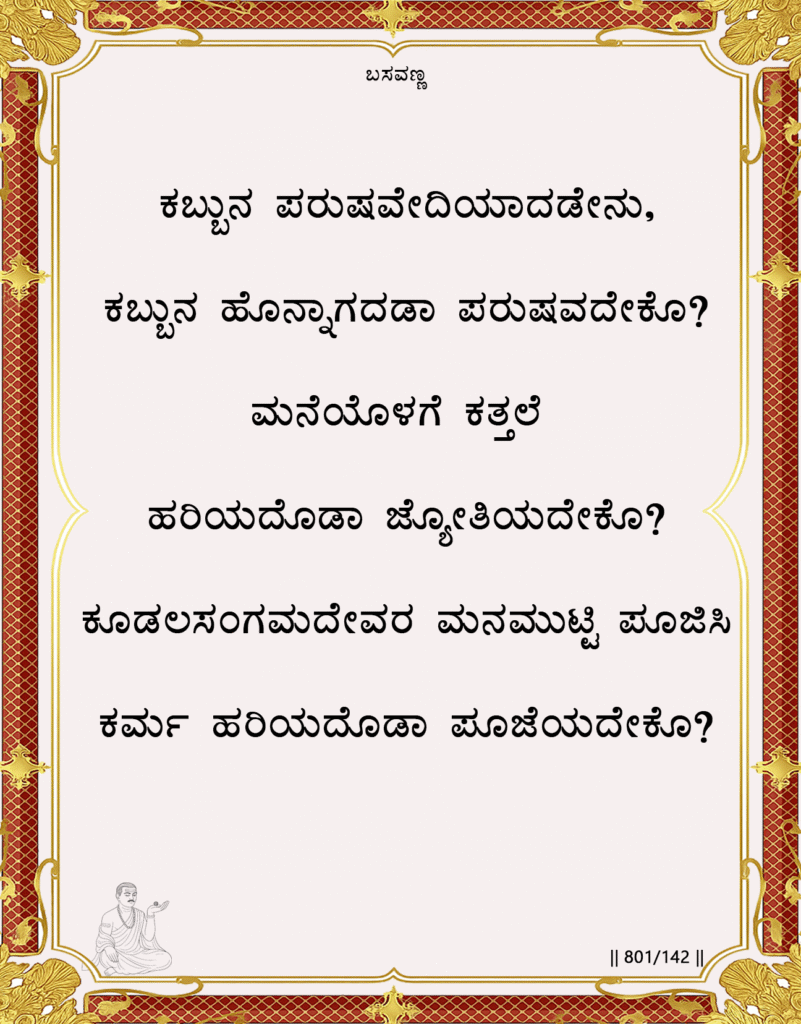
What use is iron,
even if it knows the alchemist’s chant
does it become gold by knowing the words?
What use is a lamp burning in the house,
if the house of this body
remains dark within?
And what use is worship,
if I do not offer my whole being
in undivided devotion?
How shall I ever break free
from these worldly fetters,
O Koodalasangamadeva?
This vachana exposes the hollowness of partial or superficial devotion. Sacred words “Om Namah Shivaya” cannot purify a heart that refuses transformation, just as an iron bar cannot turn to gold merely by knowing the formula. Likewise, outward worship is meaningless if the inner selfone’s true “house”remains dark with ego, ignorance, or divided intention. Basavanna teaches that only complete surrender, a devotion offered in totality, can free the soul from worldly bondage. The Divine responds not to empty ritual but to wholehearted inner illumination.
Spiritual Context
Core Spiritual Principle: True spirituality requires a fundamental transmutation of being, not just the performance of correct actions or the recitation of sacred formulas. The essence of worship is the total offering of the self; without it, all rituals are as useless as a lamp that gives no light.
Cosmic Reality Perspective: The Linga (Divine) is the true Alchemist and the source of all inner light. The process of Lingayoga is one of actual transformation, where the base metal of the ego (Anga) is subjected to the fire of devotion and discipline until it becomes one with the gold of the Divine. Mere knowledge of the process without submission to it is a contradiction.
Historical Reality (Anubhava Mantapa Context): This continues Basavanna’s radical critique of empty ritualism. It targets those who perform Vedic chants or external pujas with mechanical precision but whose hearts remain untouched by their meaning. It establishes that the goal of the path is an inner revolution, not an external validation.
Interpretation
“What use is iron, even if it knows the alchemist’s chant…?”: The “alchemist’s chant” represents all sacred mantras, scriptures, and theological knowledge. Basavanna argues that knowledge alone is inert. The iron (the unregenerate soul) must willingly submit to the fire of the alchemical process (sadhana) to be transformed. Knowledge without application is spiritual hypocrisy.
“What use is a lamp burning in the house, if the house… remains dark within?”: This is a masterful metaphor. The “lamp” is external worship puja, prayer, ritual. The “house” is the body-mind complex. If the light of awareness and devotion does not illuminate one’s own inner worlddispelling the darkness of ignorance, desire, and aversionthen the external ritual is being performed in the wrong place.
“And what use is worship, if I do not offer my whole being…?”: This is the culmination. Worship is redefined. It is not an act one does, but a state one embodies. The true offering (homa) is the burning of the limited self (ahamkara) in the fire of surrender. Partial offering giving time but not the heart.
Practical Implications: The seeker is called to audit their spiritual practice. Is it leading to inner light and self-surrender, or is it just a comforting routine? The emphasis shifts from what is done to how and why it is done with total sincerity and for the purpose of inner transmutation.
The Cosmic Reality
Anga (Human Dimension): The “iron” self and the “dark house” of the body. This is the unoffered, unillumined Anga that clings to its own separate existence and performs worship as a separate actor.
Linga (Divine Principle): Koodalasangamadeva as the transformative fire and the inner light. The Linga is the goal (the gold) and the means (the alchemist).
Jangama (Dynamic Interaction): The dynamic of total self-offering. This is the true Jangama, where the Anga actively and completely immerses itself in the Linga, allowing the transmutation to occur. The false Jangama is the hollow ritual that maintains the separation between the worshipper and the worshipped.
Shatsthala
Primary Sthala: Sharana. This Vachana defines the essence of being a Sharana: one who has taken refuge, which implies the offering of one’s entire being. The plea for freedom from fetters is the cry of one ready for this total surrender.
Supporting Sthala: Maheshwara. The Maheshwara stage is the process of “lighting the lamp within” through strict discipline and purification, making the inner house bright and ready for the total offering of the Sharana.
Practical Integration
Arivu (Awareness Practices): Practice “Inner Lamp Meditation.” Visualize a lamp in your heart. With each breath, imagine its light expanding to fill every corner of your body and mind, burning away all inner darkness, doubt, and division.
Achara (Personal Discipline): Before any spiritual practice, set the sankalpa (intention): “This offering is for the total surrender of my self.” Scrutinize your actions for any hidden self-interest.
Kayaka (Sacred Action): Transform your daily work into an act of inner illumination. Let every task be done with such mindfulness and purity that it lights up your consciousness from within.
Dasoha (Communal Offering): Offer your service in a way that demands the surrender of your pride. Serve without recognition, in situations that challenge your comfort, thus using service as fire for inner alchemy.
Modern Application
“Checklist Spirituality”going through the motions of meditation, yoga, or mindfulness because it’s a trend, without any real commitment to inner change. The focus on technique over transformation, and the commodification of practices that are meant to dismantle the ego.
This Vachana is a wake-up call for the modern seeker. It demands that we stop collecting spiritual practices and start using one practice with total depth and sincerity. It validates the feeling of emptiness that comes from hollow ritual and points the way toward the only thing that can fill it: the genuine offering of the self.
Essence
The iron knows the mantra’s sound,
Yet iron-like, it clings to ground.
The lamp outside casts not a ray
Upon the inner dark’s sway.
Till all I am is given, free,
The fetters still will bind me.
The Deeper Pattern (The Subtle Body): This Vachana describes a system where Energy and Information are Decoupled. The “alchemist’s chant” is information (the mantra). The transmutation to gold requires energy (the fire of tapas). Knowing the information without applying the energy results in zero transformation. Similarly, the external lamp is a localized energy source, but if the internal medium (the “house”/consciousness) has a high absorption coefficient (darkness of ignorance), the light cannot propagate and illuminate the system. Total worship is the act of coupling the energy of devotion perfectly to the informational template of surrender, resulting in a phase change of the entire system (liberation).
In Simple Terms (The Gross Body): You can have the world’s best recipe for baking bread (the chant), but if you never put the dough in the oven (the fire of practice), you will never get bread. You can have a powerful lantern (external worship), but if you stand in a dense fog (inner ignorance), you still can’t see. Basavanna demands we both light the fire and step out of the fog.
The Human Truth (The Causal Body): Lasting change never comes from what you know; it comes from what you are willing to become through that knowledge. The most beautiful prayer spoken with a closed heart is noise. But a single sigh of genuine surrender from an open heart is the universe’s most powerful mantra. Freedom is found not in the ritual, but in the rawness of the offering.

Views: 7