Poetic Rendering

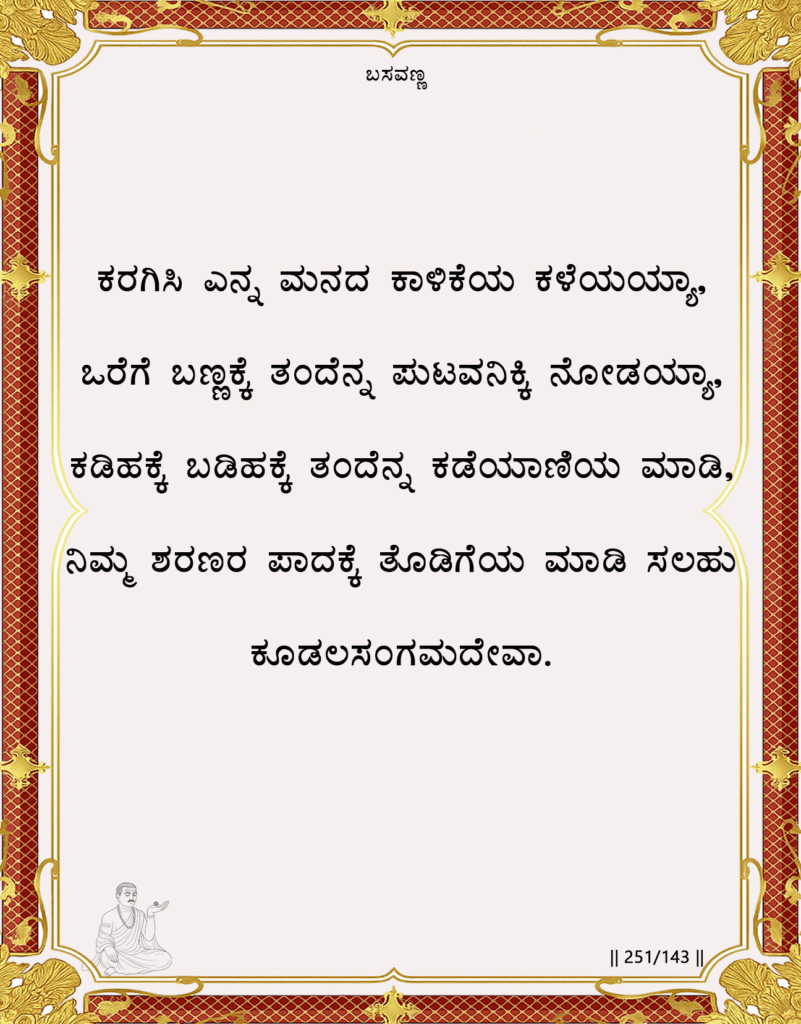
Burn away the darkness
from this mind of mine,
O Lordmelt me clean.
Heat me again in Your crucible,
refine me to the true measure of gold.
Break me, beat me,
purify every flaw within
until I shine as the highest carat,
an ornament worthy
to rest upon the feet of Your Sharanas,
O Koodalasangamadeva.
This vachana likens spiritual transformation to the intense process of metal purification. Basavanna asks not for comfort but for the Divine’s fierce graceto melt, heat, break, and shape him until every trace of impurity is burned away. True devotion, he teaches, requires complete surrender to this inner alchemy. Only when the ego is shattered and the mind fully refined can a person become an ornament of truth, fit to serve and honor the enlightened ones, the Sharanas. The path to purity is not gentleit is a sacred forging.
Spiritual Context
Core Spiritual Principle: The highest form of prayer is a plea for total purification, even if the process is painful. Spiritual refinement is not a gentle polishing but a violent, alchemical transformation where the ego-structure must be broken down and remade.
Cosmic Reality Perspective: The Linga (Divine) is the transcendent fire of consciousness (Tapas) that burns away all illusion. The path of Shivayoga is one of tapasya (austerity), where the individual soul (Anga) willingly subjects itself to this divine fire to have its dross removed, revealing its true, golden nature (the Atman, one with Shiva).
Historical Reality (Anubhava Mantapa Context): This Vachana captures the revolutionary spirit of the movement. It is not a passive, devotional surrender but an active, demanding call for inner revolution. It forges individuals strong enough to break social chains and pure enough to build a new society based on spiritual merit, not birth.
Interpretation
“Burn away the darkness… melt me clean.”: The “darkness” is ignorance (avidya) and the latent impressions (vasanas) that cloud the mind. “Melting” signifies the dissolution of all solidified egoic structures, reducing the self to a formless, malleable state of pure potential.
“Heat me again in Your crucible…”: The “crucible” is the challenging circumstances of life, seen as a sacred container designed by grace. “Again” indicates that this is not a one-time event but a repeated process of testing and strengthening.
“Break me, beat me, purify every flaw within…”: This is the essence of the prayer. “Breaking” is the shattering of pride and self-will. “Beating” is the hammering out of inconsistencies and weaknesses. The seeker invites the blows of life as a divine instrument.
“An ornament worthy to rest upon the feet of Your Sharanas…”: The final goal is not personal liberation for its own sake, but to become a thing of beauty and utility in the divine economy. The highest purpose of a purified self is to serve (Dasoha) those who are fully realized.
Practical Implications: The seeker learns to reframe all life’s difficultiespain, loss, failureas part of the divine forging process. The practice is one of joyful endurance and conscious surrender to whatever breaks the ego, trusting it is the hand of the Divine Blacksmith at work.
The Cosmic Reality
Anga (Human Dimension): The raw, unrefined metal of the individual self, full of impurities (desires, fears, arrogance). It is the material to be worked upon.
Linga (Divine Principle): Koodalasangamadeva as the Master Alchemist the fire, the forge, the hammer, and the ideal of pure gold itself.
Jangama (Dynamic Interaction): The dynamic is the transformative process itself. It is the painful, loving engagement where the Linga acts upon the Anga. The resulting “ornament” is then offered back to the Jangama (the Sharanas), completing the cycle of grace.
Shatsthala
Primary Sthala: Maheshwara. This Vachana is a perfect expression of the Maheshwara stage, which is defined by this intense, purificatory tapas. The entire process of burning, melting, and beating is the work of this stage.
Supporting Sthala: Prasadi The stated goal to become an ornament for the Sharanas is the very definition of Dasoha. This shows that the intense purification of Maheshwara is not an end in itself, but a preparation for the highest form of service.
Practical Integration
Arivu (Awareness Practices): In meditation, visualize yourself as a piece of metal in a divine forge. With each breath, feel the fire of awareness burning away impurities and the hammer of mindfulness shaping you. Welcome the process.
Achara (Personal Discipline): Embrace austerity. Voluntarily take on disciplines that “break” your comfort zones and habitual patterns. Practice accepting criticism and hardship as part of your training.
Kayaka (Sacred Action): Let your work be the anvil upon which you are shaped. Embrace the challenges and pressures of your duty as the “beating” that strengthens your character and purifies your motives.
Dasoha (Communal Offering): Actively seek out the most humble, demanding forms of service within your community. Offer yourself to the Sharanas (the wise) as an instrument, trusting that through serving them, the final stages of your forging will be completed.
Modern Application
A culture of comfort, avoidance of pain, and the pursuit of a “stress-free” life that leads to spiritual softness and a weak character. The therapeutic language of “self-care” can sometimes be used to avoid necessary growth.
This Vachana is an antidote to spiritual complacency. It re-frames suffering as sacred and necessary. It calls for a spirituality of resilience, strength, and profound transformation, where one actively asks for the challenges that will forge them into a person of depth, character, and genuine service.
Essence
Not solace, but the sacred flame,
To burn my falsehood, stake my claim.
Break, beat, and shape me, make me new,
A tool for God, both sharp and true.
The Deeper Pattern (The Subtle Body): This Vachana describes a conscious Entropy Reduction process. The egoic self is a high-entropy systema state of disordered potential and illusion (maya) where consciousness is trapped identifying with fragmented, transient forms. The divine forge is the application of conscious work to dismantle this illusion. The “fire” adds the energy of awareness to break the bonds of false identification, the “beating” is the consistent application of discipline to re-order consciousness, and the “shaping” creates a low-entropy, coherent vessel. The seeker willingly submits to this process not just to reduce disorder, but to shatter the illusion of separateness (maya) and be reconfigured as a purified instrument for a higher purpose.
In Simple Terms (The Gross Body): A sculptor doesn’t create a statue by gently sprinkling marble dust on a pedestal. They take a rough, chaotic blockwhich appears to be just a rockand aggressively cut, hammer, and chisel away everything that isn’t the masterpiece within. Basavanna is the block of marble, crying out to the Divine Sculptor: “See through my illusory form! Cut away the stone of my ego until the true image You see is all that remains, ready to be used for Your sacred work!”
The Human Truth (The Causal Body): The most profound growth often feels like destruction. To become who you are meant to be, you must surrender everything you currently think you are. The path to true strength and beauty requires being broken open not for your own sake, but to be remade as an instrument of a purpose greater than yourself. The greatest courage is to willingly hand yourself over to the fire that will burn away the illusion of a separate self, leaving only a tool fit for the divine hand.

Views: 17