Poetic Rendering

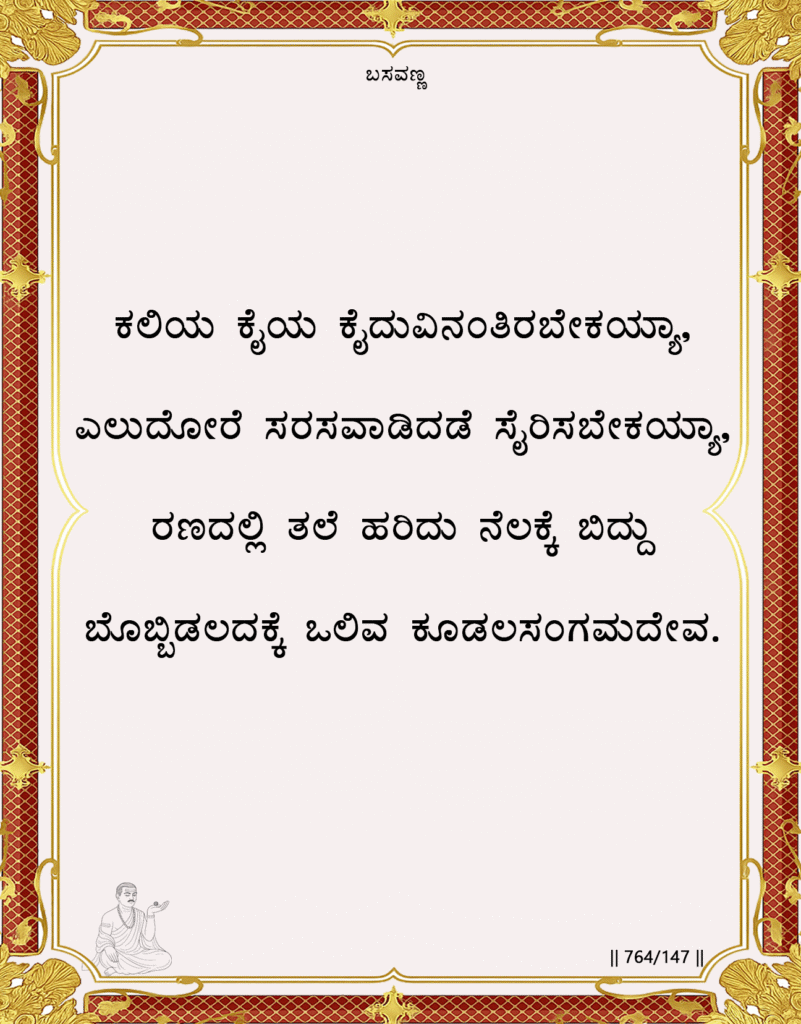
Let me hold my devotion
as a warrior holds his sword
unfaltering, unyielding.
Though my very bones may rattle
and the body falter on the path,
still let my resolve not break.
And if in this battle of life
my head itself should fall,
may my last breath cry only Your name,
O Koodalasangamadeva!
Basavanna compares spiritual effort to the fierce courage of a warrior. Devotion must be firm, unwavering, and held with the grip of one who enters battle without fear. Even when the body weakens or death approaches, the true devotee remains steadfast. The vachana declares that the ultimate victory is to let one’s final breath be a surrender to the Divine.
Spiritual Context
Core Spiritual Principle: The path to the Divine is a battlefield against the inner forces of doubt, distraction, and mortality itself. True devotion is not passive sentiment but an active, fierce resolve that must be maintained with the courage of a warrior until the very end.
Cosmic Reality Perspective: In the non-dual struggle of Lingayoga, the individual soul (Anga) is locked in combat with its own illusory separation (Maya). The Linga is both the armor and the battle-standard. Victory is not the survival of the body, but the utter dissolution of the ego (the “falling head”) in the final, conscious remembrance of the Divinea death that is the ultimate liberation (Aikya).
Historical Reality (Anubhava Mantapa Context): This Vachana captures the revolutionary spirit of the Sharanas, who were spiritual warriors fighting against the entrenched social and religious orthodoxy. It provided the ethical and emotional strength to face persecution and ridicule, framing their struggle not as a social protest but as a divine battle demanding total commitment.
Interpretation
“Let me hold my devotion as a warrior holds his sword…”: The “sword” is the weapon of discrimination (viveka) and the practice of constant remembrance (smarana). A warrior’s grip is singular, focused, and ready for use at any moment. This is the ideal state of spiritual preparedness.
“Though my very bones may rattle… still let my resolve not break.”: This acknowledges the reality of the struggle. The “rattling bones” represent the deepest levels of fear, physical suffering, and existential anxiety. The prayer is for the core of one’s being (the resolve) to remain intact even when the physical and psychological structures are shaken to their foundation.
“And if in this battle… my head itself should fall, may my last breath cry only Your name…”: This is the ultimate expression of surrender and victory. The “falling head” is the death of the ego, the final surrender of the identity that says “I am the devotee.” The goal is to make the process of death itself an act of worship, ensuring that the final conscious thought is of God, which is said to determine the soul’s next state. This is the warrior’s final, triumphant strike.
Practical Implications: The seeker is called to cultivate a disciplined, courageous approach to spirituality. Practice is not for comfort but for forging an unbreakable will. One must train the mind to turn to God not only in peace but especially in pain, failure, and the face of death.
The Cosmic Reality
Anga (Human Dimension): The spiritual warriorthe body that may falter, the mind that may know fear, but the will that is consecrated to a single purpose.
Linga (Divine Principle): Koodalasangamadeva as the ultimate source of strength and the sacred vow itself. The Name is the battle cry and the essence of the resolve.
Jangama (Dynamic Interaction): The fierce, moment-to-moment application of devotion amidst the chaos of life. It is the living act of holding the sword, standing firm when bones rattle, and uttering the Name with the final breath. This dynamic perseverance is the Jangama.
Shatsthala
Primary Sthala: Sharana. The Sharana is defined by this unwavering stance of taking refuge. The Vachana is a prayer to embody the highest ideal of a Sharana: one whose refuge is absolute, final, and triumphant over life and death.
Supporting Sthala: Aikya. The final cry of the Name with the last breath is the moment of ultimate union (Aikya). The entire battle of the Sharana is fought to achieve this victorious end.
Practical Integration
Arivu (Awareness Practices): Practice mindfulness with the attitude of a sentry on guard. Watch for the “enemy” forces of distraction, doubt, and fear. Use the mantra as your sword to cut them down the moment they arise.
Achara (Personal Discipline): Cultivate a disciplined life. Embrace challenges as training to strengthen your resolve. Practice doing what is right, not what is easy, thereby forging a warrior’s character.
Kayaka (Sacred Action): Perform your duty as your field of battle. Fight against laziness, incompetence, and dishonesty in your work. Let your labor be an expression of your unwavering commitment to truth.
Dasoha (Communal Offering): Stand firm for the community. Be a pillar that others can rely on in times of trouble. The warrior’s resolve is not just for personal salvation but for the protection and strength of the entire Sangha.
Modern Application
Spiritual passivity, a victim mentality, and a culture that avoids discomfort and commitment. The tendency to abandon spiritual practice at the first sign of difficulty or existential distress.
This Vachana is a call to spiritual arms. It provides a powerful archetype for the modern seeker: the Warrior of Awareness. It teaches that to navigate a chaotic world, one needs not just mindfulness, but mindfulness with resolvethe courage to hold fast to one’s values and inner truth against all odds, transforming life’s battles into a path of heroic self-transcendence.
Essence
A sword-like grip on faith’s own blade,
A vow that will not be unmade.
Though bone and breath and life may part,
Your Name alone, my dying heart.
The Deeper Pattern (The Subtle Body): This Vachana describes the physics of Consciousness Under Entropic Collapse. The “battle of life” is the universal slide towards entropydecay, distraction, and dissolution. The warrior’s resolve is the application of a negentropic force, a conscious ordering of energy (attention, will) against this flow. The final moment of death is the point of maximum entropic pull, where the system (the body-mind) disintegrates. The cry of the
Name is a final, conscious act of information transfer, imprinting the fundamental pattern of the Divine (Linga) onto the dissolving consciousness, thereby ensuring that the collapse results not in chaos, but in a reintegration into the source of all order.
In Simple Terms (The Gross Body): A star, under the immense pressure of its own gravity, can collapse into a black hole (entropy wins) or, if it has sufficient mass and integrity, explode in a supernova, scattering the elements of new life across the cosmos. The warrior-devotee is that massive star. The trials of life are the crushing gravity. The unwavering resolve is the internal nuclear fire that refuses to be extinguished. The final cry of the Name is the supernovaa glorious, conscious death that seeds liberation.
The Human Truth (The Causal Body): The measure of your life is not what you gain, but what you hold onto when everything else is taken away. Your deepest commitment is your true self. Cultivate that one thing so fiercely that even death becomes its servant, merely delivering you into the heart of what you loved most.

Views: 7