The Voice of Living Awareness
Anubhava Mantapa
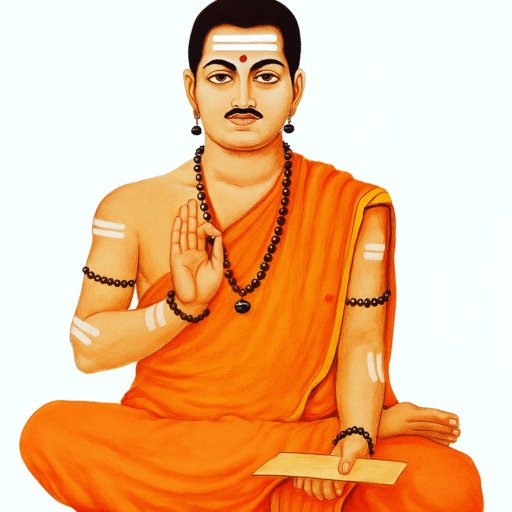
In the 12th century, amidst the courts and conflicts of Karnataka, arose a voice fearless, tender, and vast Basavanna, the saint of experience and equality. He did not write scriptures. He spoke in the rhythm of breath, in the idiom of life. His utterances, the Vachanas, were not mere poems they were living sparks of realization, short, plain, image-filled truths that broke ritual, pierced illusion, and turned devotion into direct awareness. Each Vachana was meant not to be read, but spoken, sung, and lived. It was an oral mirror for farmers, weavers, mystics, and rulers alike reflecting a way of life where God was not in stone, but in the human heart. Basavanna’s vision was radical then, revolutionary now, and eternal in its essence for he spoke not of doctrines, but of consciousness; not of heavens, but of how to live here, today, as awareness and compassion.
A Philosophical Anchor
The idea of utopia has been following humanity like a shadow for thousands of years. But somehow it got mixed up with the changing of society; the individual never got looked at. The individual is the root cause of all the problems but because the individual seems to be so small and the society seems so big, people think that we can change society, and then the individuals will change.
This is not going to be so because “society” is only a word; there are only individuals, there is no society. The society has no soul you cannot change anything in it. You can change only the individual, howsoever small he appears. And once you know the science of how to change the individual, it is applicable to all the individuals everywhere.
It is precisely this “science of the individual” that Basavanna presents. His Vachanas are not a blueprint for a perfect society, but a precise methodology for the inner transformation of the human being. He begins with the root the individual consciousness knowing that a harmonious world is the natural flowering of awakened individuals.
A Vachana for All Times
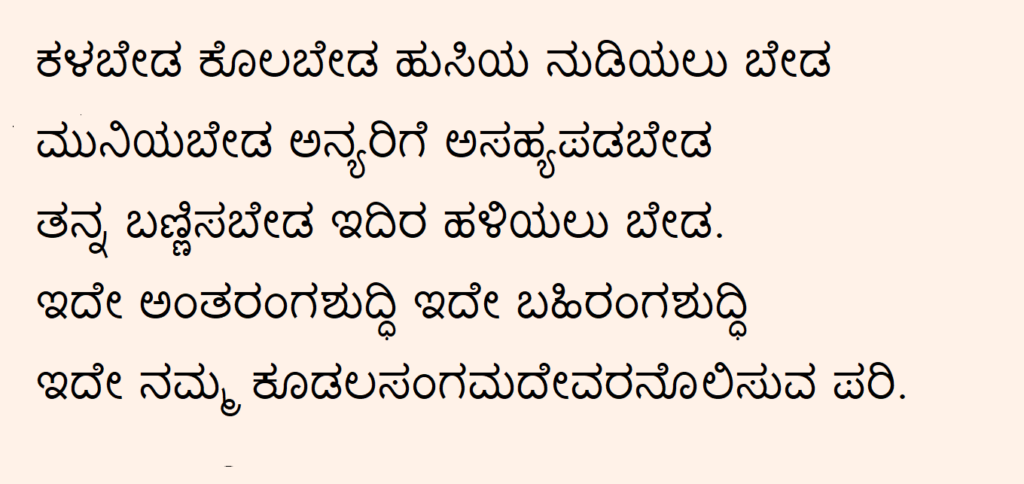
English Rendering
Steal not. Kill not.
Speak not falsehood.
Be not angry.
Do not despise others.
Do not boast of yourself.
Do not live in deceit.
This is inner purity.
This is outer purity.
This is the way to reach our Lord, Kudalasangama Deva.
Meaning and Timeless Relevance
In these few lines, Basavanna distills the essence of human conduct a code not born from fear or law, but from awakened conscience.
“Steal not” not just from others, but from your own integrity.
“Kill not” not merely bodies, but also not the truth within another.
“Speak not falsehood” for words shape the soul.
“Be not angry” for anger clouds clarity.
“Despise none” for the same life breath flows through all.
“Boast not” for ego hides the light.
“Live not in deceit” for self-deception is the first fall.
These are not commandments. They are realizations in motion the natural qualities that bloom when one lives in awareness. If these few lines were lived, humanity itself would rise into an utopian harmony a world where religion is compassion, and society breathes in truth and equality. This, Basavanna says, is the inner and outer purity the cleansing of both thought and action. And when this purity shines, the Divine need not be sought it reveals itself within.
The Way Forward For any individual wishing to understand Basavanna more deeply, this is where the journey begins: From this foundation of inner honesty, one may proceed into the unfolding stages of realization
Anga, Linga, Jangama Arivu, Āchāra, Kayaka, Dāsoha and finally, the Sixfold Evolution of Awareness, the Shata Sthala.
Basavanna’s voice still speaks not from the past, but from within us. Each Vachana is a mirror, inviting us to live as living truth.
The Foundational Inquiry “Who Am I?”
Basava Dharma – The Direct Path to Awakened Living
Every journey of awakening begins not with belief, but with a question a question that dissolves illusion: “Who am I?” We master the outer world our trades, our crafts, our knowledge yet remain strangers to our own essence. Basavanna calls the seeker back from the periphery to the center, from noise to knowing.
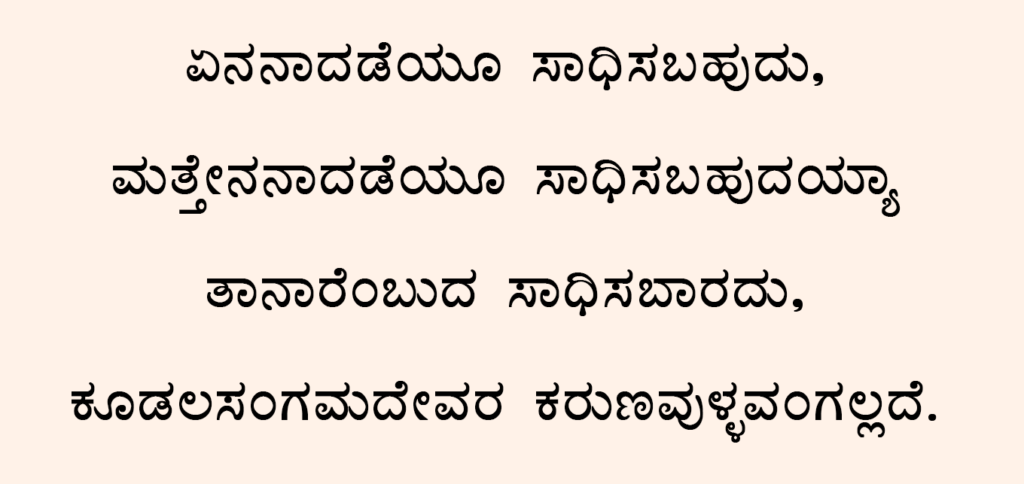
English Rendering
“One may master this, one may master that,
yet who can master the truth: ‘Who am I?’
None, unless blessed by the compassion
of Koodalasangama Deva.”
In his Vachana, Basavanna points to the core movement of Basava Dharma: self-inquiry joined with grace. Worldly skill, however refined, cannot unveil the Self; only an open heart can reflect its own light.
Basava Dharma begins not by rejecting the world but by purifying perception. This inquiry “Who am I?” is not a philosophical riddle; it is a living mirror. The question itself burns away pretense, revealing the silent witness within.
Direct Outcome
1. Ego Dissolution: Continuous reflection loosens the grip of identity and pride.
2. Humility and Grace: True learning begins where the sense of mastery ends.
3. Birth of Awareness: The seeker becomes alert, discerning between what is transient and what is timeless.
Thus, the path begins not with external discipline but with a turning inward a single question that transforms life into pilgrimage.
The Turning From Self to Service
The Cosmic Vision – The Universe as a Tapestry of Divine Joy
Once the seeker glimpses the light within, Basavanna expands that awareness outward to the vastness of existence itself. What appears as countless forms and beings is revealed as a seamless fabric woven from Divine Love.
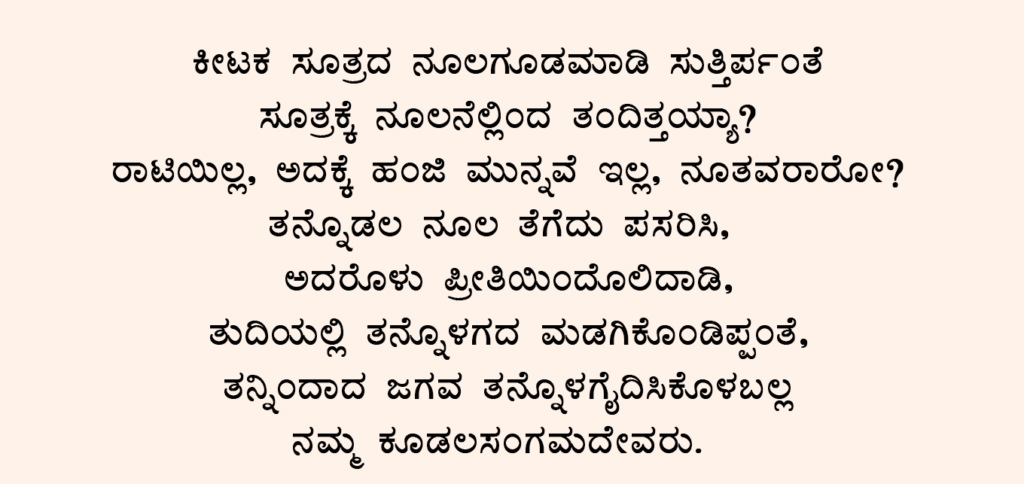
English Rendering
“The universe is spun from the joy of God,
like the silkworm that weaves its own cocoon without a loom or weaver.
Souls are threads of that joy each shining, each alive.”
In his Vachana, Basavanna illustrates that the universe is spun from the joy of God, with souls as threads of that joy.
The Vision : There is no external creator manipulating matter from afar. The cosmos is the Divine expressing Itself consciousness unfolding into form. To awaken is to realize that there was never separation.
Spiritual Context : Basavanna’s vision transforms the way one perceives the world. The awakened one does not withdraw from the world; they participate in it consciously, seeing every act as part of the Divine play.
Direct Outcome
1. Reverence for All Life: Seeing the universe as sacred dissolves judgment and hierarchy.
2. Sacred Work: Ordinary labor becomes holy when recognized as part of the cosmic fabric.
3. Joyful Participation: Life ceases to feel accidental or burdensome.
4. Alignment with the Whole: Competition gives way to collaboration, and conflict transforms into compassion.
Summary : The realization of unity redefines existence itself. Life is no longer a pursuit of heaven elsewhere but the conscious participation in Divine Creativity here and now.
From Self-Inquiry to Social Awakening : When the seeker discovers the light within, a natural transformation follows the awakening of conscience in daily life. This marks the transition from personal enlightenment to social flowering. It is here that his moral revolution begins where heaven and hell are no longer distant destinations, but immediate reflections of how truth and awareness are lived.
The Receiving Grace Becomes Life
The Moral Revolution: Heaven and Hell Are Present States
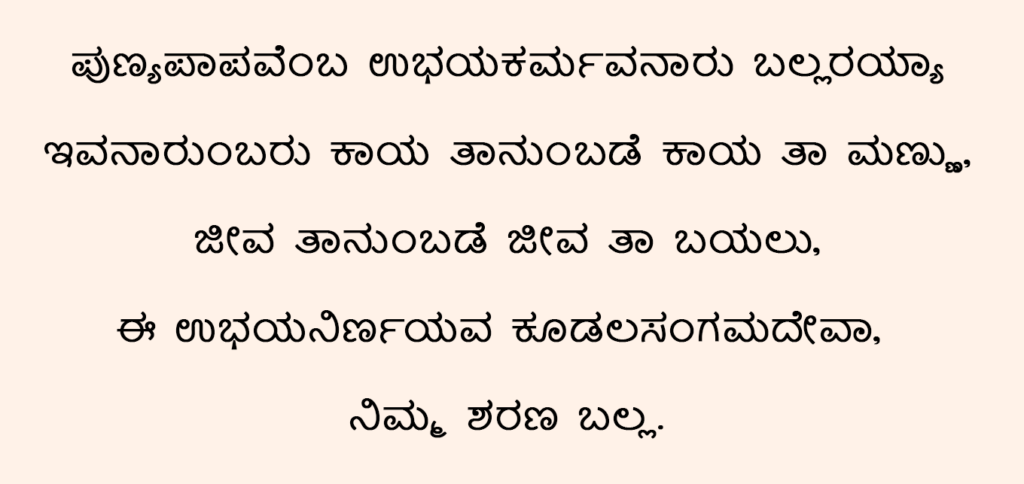
English Rendering
“Who can truly know what is sin and what is virtue,
O Lord? When the body belongs to earth and the soul to the open sky,
who can judge between them?
Only Your true devotee, O Kudalasangama Deva,
sees beyond both and rests in You.”
Basavanna executes a radical paradigm shift, transforming the concepts of heaven and hell from distant metaphysical realms into present states of awareness within daily living. In his Dharma, heaven and hell are not rewards or punishments reserved for the dead; they are psychological, ethical, and social realities experienced here and now.
Foundational Insight : In a foundational Vachana, Basavanna dissolves the idea of eternal reward or punishment. Heaven and hell, therefore, are not external realities but inner conditions created by one’s own actions and awareness.
The Defining Vachana :
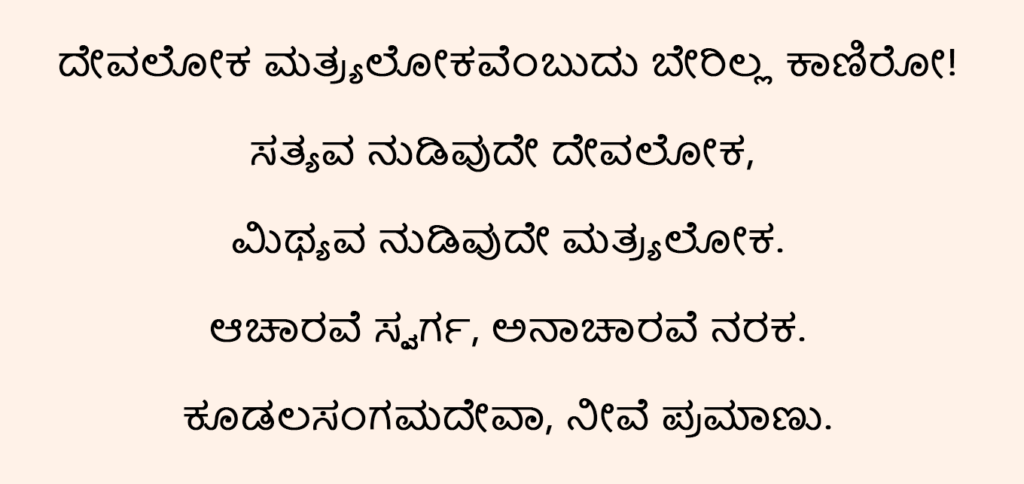
English Rendering
“There is no difference between heaven and the mortal world, my friends!
Speaking the truth is heaven; speaking falsehood is the mortal world.
Right conduct is heaven; wrong conduct is hell.
Kudalasangamadeva,
You are the ultimate witness.”
In his defining Vachana, Basavanna declares that heaven and the mortal world are not different realms; truthfulness is heaven and falsehood is the mortal world; right conduct is heaven and wrong conduct is hell; and Kudalasangamadeva is the ultimate witness.
Spiritual Context and Direct Understanding : Basavanna brings heaven and hell into direct immediacy. When one speaks truth and acts rightly, heaven unfolds in that very moment. This marks the moral revolution of Basava Dharma.
The Vachana is explained through its core themes: It erases the boundary between heaven and the world, showing they are different levels of consciousness. It defines truth as alignment with inner awareness, and falsehood as distortion. It establishes that right conduct arises from awareness, and wrong conduct from a clouded mind. It concludes by anchoring ethics in the Divine as the inner witness, making morality spontaneous.
This Vachana integrates seamlessly with Basavanna’s core directives Arivu (Awareness), Āchāra (Discipline), Kayaka (Sacred Work), and Dāsoha (Offering). When these principles are lived, society itself becomes a reflection of heaven.
In the modern context, Basavanna’s teaching holds timeless relevance. A truthful individual lives without fear this is heaven in the mind. Conversely, falsehood immediately generates hellish conditions.
The Final Understanding : Heaven and hell are not destinations beyond death; they are the living realities of one’s present awareness, speech, and conduct. Truth is heaven. Falsehood is hell. Right conduct is heaven. Wrong conduct is hell. Kudalasangamadeva is the witness within all. Heaven is not to be reached; it is to be lived.
The Joining Breath as Bridge
The Practical Path – Anga, Linga, Jangama and the Four Directives
After establishing the moral foundation, Basavanna brings spirituality down from abstraction into direct daily experience. This practical path is built on the triadic realization of Anga, Linga, and Jangama, supported by four directives: Arivu, Āchāra, Kayaka, and Dāsoha.
1. Anga – The Living Body as the Field of Awareness
Anga means the body the living instrument of realization. The body is sacred, for it is the very field where awareness, discipline, and service manifest.
2. Linga – The Symbol of Inner Divinity
The Linga is the visible reminder of the invisible awareness within. Worship is done through the offering of one’s own awareness, work, and love.
3. Jangama – The Living Manifestation of Truth
The Jangama is the living embodiment of awareness anyone who has awakened to the truth of unity. Basavanna’s triad forms a dynamic circuit: Anga is the field, Linga is the center, Jangama is the expression.
The Four Directives: The Living Framework
1. Arivu (Awareness): The root of all transformation. It is the light that reveals unity.
2. Āchāra (Right Conduct): Awareness expressing itself as natural discipline.
3. Kayaka (Sacred Work): The sanctification of labor. “Kayakave Kailasa” “Work itself is heaven.”
4. Dāsoha (Offering / Sharing): The act of sharing the fruits of Kayaka with others in gratitude.
Integration of the Path : The union of the triad and the four directives forms the complete sādhana of Basava Dharma. It is a circle of continuous realization. When lived fully, this path transforms every aspect of life.
The Living Outcome: A society that lives this path experiences spontaneous order. This living revolution naturally evolves toward the deeper realization of Śhata-sthala.
The Surrender Living as Offering
The Śhata Sthala – The Sixfold Evolution of Awareness
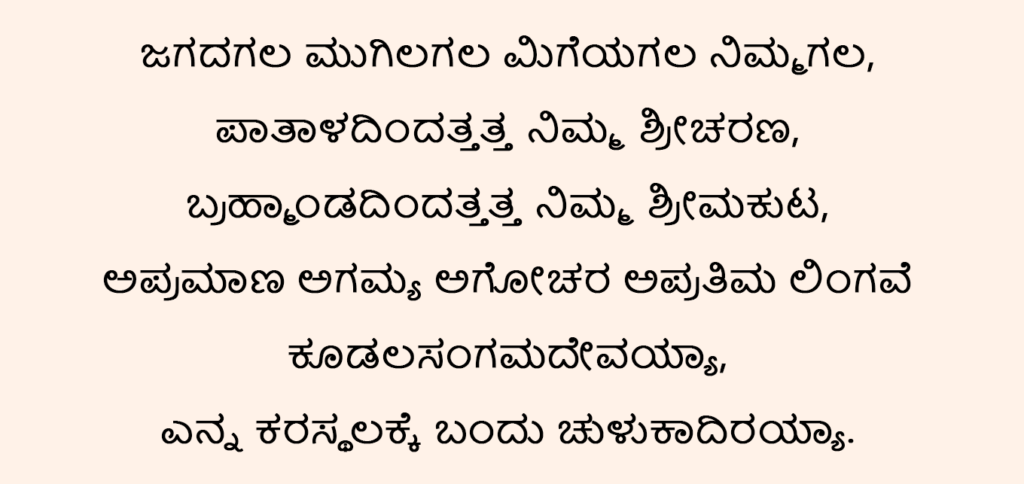
“The vast expanse of sky, the unseen cosmic veil
Your presence fills the heavens.
Your feet reach the depths, Your crown graces the cosmos.
Infinite, unfathomable, unseen, and beyond measure,
O Kudalasangama Deva
in my palm You now reside, a living light,
revealing Your presence both day and night.”
Having laid the foundation, Basavanna opens the next gateway of realization the progressive unfolding of awareness known as Śhata Sthala. It is a living map of inner maturation from devotion to union.
1. Bhakta Sthala The Ear That Awakens
The journey begins in devotion. The Bhakta opens to the call of the Divine through love and longing.
2. Maheshwara Sthala The Eye That Recognizes
Awareness deepens; one begins to recognize the sacred in every form and face.
3. Prasādi Sthala The Body That Serves
Devotion and vision mature into selfless action. Work is performed as a sacred offering.
4. Prāṇaliṅgi Sthala The Palm-Linga: Micro ↔ Macro Awareness
Awareness deepens into the rhythm of breath itself. The life-force becomes the direct bridge to Divine consciousness.
5. Śharaṇa Sthala -The Surrendered Life
The individual “I” begins to dissolve into the greater “We.” The Sharana lives through love, transparency, and service.
6. Aikya Sthala – The State of Union
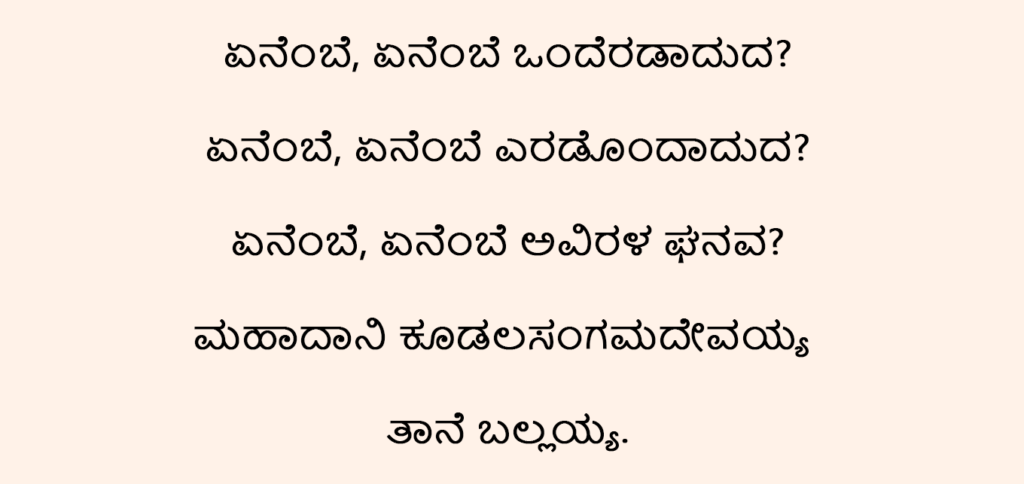
English rendering
“What is this, what is this how does one become two?
What is this, what is this how do two become one?
What is this, what is this the seamless, unbroken whole?
Only You, O great giver, Kudalasangama Deva, know this mystery in full.”
This is the flowering of the entire path. All dualities dissolve into one indivisible awareness. The seeker awakens to the timeless truth: there was never two only One Awareness.
From Bhakta to Aikya, the six stages are six petals of one unfolding flower. This is the complete flowering of Basava Dharma a way of being to be lived.
The Union – Only One Remains
The Ultimate Realization The Śharaṇa as Primordial Awareness
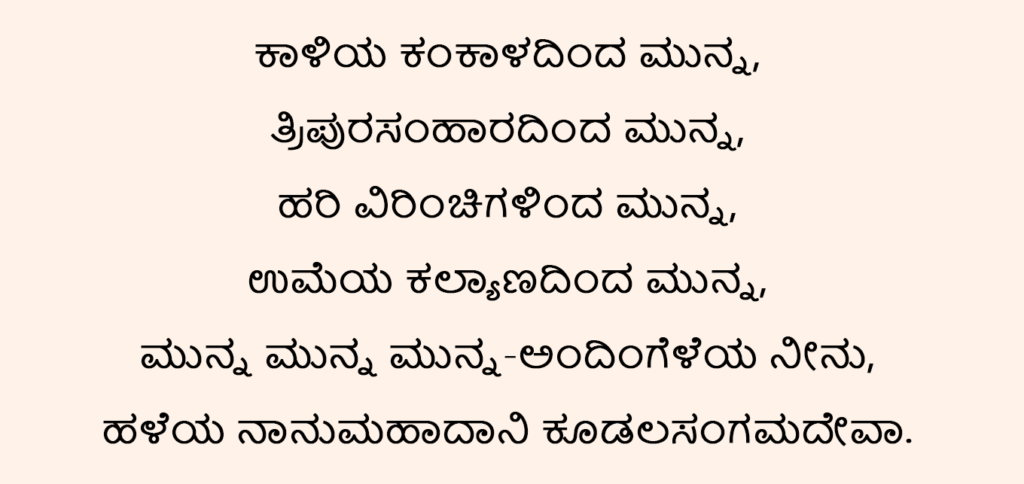
English rendering
“Before Time had bones,
Before the destruction of the three cities,
Before Vishnu and Brahma were born,
Before the divine wedding of Uma
Before all beginnings
You were the Ancient One,
And I, Your eternal companion, O Mahādāni Kudalasangamadeva.”
The culmination of Basavanna’s path is the direct realization of the Śharaṇa, the one who has awakened to the truth of being itself.
1. The Eternal Witness Awareness Before Creation
In a profound Vachana, Basavanna speaks as awareness itself the primordial witness that existed before creation. This is the revelation that ends all seeking.
2. The Transformation of Identity
As awareness matures, identity shifts completely. The Śharaṇa is not becoming divine he awakens to what has always been true.
3. The Śharaṇa as Living Consciousness
The Śharaṇa lives in complete alignment with the triadic vision and the four directives. Their life itself becomes a living scripture.
4. The Dissolution of Duality – The End of Fear and Desire
The Śharaṇa has transcended dualities. Heaven and hell are seen as internal states. The Śharaṇa lives in unbroken peace.
5. The Śharaṇa as the Fulfillment of Cosmic Purpose
The Śharaṇa is the thread that has recognized its luminous origin. The realization, “You yourself are God,” is humility in its highest form.
6. Living Liberation – The Śharaṇa as Jeevanmukta
Basavanna brings the ideal of Jeevan Mukti liberation while living into the heart of ordinary life.
7. The Final Revelation – The Infinite Within the Finite
The Śharaṇa realizes that there was never a journey at all only awakening from forgetfulness.
The Living Legacy Heaven on Earth : When the insights of Basava Dharma are lived collectively, then heaven and earth are no longer separate. The world itself becomes Kailāsa. This is the complete fulfillment of Basavanna’s vision. Thus the circle of Basava Dharma begins The Direct Path to Awakened Living.
Dedication & Gratitude
Every act of remembrance is an offering every word a return to the Source.
Search, Reach, and the Power of Poetry
Every seeker can now explore the Sounds of Basava App searching for words, emotions, or states of being, and discovering the corresponding Vachana.
For deeper outreach and spiritual resonance, we continue to share poetic renderings
because while literal translation informs, poetic rendering transforms. It touches the heart where logic cannot reach. This care preserves the essence preventing the “loss by relay,” the fading of meaning across tongues and time. It keeps Basavanna’s light undiminished pure, resonant, and alive in every ear that listens.
This App, and all that it holds, is lovingly dedicated to my late father Shri Somanathappa Basvannappa Khuba. It was he who first sowed this seed within us. He taught us a simple, enduring truth: “Live your life here and now, without being a burden on society. Earn what you need to live and another measure to stand strong. And once you have enough give back. Serve the society that sustains you.” These words became the compass of this work the guiding ethic behind Sounds of Basava.
With Gratitude: The Heart Behind Sounds of Basava I offer my deepest thanks to:
Dr. Arvind Jatti of the Basava Samithi inspired me to undertake this work. Dr. Veeranna Dande’s book, Basva Vachana for the Commoners, provided essential clarity. I am also indebted to my revered teacher, Shri Uddanadayya H K of Kalaburgi, whose guidance continues to deepen my understanding of Old Kannada.
My gratitude extends to Shri Bapu Padmanabh, with whom I worked closely on the project “Angadinda Lingada Kadege,” a collaboration that gave me profound insight into the living sounds of Basava.
My heartfelt thanks to Smt. Mamatha S. N. from Bangalore, who, with devotion and grace, read and sang all 432 Vachanas in Kannada, offering her service selflessly and wholeheartedly, without expectation of any kind. May Basavanna bless her.
My heartfelt gratitude to Shri Mallikarjuna H. Rao, who developed this software and gave sacred form to this vision. Working day and night with unwavering devotion and without expectation of any kind, he completed this project solely out of reverence for Basavanna. I offer my sincere thanks and pray that Basavanna bless him with peace and happiness.
To Shri Pha Gu Halkatti, who collected and preserved these Vachanas, ensuring that the voice of Basavanna could echo once more in our age my deepest reverence.
To my mother, Dr. Vilasvathi Somanathappa Khuba, who offered her life in service to Basavanna’s work. Her unwavering commitment shines as a steady flame on this sacred path. Through her boundless compassion and support—embracing not only her son but the entire community—she has come to be lovingly known as “Awwa.”
To my sister Shrimati Mahadevi Prasad, my elder brother Shri Allamaprabhu, and to all my family members who have supported me with patience, faith, and quiet strength
I thank you with all my heart. And above all
I bow in gratitude to
Basavanna himself.
For it is he who granted me the vision to hear, the strength to serve,
and the humility to understand.
I have tried, with all sincerity, to bring forth the essence
that Basavanna would have wished to convey
then, and now to every heart that still listens.
Shri Rajendra Somanathappa Khuba
Kalaburgi, Karnataka, India
Website: www.khuba.in
Disclaimer
Sounds of Basava
The interpretations, explanations, and poetic renderings presented in the Sounds of Basava project including the explanations of all 432 Vachanas are offered as personal reflections based on the compiler’s individual study, contemplation, and understanding.
They represent one seeker’s perspective and are not intended to be definitive, doctrinal, or institutional interpretations of Basavanna’s teachings.
Each Vachana is a vast, multi-layered utterance that can be understood through different dimensions spiritual, poetic, philosophical, ethical, or social depending upon the seeker’s depth, intent, and inner readiness.
The views expressed here are, therefore, limited to my own thoughts and capacity for expression, and should be read in that spirit of personal reflection and devotion.
This work has been created independently, without affiliation to or endorsement from any religious, governmental, or academic body.
It is intended purely as a spiritual, cultural, and educational resource to help individuals understand, reflect upon, and apply the universal values embodied in Basavanna’s teachings.
Those seeking deeper guidance in Lingayoga, Shivayoga, or other traditional aspects of Basava philosophy are encouraged to consult qualified teachers or spiritual mentors within their respective traditions.
Researchers and scholars pursuing linguistic, historical, or philosophical study may refer to recognized institutions and organizations dedicated to Vachana Sahitya and Basava studies.
This project is not intended to promote, convert, or influence religious identity in any way.
The essence of Basavanna’s message Kayaka, Dasoha, Arivu, and the realization of the Divine within is universal in nature and may be embraced by individuals of any faith, culture, or background as a path of ethical living and inner awareness.
While every effort has been made to ensure accuracy, authenticity, and respect for the original Kannada texts (as provided by Basava Samithi, Bangalore), the compiler disclaims all liability for any unintended errors, omissions, or misinterpretations that may arise in translation or contextual explanation.
By accessing or using the Sounds of Basava website or app, users acknowledge and accept that the content herein is for personal spiritual enrichment and educational exploration only, and that each individual bears full responsibility for how they interpret or apply these teachings in their own lives.
Sounds of Basava – Kalaburgi, Karnataka, India
Website: www.soundsofbasava.in
Views: 112