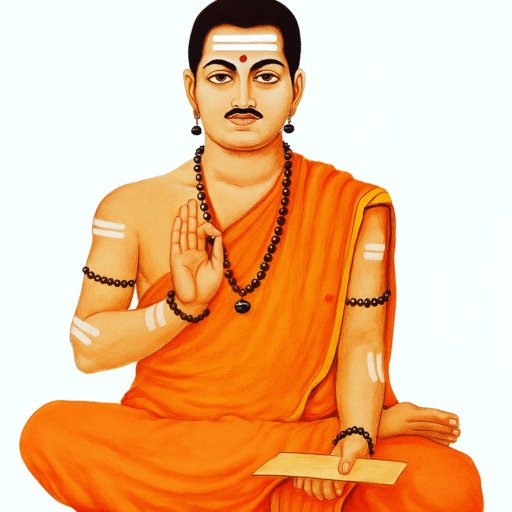

Poetic Rendering

They speak of eighty-four lakh forms
through which beings wander,
each carrying a different face,
each pursuing a different longing.
Search me, test me, question me, Lord
for if You Yourself do not ask,
what becomes of the ancient quest,
the lifetimes spent seeking Your truth?
In which form, with which face,
will You come to question me,
O Koodalasangamadeva?
Basavanna recalls the old belief that beings roam through 8.4 million forms in their search for God. Yet he turns this idea inside out. In the line “Search me, question me, Lordotherwise what becomes of the very quest the ancients lived and died for?” he challenges the very heart of spiritual striving. He suggests that human searching is incomplete until the Divine begins to seek the devotee in return. All the lifetimes of wandering, all the spiritual effort, all the ancient inquiriesreach fulfillment only when God’s glance meets the seeker’s longing.
Spiritual Context
Core Spiritual Principle: The spiritual journey is not a one-sided search but a divine romance. The culmination is not when the seeker finds God, but when the seeker realizes they have been found by God. The Lord’s questioning glance is the grace that awakens and completes the soul.
Cosmic Reality Perspective: This Vachana reveals the dynamic nature of non-duality. The Linga (Absolute) is not a static object to be found, but the very Subject, the primordial Seeker. The soul’s longing for God is, in truth, God’s own longing for the soul reflected within the finite being. The “84 lakh forms” are the myriad expressions of this one, divine search for Self-recognition.
Historical Reality (Anubhava Mantapa Context): This Vachana represents the pinnacle of the Lingangayoga experiential path. It moves beyond effortful practice (sadhana) to the state of receptive grace (Prasada). It democratizes the ultimate mystical experience, making it accessible not only to yogis but to any sincere heart that yearns for this divine reciprocity.
Interpretation
1. “eighty-four lakh forms… each pursuing a different longing.”: This describes the entirety of Samsarathe endless cycle of birth and death driven by unfulfilled desires. It frames all of existence itself as a grand, if unconscious, search for the Divine.
2. “Search me, test me, question me, Lord…”: This is the pivotal turn. Basavanna stops seeking and instead invites the Divine to seek him. This is the ultimate surrender, offering himself as the subject of God’s inquiry. The words “search,” “test,” and “question” imply a deep, intimate, and transformative engagement.
3. “if You Yourself do not ask, what becomes of the ancient quest…?”: This is a profound theological insight. It states that the seeker’s efforts, however ancient and rigorous, are ultimately incomplete without the responsive grace of the Divine. The quest finds its meaning only in the moment it is met and validated by its Object.
4. “In which form, with which face, will You come…?”: This is the final, loving anticipation. He is ready to recognize the Divine in any and every form it may choose to appear. This question dissolves all preconceptions of God, opening the devotee to the surprise of grace in the most unexpected moments and guises.
The Cosmic Reality
Anga (Human Dimension): The Anga has transitioned from a seeker to a “calling presence.” It is a vessel emptied of self-will, now filled only with the passionate anticipation of being found. It is the question waiting for its Answer.
Linga (Divine Principle): The Linga is the “Questioner.” It is dynamic, personal, and responsive. Koodalasangamadeva is not a distant ruler but an intimate lover who actively searches for the beloved soul, testing and questioning to awaken it to its true nature.
Jangama (Dynamic Interaction): The Jangama is the “divine encounter.” It is the sacred space where the Linga’s questioning glance meets the Anga’s receptive heart. This interaction is not a dialogue of words but a transformative resonance that shatters the illusion of separation, fulfilling the purpose of all lifetimes.
Shata Sthala
Primary Sthala: Pranalingi Sthala. This stage is defined by the Linga becoming one’s very life force (Prana). Basavanna’s prayer exemplifies this: he is not asking to possess the Linga, but for the Linga to actively possess and interrogate his entire being, thus becoming his life.
Supporting Sthala: Aikya Sthala (Stage of Union). The divine questioning he invites is the final process that incinerates the last vestiges of separation, leading directly into the non-dual union of the soul and God.
Practical Integration
Arivu (Awareness Practices): Shift your meditation from seeking God to listening for God. Sit in silence and cultivate the feeling of being looked for, known, and questioned by a loving, divine intelligence. Ask, “How are You seeking me today?”
Achara (Personal Discipline): The primary discipline is to live life as an open question. Approach every person, event, and challenge with the inner attitude: “Are You my questioner? Is this the form in which You are coming to me today?” This turns all of life into a potential site of divine encounter.
Kayaka (Sacred Action): Perform your work as an answer to a divine call. See your daily tasks not as your own pursuits, but as responses to the unspoken questions of the Linga manifesting as the needs of the world.
Dasoha (Communal Offering): Become a mirror of this divine seeking for others. By seeing and honoring the sacred longing in every person, you help create a community where everyone is recognized as a participant in this cosmic romance, a beloved being sought by the Divine.
Modern Application
Spiritual Burnout and the Tyranny of Self-Help. The modern seeker is often exhausted by the relentless pursuit of enlightenment, wellness, and self-improvement. This one-sided effort, devoid of a sense of grace or response, leads to fatigue, disillusionment, and a feeling that the universe is indifferent.
This Vachana offers liberation from the treadmill of spiritual achievement. It replaces striving with surrendered anticipation. It teaches that you are not alone in your search; the Universe is conscious and is actively seeking you out. This transforms the journey from a lonely pilgrimage into a joyful, mutual discovery, restoring wonder and easing the burden of the ego that thinks it must do everything itself.
Essence
Through countless forms, my longing grew,
A search that all creation knew.
But now the seeker’s role is done,
I wait for You to ask, to come.
O Question at my very core,
Seek me, and I shall be no more.
1. The Quantum Observer Effect of Grace: Just as in quantum physics the act of observation collapses a probability wave into a particle, the “glance” or “question” of the Divine Observer (Linga) collapses the soul’s wavefunction of wandering through “84 lakh forms” into the singular, realized state of “the found.” The soul’s journey is a superposition of all possible paths; divine grace is the measurement that selects the one true path home.
2. The Thermodynamics of the Quest: The ancient, one-sided search represents a system of high spiritual entropyenergy (seeking) scattered across countless lifetimes and forms without achieving its goal. The Divine’s responsive question is the injection of “negative entropy” or information that organizes this scattered energy, giving it direction and purpose, and culminating in the low-entropy state of ordered union.
3. Jangama as the Unitive Resonance: The functioning Jangama here is the state of symmetry between the soul’s call and God’s response. When the frequency of the soul’s longing perfectly matches the frequency of the Divine’s seeking, a resonant field is created. In this field, the distinction between the caller and the called dissolves. Basavanna is not praying to God; his prayer is the voice of God seeking God. This self-referential loop is the metaphysical structure of Aikya (Union), where the search, the seeker, and the sought are one.
Your deepest longing for love, meaning, and connection is not a sign of your lack, but an echo of a greater Longing that is seeking you. You are not a lonely pilgrim, but the beloved of the universe, being actively courted and called home. Stop straining to find the light; instead, open your eyes and discover that you are already being seen by it. The final step of the journey is to allow yourself to be found.

Views: 2