Poetic Rendering

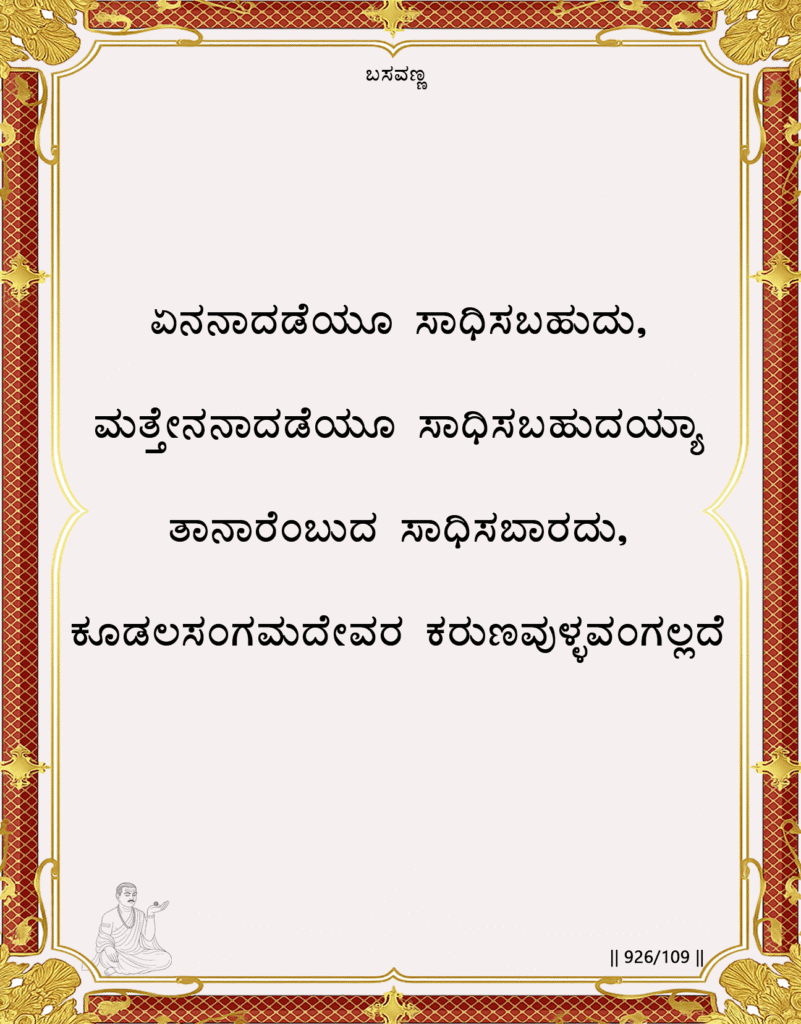
One may master this,
one may master that,
yet who can master the truth:
“Who am I?”
None, unless blessed
by the compassion of
Koodalasangamadeva.
vachana
Spiritual Context
Core Spiritual Principle: The final and most subtle obstacle on the path is the ego’s belief that it can achieve self-realization through its own effort. The ultimate truth, “Who am I?”, is not a puzzle to be solved by the mind but a state to be revealed when the mind’s activity, including its striving for mastery, ceases through grace.
Cosmic Reality Perspective: The Linga is the non-dual Self. The question “Who am I?” arises from the Aṅga under the illusion of separation. The Linga does not answer this question; its grace reveals that the question itself was based on a false premise. The seeker realizes they are, and always have been, the Linga itself.
Historical Reality (Anubhava Mantapa Context): This Vachana is the ultimate safeguard against spiritual hierarchy and pride within the community. It ensures that no scholar, yogi, or ritualist can claim superiority, as the pinnacle of knowledge is not an achievement but a gift bestowed by grace upon the humble.
Interpretation
1. “One may master this, one may master that…”: This encompasses all forms of worldly and spiritual accomplishmentarts, sciences, philosophy, even scriptural knowledge and yogic techniques. All are within the domain of the ego-intellect.
2. “yet who can master the truth: ‘Who am I?'”: The question “Who am I?” is unique. It is a metaphysical trap for the ego. The “I” that seeks to master this question is the very object of the inquiry. The seeker and the sought are one. The ego cannot grasp itself; it can only be transparent to itself.
3. “None, unless blessed by the compassion…”: This is the definitive statement. The dissolution of the questioning ego and the revelation of the true Self is an act of divine compassion (karuṇe). It is a fundamental shift in the locus of identity that cannot be willed into being; it can only be allowed through the gift of grace.
The Cosmic Reality
Anga (Human Dimension): The Anga is the “master,” the achiever. Its entire identity is built upon its capacities. This Vachana brings this identity to a crisis by presenting a question it is constitutionally incapable of answering, thereby creating the vacuum of humility necessary for grace.
Linga (Divine Principle): The Linga is the silent, ever-present answer to “Who am I?”. It is the foundational consciousness that remains when the illusion of the separate, mastering ego is dissolved by its grace.
Jangama (Dynamic Interaction): The Jangama is the compassionate activity of the Linga that deconstructs the Anga’s pride. It is not an exchange but a revelation. The grace of Koodalasangamadeva does not give the
Anga something new; it removes the veil of ignorance, allowing the Anga to recognize its inherent, non-dual nature as the Linga.
Shatsthala
Primary Sthala: Prasadi Sthala. This Vachana is the very definition of this stage. It marks the transition from sadhana (practice) to prasada (grace), where all doing ceases and being is revealed as a gift.
Supporting Sthala: Aikya Sthala (Stage of Union). The revelation granted by grace is the experiential knowledge of union, where the question “Who am I?” becomes redundant because only the One Self remains.
Practical Integration
Arivu (Awareness Practices): Use the question “Who am I?” not as a mantra to be repeated, but as a sword to sever identification. When pride in an accomplishment arises, ask, “Who has mastered this?” When fear arises, ask, “Who is afraid?” Do not seek an answer; allow the question to point you back to the silent, aware presence that is prior to all concepts.
Achara (Personal Discipline): The core discipline is the cultivation of radical humility. Actively acknowledge that all your skills, knowledge, and even your spiritual practices are possible only through a grace that operates through you. Offer every success at the feet of the Divine.
Kayaka (Sacred Action): Perform all actions as an instrument. See your mastery in any field not as a personal possession but as a capacity lent to you by the Divine for the purpose of service. This prevents the “shadow of pride” from falling upon your work.
Dasoha (Communal Offering): Create a community where the greatest teachers are those who are most humble about their own realization. Value sincerity and receptivity to grace over displays of knowledge or power. This ensures the community remains a conduit for grace, not a arena for spiritual competition.
Modern Application
The Expert Ego and the Commodification of Enlightenment. In the modern world, knowledge is power, and we are conditioned to become “experts” and “masters” in every field, including spirituality. Enlightenment itself is often marketed as the ultimate achievement, a state to be “mastered” through the right technique, leading to a powerful and prideful “spiritual ego.”
This Vachana liberates one from the spiritual rat race. It is the ultimate antidote to the expert ego. It assures that the most profound truth is not another trophy for the ego to win, but a gift of grace that arrives when the ego surrenders its claim to mastery. It offers rest from the exhausting project of self-improvement and opens the door to the peace of self-surrender.
Essence
You may master every art,
And fill the shelves within your heart.
But one truth alone will break the mold:
The “I” you seek, cannot be held.
It is not won, but only given,
When the grasping self is forgiven.
1. The Liar’s Paradox of the Ego: The question “Who am I?” places the ego in a logical paradox akin to the “liar’s paradox.” The ego, which is the subject of all other knowledge, becomes the object of its own inquiry. It cannot validate its own existence without presupposing it, and it cannot find itself as an object because it is the subject. This creates a cognitive implosion that can only be resolved from a higher dimension of knowing grace.
2. Grace as the Meta-Cognitive Shift: The “compassion of Koodalasangamadeva” is not an emotional sentiment but a meta-cognitive event. It is a fundamental shift in the operating system of consciousness from a subject-object paradigm (the ego knowing things) to a pure, non-dual awareness (consciousness knowing itself as all). This shift cannot be caused by the ego; it can only be catalyzed by grace when the ego’s futile self-seeking reaches its peak.
3. Jangama as the Unasking of the Question: The functioning Jangama here is the graceful dissolution of the questioning entity. The answer to “Who am I?” is not a piece of information; it is the disappearance of the “I” that was asking. The Jangama is the active, compassionate power of the Linga that un-asks the question by revealing that the assumed separate self was never there to begin with. What remains is not a mastered truth, but the simple, unmasterable is-ness of the Linga, which was the reality all along.
You can become a master of everything in the world, but you can never become the master of your own Self. The deepest truth of who you are will always elude your grasp because you are it. Stop trying to achieve yourself. The peace you seek comes not from another accomplishment, but from the gracious ending of the seeker. Open yourself in humble receptivity, and what you have been striving to find will reveal itself as the very ground of your being.

Views: 1