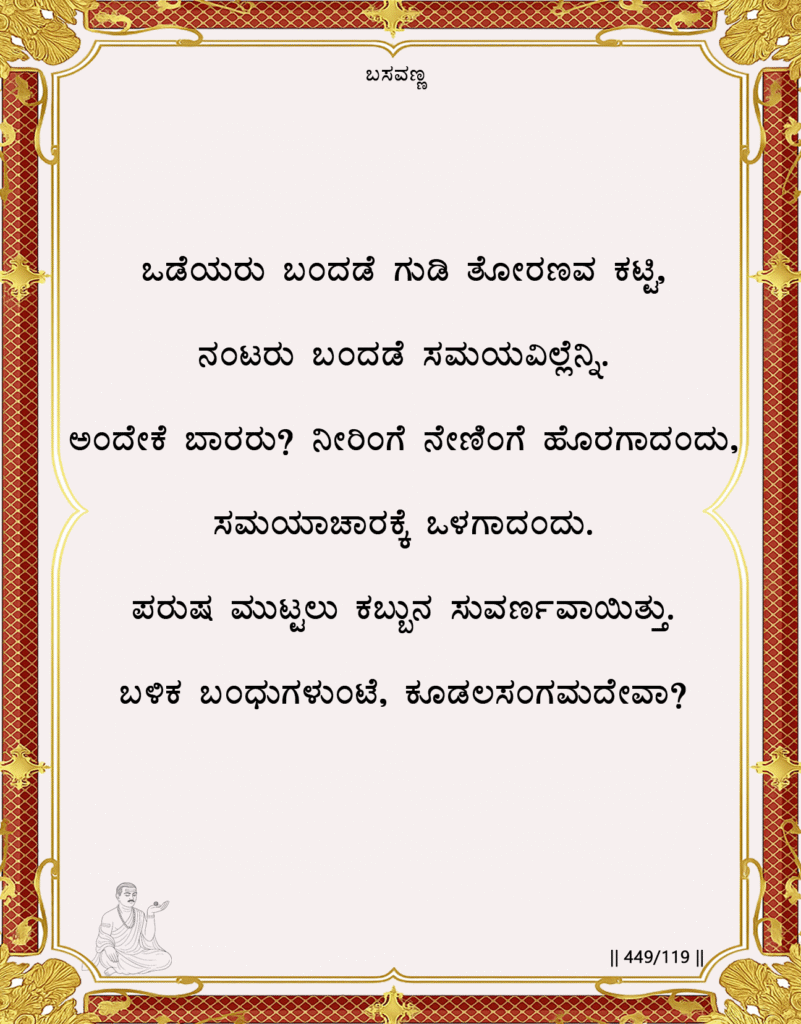
Poetic Rendering

When an ordinary guest arrives,
I string garlands and adorn the doorway.
But when my own people come,
I shrink away, saying, “I have no time.”
Tell me then, O Lord
why do Your Sharanas never come here?
Let others cling to lineage and ritual;
I will cast off the sacred thread
and its empty hierarchies.
I will live only by the truth
that rises fresh in this very moment.
For when the Linga touches me
just once
this dull iron of a life
is transmuted into imperishable gold.
After that alchemy,
what use are worldly relatives?
What bond can compare
to the kinship of Your truth,
O Kudalasangamadeva?
Basavanna reveals how true spiritual experience overturns ordinary social priorities. While worldly guests and relatives draw uneven responses from him, his heart yearns only for the company of enlightened beings the Sharanas. He rejects all empty ritual identities, such as the sacred thread, choosing instead to live by the truth that arises directly from the Divine.
Spiritual Context
Core Spiritual Principle: Spiritual realization creates a new ontological identity that supersedes all worldly identities based on birth, caste, or ritual. This new identity is forged in the fire of direct divine experience (anubhava) and is shared with all who have undergone the same transformation, creating a “sangha” or community of the awakened.
Cosmic Reality Perspective: The Linga is the philosopher’s stone of consciousness. Its touch performs the ultimate alchemy: it transmutes the base metal of the egoic, conditioned self (identified with the body and its social roles) into the gold of the divine Self (Atman), which is eternal, pure, and free.
Historical Reality (Anubhava Mantapa Context): This Vachana is a manifesto of the social revolution initiated by Basavanna. It explicitly rejects the Brahmanical sacred thread (yajnopavita), the primary symbol of caste hierarchy and ritual purity. It announces the creation of a new society based not on birth but on spiritual attainment and shared devotion to the Linga.
Interpretation
1. Contrasting Hospitality: The opening lines expose the hypocrisy of conventional social life, where we perform for strangers but neglect our own. This sets the stage for a higher truth: his true “own people” are not his blood relatives but the Sharanas, the community of truth.
2. “why do Your Sharanas never come here?”: This is a poignant lament. He feels isolated, longing for the fellowship of those who understand his new spiritual orientation. His home has become a place of old rituals, not yet a sanctuary for the new kinship.
3. “I will cast off the sacred thread…”: This is an act of public, spiritual declaration. The sacred thread represents a identity conferred by others (priests, tradition). Casting it off is an act of self-authoring, claiming an identity given directly by God.
4. “the truth that rises fresh in this very moment.”: This defines the epistemology of the Sharana. Truth is not found in ancient texts alone, but in the living, immediate experience (anubhava) of the Divine in the present moment.
5. The Alchemy of “Iron to Gold”: This is the central metaphor. “Iron” represents the heavy, earthly, corruptible nature of the worldly self. “Gold” represents the luminous, incorruptible, and divine nature of the realized self. The “touch of the Linga” is the catalytic event of grace that enables this transmutation.
The Cosmic Reality
Anga (Human Dimension): The Anga undergoes a fundamental change in substance. It is no longer defined by its social form (the iron) but by its divine essence (the gold). Its old relationships and obligations become irrelevant.
Linga (Divine Principle): The Linga is the transformative agent. It is not just a symbol but an active, catalytic power that changes the very nature of the individual who comes into contact with it.
Jangama (Dynamic Interaction): The Jangama is the transmutation itself. It is also the new community of the “golden” onesthe Sharanas. Their fellowship is the social expression of the Jangama relationship, a community living in the truth of this transformed state.
Shatsthala
Primary Sthala: Sharana Sthala. This Vachana is the very definition of this stage. To be a Sharana is to have cast off external identities and to have found one’s true self and family in the Linga and its community.
Supporting Sthala: Aikya Sthala (Stage of Union). The transmutation into “gold” is the process of becoming one with the divine nature. The longing for the company of Sharanas is the longing to be with those who share this non-dual consciousness.
Practical Integration
Arivu (Awareness Practices): Contemplate the “Iron and Gold” within. Meditate on the aspects of your life and identity that feel heavy, conditioned, and “iron-like” (e.g., social roles, past conditioning). Then, contemplate the aspects that feel light, free, and “gold-like” (e.g., moments of love, peace, selfless action). Offer the “iron” to the Linga, asking for its transmutation.
Achara (Personal Discipline): Consciously simplify your life of external labels and status symbols. Practice introducing yourself without reference to your job, qualifications, or family background. Identify first and foremost as a seeker, a devotee.
Kayaka (Sacred Action): Let your work be an expression of your “golden” nature. Perform your duties without attachment to the social status they confer. See your work as a field for expressing compassion, integrity, and awareness the qualities of the transformed self.
Dasoha (Communal Offering): Actively build and nurture your spiritual community (satsang). Prioritize time with those who inspire your spiritual growth. Make your home a place where Sharanas would feel welcome to come, a sanctuary of truth and simplicity.
Modern Application
Identity Fragmentation and Tribalism. Modern individuals often suffer from a fractured sense of self, defined by professional titles, social media profiles, political affiliations, and consumer choices. This leads to anxiety and deep loneliness. At the same time, people retreat into narrow tribal identities (national, political, ideological) in a desperate search for belonging.
This Vachana offers liberation from the tyranny of manufactured identities. It proposes a universal, transformative identity based not on what you have or do, but on what you are at the level of consciousness. It replaces fragile tribal bonds with the profound kinship of shared spiritual awakening. In a lonely world, it points to the creation of a true sanghaa community not of agreement, but of shared transformation.
Essence
For common guests, a garland bright,
For my own kin, a weary slight.
But for the ones whose gold is true,
My door and heart stand open, new.
The thread of caste, a brittle tie,
The Linga’s touch, a golden sky.
1. The Alchemy of Consciousness: The metaphor of iron to gold is not merely poetic. It describes a change in the fundamental vibrational frequency of the individual’s consciousness. The “iron” self vibrates at the frequency of fear, separation, and materiality. The “touch of the Linga” introduces the frequency of pure, non-dual awareness (cit). The individual’s consciousness begins to resonate with this new frequency, and over time, its entire substance is reconfigured. This is the scientific process of spiritual transformation described in mystical terms.
2. The Emergence of a New Social Organism: The longing for the Sharanas signifies the birth of a new social impulse. Just as atoms with similar properties bond to form molecules, individuals who have undergone this ontological transmutation naturally recognize and gravitate toward each other. They form a new social organismthe Sanghawhich is based on the laws of consciousness (love, truth, compassion) rather than the laws of the jungle (power, status, bloodline).
3. Jangama as the Transmutative Field: The functioning Jangama is the living, dynamic field of force created by the presence of the Sharanas. This field itself has a catalytic effect. To be in the company of a true Sharana (satsang) is to be exposed to the “golden” frequency, which can accelerate the transmutation of one’s own “iron.” Thus, the Jangama is both the process of individual transformation and the collective field that sustains and propagates it. Basavanna’s lament, “why do Your Sharanas never come here?” is a prayer for this catalytic field to manifest in his own life, to complete his own alchemy and to make his home a node in this new, divine network.
You are not who the world says you are. Beneath the layers of conditioning, social roles, and inherited identity, there is a core of pure, golden consciousness. The purpose of spiritual life is to allow that core to be touched and awakened. When this happens, you will discover your true family not necessarily in your bloodline, but in all those everywhere who are living from that same awakened heart. This is the only kinship that death cannot touch and time cannot corrupt.

Views: 2