Poetic Rendering

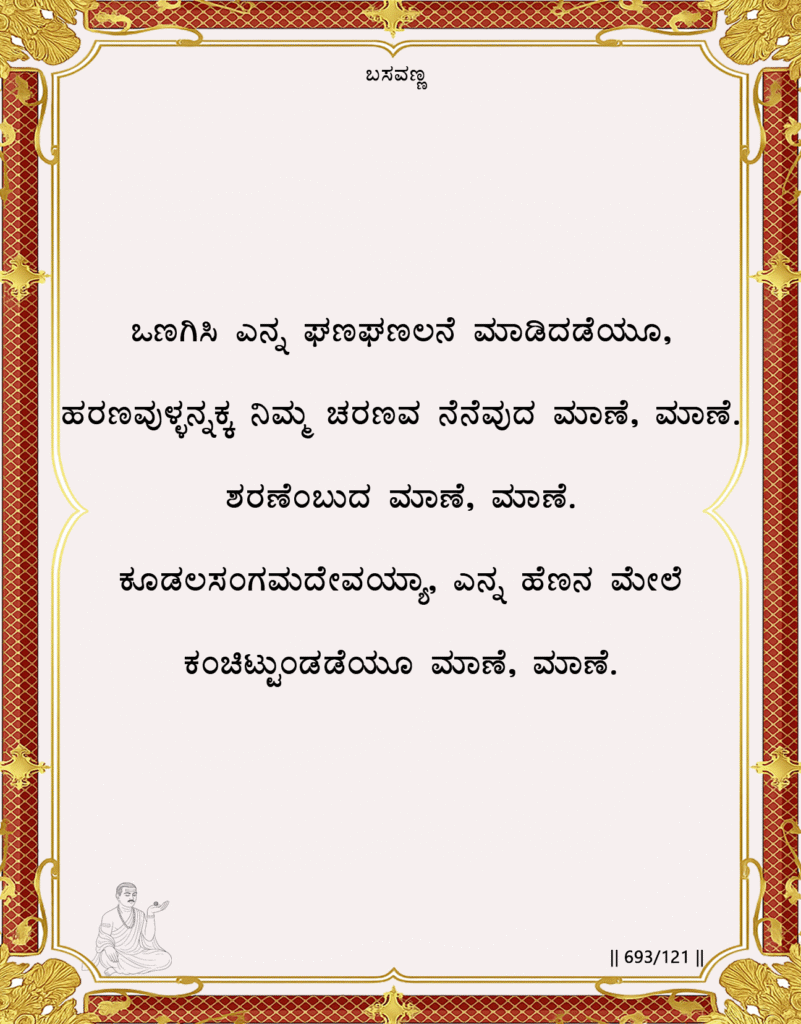
Even if they flay my flesh
and stretch it tight like a drumskin
to beat upon in the marketplace
still, I will not forget Your sacred feet.
Even if they mock my devotion,
sneer at my cry of “Sharana!”
still, I will not stop calling Your name.
And even if, O Koodalasangamadeva,
they shoe their feet with copper
and trample upon my very corpse
still, I will not forsake You.
I will not. I will not.
This vachana expresses Basavanna’s vow of absolute, indestructible devotion. The body may be tortured, humiliated, or destroyed, yet the bond between the seeker (Anga) and the Divine (Linga) remains unbreakable. Earthly violence can wound flesh, but it cannot touch the inner truth of a realized soul. Basavanna proclaims that neither fear, ridicule, nor death can separate him from God. His devotion is not emotional or transactionalit is ontological, the very essence of his being. This vachana stands as the purest declaration of spiritual steadfastness: when the world breaks the body, the realized heart only shines brighter.
Spiritual Context
Core Spiritual Principle: True devotion (bhakti) is the realization of an identity that is prior to and survives the body-mind complex. When the self is known to be the Self (Linga), no external force can sever that connection. The ultimate test of faith is not in comfort but in the face of annihilation, and it is here that faith becomes knowing.
Cosmic Reality Perspective: The Linga is the eternal, indestructible Consciousness. The Anga, in its essence, is not the body but a manifestation of that same consciousness. Persecution, therefore, can only affect the temporary form, not the essential substance. The cry of “Sharana!” is the affirmation of this essential identity, which is why it cannot be silenced.
Historical Reality (Anubhava Mantapa Context): This Vachana must be read in the context of the intense persecution the Linga Yoga movement faced from the orthodox establishment. It is a declaration of fearless resolve from a revolutionary leader to his community, affirming that their commitment to their path must be absolute, able to withstand any form of social ostracization, mockery, or physical violence.
Interpretation
1. “flay my flesh… like a drumskin…”: This is the ultimate image of physical violation and public humiliation. The body is turned into an instrument of its own mockery. Yet, Basavanna says that even this extreme violation cannot reach the core of his being where the Linga resides.
2. “sneer at my cry of ‘Sharana!’…”: “Sharana” is the core identity of a Linga Yoga devoteeone who has taken refuge. To mock this is to attack the very foundation of their spiritual identity. His refusal to stop is the assertion that this identity is not a social label but an unassailable inner truth.
3. “trample upon my very corpse…”: This moves beyond torture to the finality of death and desecration. His vow extends beyond the boundary of life itself. This indicates that his devotion is not contingent upon existence in a physical body; it is a fundamental law of his being that not even death can revoke.
4. “I will not. I will not.”: The repetition is not a cry of desperation but a calm, definitive statement of ontological fact. It is the declaration of a law of nature: as surely as the sun rises, his being is inseparable from Koodalasangamadeva.
The Cosmic Reality
Anga (Human Dimension): The Anga is the “drumskin,” the physical vehicle that can be broken. But the consciousness that identifies as the Anga has realized its true nature as the Linga. Therefore, the destruction of the vehicle is seen as a superficial event.
Linga (Divine Principle): The Linga is the silent, unmoving “sacred feet.” It is the eternal ground that provides an unshakeable anchor for the devotee’s consciousness, regardless of the storms raging in the phenomenal world.
Jangama (Dynamic Interaction): The Jangama is the unstoppable flow of remembrance. It is the dynamic truth that the devotee’s consciousness and the Divine are one. This unity is not broken by the destruction of the physical body; it is, in fact, fully revealed when the body is gone.
Shatsthala
Primary Sthala: Aikya Sthala. This level of unwavering devotion, which sees the body’s destruction as irrelevant to the core truth, is only possible in the non-dual realization of union.
Supporting Sthala: Sharana Sthala. The act of taking refuge is here demonstrated in its most absolute form. The Sharana has taken refuge so completely that even when the world takes everything else, the refuge remains intact.
Practical Integration
Arivu (Awareness Practices): Practice “Unshakeable Abidance.” In meditation, contemplate: “I am not this body. I am not this mind. I am the eternal consciousness that is one with Koodalasangamadeva.” Cultivate this awareness until it becomes a felt reality, a ground of being that remains stable amidst life’s inevitable pains and losses.
Achara (Personal Discipline): Cultivate fearlessness in expressing your core spiritual values. Do not be swayed by social pressure, ridicule, or the fear of inconvenience. Let your commitment to truth and compassion be non-negotiable, a small-scale reflection of the absolute commitment described in the Vachana.
Kayaka (Sacred Action): Perform your duties with the attitude that you are acting for the Divine alone. When faced with criticism or failure in your work, let your inner reference point be your dedication to truth, not the approval of others. This builds the resilience of the “unbroken drum.”
Dasoha (Communal Offering): The community’s role is to be a collective “unbroken drum.” By supporting each other through persecution and hardship, the community becomes a living testament to this Vachana, proving that the spirit of the Shiva yoga path cannot be crushed by worldly power.
Modern Application
The Fear of Social Ostracization and “Cancel Culture.” In the modern world, while physical persecution is rare in many societies, there is a profound fear of social and professional ruin, of being “canceled,” mocked online, or ostracized for one’s beliefs or identity. This fear can lead to self-censorship, inauthenticity, and a fragile sense of self.
This Vachana offers the ultimate liberation from the fear of social judgment. It teaches that if your identity is rooted in something transcendentala deep truth, a profound love, a spiritual realitythen no amount of social shunning or online mockery can touch your core. It gives you the courage to stand for your truth, knowing that your real self is inviolable.
Essence
Flay the skin, and beat the sound,
Upon this flesh, my love is found.
Mock the name I call in faith,
It will outlive your scorn and wraith.
And when my body’s trampled, cold,
The story of my love is told.
This Vachana presents a metaphysics of inviolable consciousness, positing that realized identity exists in a dimension untouched by phenomenal causality.
1. The Physics of the Realized Self: The ordinary self is like a wave on the ocean, subject to all the forces of wind and current (society, pain, death). The realized Self knows itself to be the ocean itself. You cannot “flay” the ocean by disturbing a wave. The persecution described is an attack on the wave, but Basavanna is abiding as the ocean. The “drum” is the wave; the music is the ocean’s own song, which continues regardless.
2. Consciousness as a Non-Local Phenomenon: The vow “I will not forsake You” persists through death because consciousness is not a local product of the brain. In the state of Aikya, individual consciousness is recognized as a focal point within the non-local, universal consciousness (Linga). Destroying the brain is like destroying a television; it does not destroy the broadcast signal. The essential identity of the Sharana is that signal, not the television.
3. Jangama as the Eternal Verb: The functioning Jangama, in this ultimate sense, is not an interaction between two separate entities but the perpetual activity of the one Reality knowing itself. The cry of “Sharana!” is the voice of the Linga calling to itself through the form of Basavanna. The trampling of the corpse is merely the dissolution of a form. The Jangamathe dynamic self-recognition of the Divineis an eternal process that simply withdraws one instrument and continues its expression through countless others. Basavanna’s final “I will not” is the voice of the Absolute itself, stating the impossibility of its own non-existence.
Find something within you that cannot be taken away. Anchor your identity not in your body, your reputation, or your thoughts, but in a truth or love so profound that it is synonymous with your very being. When you do, you become invincible. The world can take everything from you, but it can never take you from yourself. This is the birth of true fearlessness and the end of all slavery.

Views: 0