Poetic Rendering

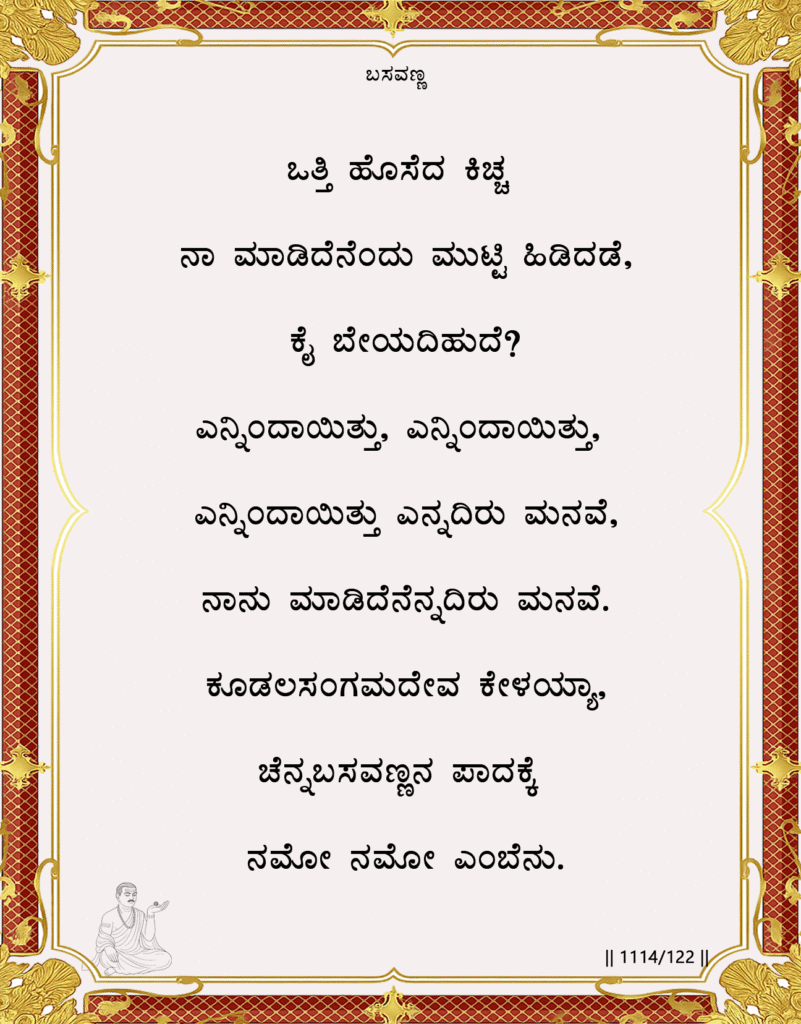
If a man twists a humble cotton wick
and boasts, “This flame is mine, for I prepared the wick!”
let him grasp the fire once,
and see whether it spares his hand.
The wick may be ours,
but the flame is never ours.
Stop this foolish cry of “I, I, I!”
O mind, be still.
Yes, the method of Śhivayoga
that was the wick I offered.
But the flame that leapt upon it,
the living radiance that made it shine
that was the grace of the Sharana,
of Chenna Basavanna.
Never mine, never mine.
O Koodalasangamadeva,
again and again
I bow at the feet of Chenna Basavanna.
Basavanna distinguishes between human preparation and the arising of divine realization. The seeker may prepare the wick discipline, sincerity, and the framework of Śhivayogabut the flame of awakening cannot be claimed as personal achievement. To say “I caused the flame” is to invite the burning of ego. Basavanna affirms that while he shaped the method of Śhivayoga,
its radiance, clarity, and living expression were brought into fullness through the enhancement, explanation, devotion, and steadfastness of Chenna Basavanna. Through Chenna Basavanna’s insight and purity, the flame of Śhivayoga shone forth into the world with unmistakable brilliance. This is not disciple to guru, but mutual reverence among Sharanas of equal vision Basavanna honoring the one who carried the flame with extraordinary steadiness. The message remains timeless: One may prepare the wick, but the flame is revealed only when truth ripens in the company of those who embody it.
Spiritual Context
Core Spiritual Principle: The ego’s claim of authorship over spiritual realization is the final and most subtle obstacle. One can create the conditions for grace (the wick), but the flame of enlightenment is a gift (prasada) that descends spontaneously. True wisdom is to acknowledge the source of the flame with profound humility.
Cosmic Reality Perspective: The Linga is the transcendent firethe source of all light and consciousness. The individual effort of Sadhana is the wick, a finite, conditioned object. The ignition is a divine act that transcends the cause-and-effect chain of the phenomenal world. To claim ownership is to misunderstand the very nature of the Absolute.
Historical Reality (Anubhava Mantapa Context): This Vachana is a profound historical record of the relationship between two great masters. It demonstrates the core Shivayoga value of absolute humility and the rejection of guru-worship. Basavanna, the revolutionary leader, publicly honors Chenna Basavanna not as a subordinate, but as a peer whose pure embodiment of the teachings was the “flame” that gave life to the “wick” of the philosophical framework. It is a model of spiritual collaboration over hierarchy.
Interpretation
1. “let him grasp the fire once, and see whether it spares his hand.”: This is a warning about the nature of egoic appropriation. The “fire” of true realization will inevitably burn away the illusion of a separate “I” that tries to claim it. The metaphor is both a spiritual truth and a law of consciousness.
2. “The wick may be ours, but the flame is never ours.”: This is the central, liberating insight. It creates a healthy, non-attached relationship to spiritual practice. We are responsible for the preparation (the Sadhana), but we must surrender all attachment to the outcome, which is in the hands of grace.
3. “the method of Śhivayogathat was the wick I offered.”: Basavanna acknowledges his own monumental rolesystematizing the path, establishing the Anubhava Mantapa, and articulating the Shivayoga doctrine. Yet, he sees this as merely preparing the vessel, not creating the content.
4. “the flame… was the grace of the Sharana, of Chenna Basavanna.”: This is the ultimate humility. He attributes the living power, the transformative radiance of the path, not to his own intellectual labor, but to the embodied grace and unwavering devotion of another Sharana. This acknowledges that a teaching becomes alive only through its perfect exemplars.
The Cosmic Reality
Anga (Human Dimension): The Anga is the wick-maker. Its work is essential but preparatory. Its fulfillment comes not in claiming the light, but in being consumed by it, thereby becoming one with the illumination.
Linga (Divine Principle): The Linga is the uncreated, eternal flame. It is the source of all light and the ultimate reality that ignites the seeker’s consciousness.
Jangama (Dynamic Interaction): The Jangama is the ignition itself, and also the pure being (like Chenna Basavanna) through whom the flame burns so clearly that it illuminates the path for others. The act of bowing is the Anga’s perfect response to the Jangama’s manifestation of the Linga.
Shatsthala
Primary Sthala: Prasadi Sthala. The entire Vachana is an exposition on grace. The “flame” is the definitive symbol for Prasadathe undeserved, transformative gift of God-consciousness.
Supporting Sthala: Aikya Sthala. The final dissolution of the “I, I, I” is the very process of Aikya. This Vachana describes the attitude of mind that makes that union possible: the total relinquishment of doership.
Practical Integration
Arivu (Awareness Practices): Practice “Wick and Flame” meditation. Sit quietly and let your body and focused mind be the “wick.” Then, in silent receptivity, invite the “flame” of divine consciousness to descend and ignite your awareness. When thoughts of “my meditation” arise, remember: you are the wick, the flame is God’s.
Achara (Personal Discipline): Cultivate the discipline of gratitude and acknowledgment. In your spiritual life, actively acknowledge the teachers, texts, and fellow seekers who have helped “ignite” understanding in you. Eradicate any subtle sense of spiritual superiority or ownership of your insights.
Kayaka (Sacred Action): Perform your duties as the preparation of the “wick.” Do your work with excellence as an offering, but release all claim to the results. Understand that the true success and impact of your work is a form of grace that operates through you, not from you. Dasoha (Communal Offering): The highest Dasoha is to be a clear “wick” for others. Live the teachings with such integrity that your life itself becomes a vehicle for the “flame” of divine grace to be visible to others, just as Chenna Basavanna did for Basavanna.
Modern Application
The “Self-Made” Spiritual Ego and Guru Inflation. In modern spirituality, there is a tendency for teachers to build personal brands and for students to become attached to charismatic figures. Conversely, some practitioners fall into the trap of the “self-made” adept, claiming their realizations as personal achievements, which often masks a deep spiritual pride.
This Vachana liberates both teacher and student. It frees teachers from the burden of being the “source” and allows them to be transparent conduits. It frees students from hero-worship and teaches them to honor the teacher as a window to the Divine, not the Divine itself. For the individual, it replaces the anxiety of spiritual achievement with the peace of receptive surrender.
Essence
I twisted cotton, soft and fine,
And called the preparation mine.
But when the flame leapt from above,
It burned the hand that claimed the love.
The wick was mine, the light was his,
A truth that shatters all false bliss.
1. The Non-Linear Causality of Grace: The relationship between the wick (preparation) and the flame (realization) is not one of linear cause and effect. The wick is a necessary condition but not a sufficient cause. The flame belongs to a different order of reality. This is why the ego’s claim of authorship is a categorical errorit attempts to apply the logic of the phenomenal world (karma) to the noumenal world of grace (prasada).
2. The Communal Nature of Realization: The flame does not ignite in a vacuum. While the individual prepares their own wick, the ignition often happens in the presence of a “living flame”a realized being whose consciousness provides the catalytic field. Chenna Basavanna was such a catalytic field for the full manifestation of the Shivayoga flame. Realization is thus a collaborative event between individual readiness, divine grace, and the sacred community (satsang).
3. Jangama as the Perfect Conductor: The functioning Jangama, embodied by Chenna Basavanna, is a consciousness with zero resistance. The wick (the method) has a certain density and form. The flame (the Linga) is pure, unmanifest energy. The Jangama is the perfect conductor that allows the formless flame to fully manifest through the form of the wick without any distortion or diminution. Basavanna’s bow is the acknowledgment of this perfect conductivity. In doing so, he is not worshiping a person, but honoring the principle of a consciousness so pure that it becomes a perfect vehicle for the Divine. This is the ultimate purpose of the Jangama relationship in the world.
You can prepare yourself with discipline and sincerity, but the moment of true awakening is always a gift. Do not make the mistake of claiming the sunrise because you opened your eyes. Honor the preparation, but worship the source of the light. And when you encounter someone through whom the light shines with exceptional clarity, bow to that light in them, for they are showing you the face of your own potential. In the economy of spirit, the greatest strength is found in the humility that acknowledges, “The wick was mine, but the flame was never mine.”

Views: 0