Poetic Rendering

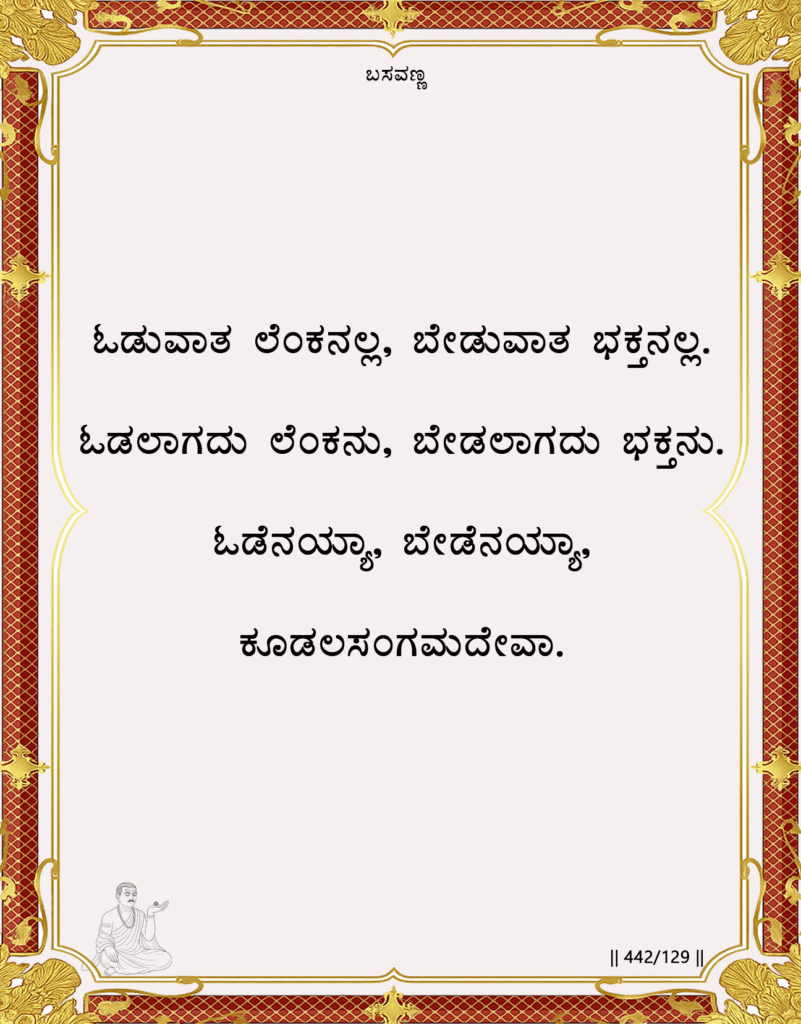
One who flees is no warrior.
One who begs is no devotee.
A true warrior stands his ground.
A true devotee asks for nothing.
I shall not flee, O Lord.
I shall not beg.
O Koodalasangamadeva, grant me this strength.
This vachana is a powerful declaration of the dignity and sovereignty of the enlightened soul. Basavanna draws a parallel between the valor of a warrior on the battlefield and the faith of a devotee on the spiritual path. Both are defined by an unyielding inner stance. The warrior’s duty is to face the external enemy without flight; the devotee’s duty is to face the Divine with a heart so full of trust that it transcends all forms of needy supplication. This is not a rejection of prayer, but a transcendence of beggarly consciousness.
Spiritual Context
Core Spiritual Principle: True devotion is a state of sovereign strength and unwavering presence, not one of neediness or flight from reality.
Cosmic Reality Perspective: In the non-dual reality, the individual soul (jiva) and the Divine (Shiva) are not separate entities in a transactional relationship of beggar and benefactor. The seeker’s journey is to realize their inherent, divine strength (Shakti), standing firm in the recognition of their true nature.
Historical Reality (Anubhava Mantapa Context: This Vachana is a radical social equalizer. In 12th-century Karnataka, it dismantled the hierarchical priestly system where divine favor was seen as something to be begged from the gods through intermediaries. It empowers every individual, regardless of birth, to claim a direct, courageous, and dignified relationship with the Divine.
Interpretation
“One who flees is no warrior. One who begs is no devotee.”: The “flight” is from one’s own self, from the challenges of spiritual practice (sadhana), and from the raw, unvarnished truth of existence. “Begging” represents a state of lack, a consciousness that believes the Divine is external and grace must be procured. This is identified as a fundamental error in perception.
“A true warrior stands his ground. A true devotee asks for nothing.”: “Standing ground” is the unwavering abidance in the Self (Atma-sthiti). “Asking for nothing” is the pinnacle of trust (Shraddha) and contentment (Santosh), signifying a consciousness that is whole and complete in itself, recognizing the Divine as its very core, not an external supplier.
“I shall not flee, O Lord. I shall not beg.”: This is the fierce vow (Sankalpa) of the seeker. It is an active, willful declaration of intent to root out the inner tendencies of avoidance (fleeing) and dependency (begging).
“O Koodalasangamadeva, grant me this strength.”: This is the ultimate paradox and key to the Vachana. The only “request” is for the strength to not be a beggar. It is not a plea for objects, but for the capacity to realize one’s own inherent divinity. The grace (Prasada) is the empowerment to stand without needing grace in a transactional sense.
Practical Implications: The seeker is instructed to confront life’s internal and external challenges with courage. In prayer and meditation, one must move from a mindset of petitioning for desires to one of cultivating inner fortitude and presence.
The Cosmic Reality
Anga (Human Dimension): The individual who has purified the body and mind to such an extent that it becomes a vessel of unwavering resolve. The ego is not destroyed but transformed into a disciplined instrument of will, aligned with the divine purpose.
Linga (Divine Principle): Koodalasangamadeva, the Ishta Linga, represents the ultimate, non-dual Realitythe very source of all strength, stability, and self-sufficiency. It is the ground upon which the warrior-devotee stands.
Jangama (Dynamic Interaction): The dynamic is the act of “standing firm” in the face of existential and worldly challenges. It is the living relationship where the Anga, drawing upon the Linga, actively manifests the qualities of the Linga (strength, stability) in the world. The Guru, or the enlightened community, embodies this stance, demonstrating this possibility.
Shatsthala
Primary Sthala: Sharana. The Sharana is the “refuge” who has taken shelter in the Divine. This stage is characterized by immense inner stability, fearlessness, and a total offering of the self without any expectation of return. The Vachana’s central theme of “standing firm” and “asking for nothing” is the definitive mark of a Sharana.
Supporting Sthala: Maheshwara. The Maheshwara stage is one of strict personal discipline and purification, where the seeker learns to control the senses and the mind. This is the necessary foundation that builds the strength and discipline required to become the “warrior-devotee” of the Sharana stage.
Practical Integration
Arivu (Awareness Practices): Practice mindfulness to notice moments of internal “flight” (avoidance of difficult emotions or truths) and “begging” (seeking external validation or comfort). Meditate on the feeling of being an unshakable mountain (Dharaṇa).
Achara (Personal Discipline): Cultivate a disciplined life. Fulfill all duties without complaint or avoidance. Practice accepting outcomes with equanimity, without feeling entitled to specific results.
Kayaka (Sacred Action): Perform your daily work as an act of worship and duty, not as a means to beg for a reward or flee from responsibility. Let the quality of your work be your offering.
Dasoha (Communal Offering): Share the “strength” you cultivate. Offer courage, stability, and wise counsel to the community. Be a pillar that others can rely on, embodying the principle of standing firm for collective well-being.
Modern Application
The epidemic of anxiety, escapism (through substance abuse, digital distraction, consumerism), and a “victim mentality” where individuals feel powerless and externalize responsibility for their happiness.
This Vachana is an antidote to disempowerment. It calls the modern individual to psychological sovereignty. It teaches that mental peace is not found by fleeing from challenges or begging for external solutions, but by cultivating an unassailable inner core of strength and self-reliance, facing life with the courage of a spiritual warrior.
Essence
Not a step back from the battle within,
Not a palm held out for a prize.
A stance of granite, a heart free of need,
This itself is the grace I seek from Thee.
This Vachana maps the metaphysics of sovereignty. It posits that the perceived separation between the seeker and the Divine is the root of “begging,” and the consequent fear is the root of “flight.” The resolution is not a merger from a position of weakness, but a realization of innate strength. The final plea is the Jangama catalyst that dissolves the duality between the one who asks and the strength that is given, revealing that the capacity to stand firm is the very nature of the Self, activated by divine intent.
Ultimate freedom is found in courageous self-reliance and unwavering presence. The highest form of prayer is not to ask for what you lack, but to be empowered to embody the wholeness you inherently are.

Views: 0