Poetic Rendering

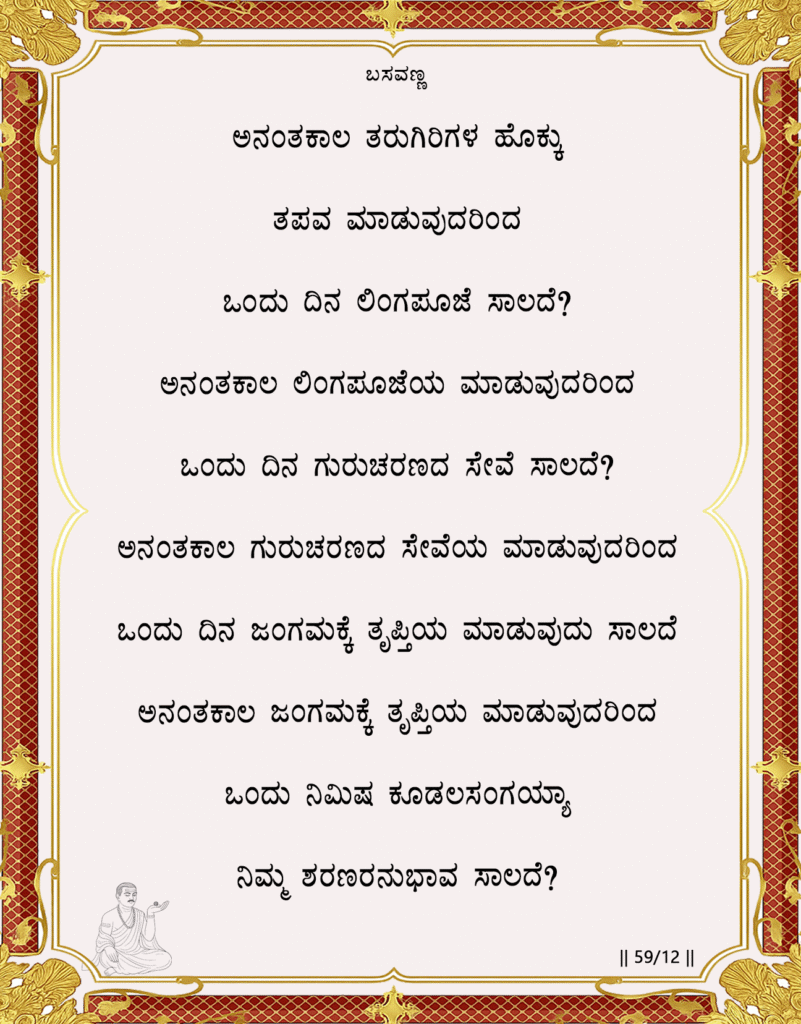
If for endless ages you perform penance,
is a single day’s worship of the
Linga not enough?
If you worship the Linga for ages,
is a single day’s service to the Guru not enough?
If you serve the Guru for ages,
is a single day’s feeding of
the jangama not enough?
If you serve the jangama for ages,
is a single moment of sharing in the sharana’s experience not enough,
O Koodalasangayya?
The poet constructs a ladder of spiritual practice, where each higher stage makes the previous one obsolete. He questions if endless penance is superior to a day of Linga worship, if endless Linga worship is superior to a day of serving the Guru, if endless Guru service is superior to a day of serving the Jangama, and finally, if all that is superior to a single moment of sharing in the direct spiritual experience (Anubhava) of a Sharana.
Spiritual Context
Core Spiritual Principle: The path to the Divine is a progression from external, individual effort to internal, grace-filled realization through sacred relationship. The most potent spiritual practice is not solitary austerity but selfless service to and communion with those who embody the truth.
Cosmic Reality Perspective: The formless Divine (Linga) becomes accessible through its manifestations in the world. The Guru is the Linga in human form, the Jangama is that truth in dynamic motion, and the Sharana’s experience (Anubhava) is the living proof of the truth. To serve them is to serve the Cosmic Reality directly.
Historical Reality (Anubhava Mantapa context): This vachana is a theological cornerstone for the Lingayat community. It systematically devalues solitary, ascetic practices (prevalent in other traditions) and establishes the Guru-Sishya parampara and the sacred community (Sangha) as the supreme means of liberation.
Interpretation
1. Penance – Linga Worship: Moves from harsh, ego-driven austerity to a focused, devotional relationship with the Divine principle. The Linga internalizes the practice.
2. Linga Worship – Guru Service: Moves from worship of a symbolic form to service of the living embodiment of that truth. The Guru makes the abstract Linga tangible and provides guidance.
3. Guru Service – Jangama Service: Moves from serving a single enlightened master to recognizing and serving the moving Divine in all sincere devotees and teachers. This expands the heart and dissolves hierarchy.
4. Jangama Service – Anubhava of the Sharana: This is the ultimate leap, from external service to internal transformation. It is not about doing for the Jangama, but being with the Sharana in their state of realized consciousness (“sharing in the sharana’s experience”). This is the moment of grace where knowledge (Jnana) is transmitted not through words, but through presence and shared experience.
Practical Implications: The seeker should understand that spiritual progress is not linear accumulation but a qualitative leap to higher paradigms. One should actively seek the company of the enlightened (Satsangha) and serve them selflessly, as this is the most direct route to imbibing their state of consciousness.
The Cosmic Reality
Anga (Human Dimension): The seeker evolving through the stages: from penitent, to devotee, to servant, and finally to a receptive vessel ready for direct experience.
Linga (Divine Principle): The ultimate goal, which is approached first as a symbol, then as the Guru, then as the Jangama, and finally as the direct Anubhava (experience) itself.
Jangama (Dynamic Interaction): The Jangama is the active principle in this entire ladder. It is the Guru’s guidance, the service to the moving saint, and the shared spiritual experience that dynamically bridges the gap between the seeking Anga and the transcendent Linga.
Shata Sthala
Primary Sthala: Prasadi. The entire ladder is a process of receiving ever-greater doses of grace. Each step is a more potent form of Prasada than the last, culminating in the ultimate Prasada: direct spiritual experience.
Supporting Sthala: Aikya. The “sharing in the sharana’s experience” is a taste of the state of Aikya, or union. It is not merely observing, but participating in the non-dual consciousness of the realized being.
Practical Integration
Arivu (Awareness): Reflect on your own spiritual practice. Where does it fall on this ladder? Are you engaged in solitary effort, or are you cultivating the sacred relationships that lead to direct experience?
Achara (Personal Discipline): The discipline is to progressively reorient one’s life towards service (Dasoha). Make it a rule to prioritize service to the Guru and the spiritual community above solitary practices.
Kayaka (Sacred Action): Let your work be an offering that supports the Jangamas and the Sangha. See your profession as a means to feed, clothe, and sustain the living embodiments of the Divine.
Dasoha (Communal Offering): This vachana is the blueprint for Dasoha. The highest Dasoha is not just giving material things, but creating the conditions for the “Anubhava of the Sharana” to be shared and transmitted within the community.
Modern Application
The modern spiritual seeker often suffers from “seeker syndrome,” hopping from one technique or retreat to another, accumulating practices without deep transformation. This is the “endless penance” or “endless worship” without progressing to the relational and communal stages that bring real change.
This vachana provides a clear roadmap. It liberates from spiritual consumerism by directing us to find a true teacher (Guru), to serve the wider spiritual community (Jangama), and to value deep, transformative fellowship (Satsangha) over the accumulation of isolated techniques. The goal is not more knowledge, but a shared experience of truth.
Essence
Why penance for a thousand years,
When one day with the Linga appears?
Why worship for an age alone,
When serving feet of Living Stone?
For in the shared and sacred glance,
Lies the soul’s true deliverance.
Metaphysically, this vachana charts the journey from gross (Penance) to subtle (Anubhava). It demonstrates how grace operates through increasingly subtle channels. The final stage, “sharing in the sharana’s experience,” is a transmission of consciousness (Chinmudra) where the individual mind of the Anga temporarily dissolves into the universal mind of the Sharana, providing a direct taste of non-duality that burns away ignorance more effectively than any self-powered practice.
The most profound growth happens in the context of transformative relationships. A single moment of genuine connection with a person who embodies wisdom, compassion, or mastery can do more for our development than years of solitary study or effort. We are evolved by community, not in isolation.

Views: 6