Poetic Rendering

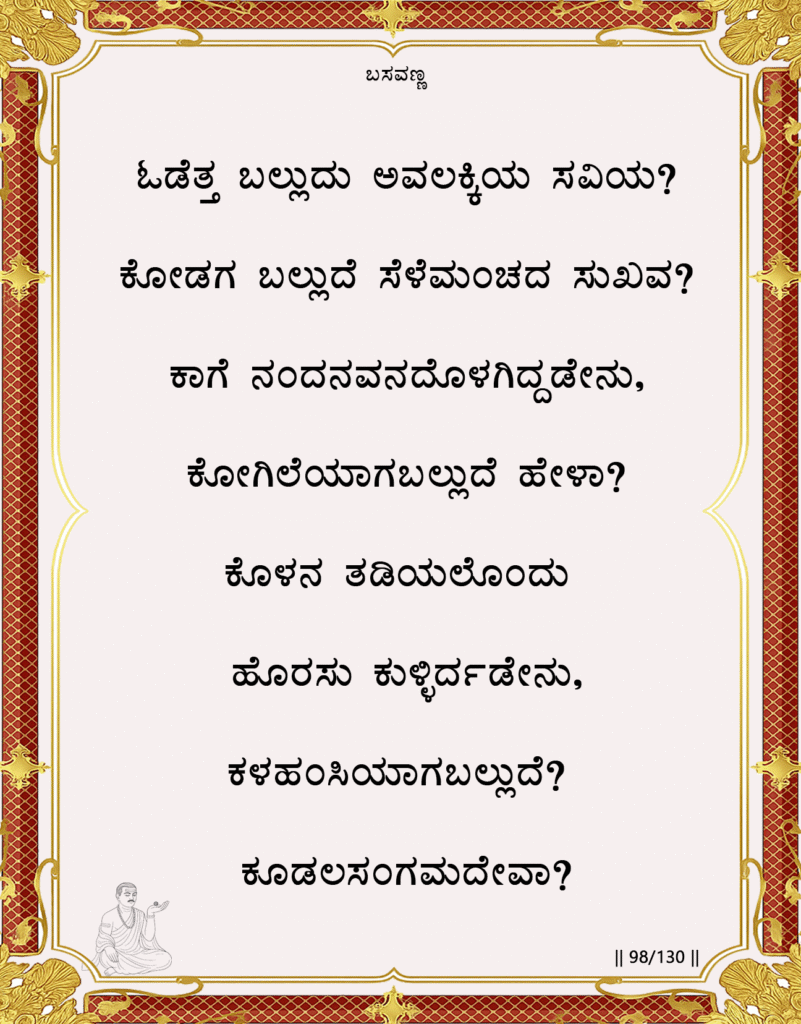
Can a frying pan ever know
the subtle fragrance of parched rice?
Can a monkey understand
the joy of swinging with grace?
Though a crow may rest
in the gardens of paradise,
will it ever learn
the cuckoo’s sweet song?
And even if a white dove
sits upon still and sacred waters,
can it become the Hamsa
the swan that discerns milk from water?
Tell me,
O Koodalasangamadeva!
Basavanna teaches that outer conditions cannot transform inner nature. One may sit among the holy, adopt their symbols, or imitate their practices, yet without inner refinement, discernment, and sincerity, no true spiritual evolution occurs. Just as a crow cannot sing like a cuckoo and a dove cannot become a swan by merely sitting on pure waters, a person cannot become a Sharana through proximity or imitation alone. Transformation arises only from inner purity, discrimination, and the awakening of truth, not from external association.
Spiritual Context
Core Spiritual Principle: Authentic spiritual transformation is an alchemy of inner nature (Svabhava), not a product of external environment, ritual, or imitation. It requires the development of viveka (discernment) to separate the real from the unreal.
Cosmic Reality Perspective: The non-dual truth is that consciousness (Linga) must infuse and transmute every particle of one’s being (Anga). Merely being in proximity to the sacred (Jangama) without this inner, willing receptivity is inert. The Hamsa (swan) symbolizes the realized soul that can extract the essential (milk/Spirit) from the phenomenal (water/world).
Historical Reality (Anubhava Mantapa Context): This is a direct critique of empty ritualism and caste-based sanctimony. Basavanna challenges the notion that birth in a priestly family or mere performance of rites confers enlightenment. The Anubhava Mantapa was a community based on the quality of one’s inner experience, not external labels, demanding genuine inner change from all its participants.
Interpretation
The Frying Pan & The Monkey: These represent gross, unprepared instruments. The pan, though in contact with food, cannot taste it; the monkey, though swinging, lacks the grace of conscious movement. This symbolizes a person going through the motions of spirituality without inner sensitivity or understanding.
The Crow in Paradise: The crow symbolizes a mind rooted in impurity (grasping, noise, attachment to carrion). Even in the highest spiritual environment (“paradise”), its inherent nature remains unchanged. External holiness cannot sanctify an unsanctified heart.
The Dove vs. The Hamsa: This is the climax of the argument. The dove represents superficial pietywhite (pure in appearance), sitting on sacred waters (engaged in spiritual practice). But it lacks the Hamsa’s power of viveka (discernment). True spirituality is not about being in a pure place, but about possessing the innate capacity to distinguish and ingest only the essential, divine substance (milk) from the mixture of life (milk and water).
Practical Implications: The seeker is warned against spiritual complacency based on external affiliations. The focus must shift from what one does to who one is becoming. The path requires cultivating inner purity, sharpening discernment in daily life, and ensuring that external practice is a reflection of an internal state.
The Cosmic Reality
Anga (Human Dimension): The individual consciousness in its raw, untransformed statethe “crow” or “dove” mind. It is characterized by a lack of discrimination, driven by base instincts and superficial piety, unable to absorb the subtle essence of the Divine.
Linga (Divine Principle): Koodalasangamadeva as the ultimate principle of Pure Discernment (Viveka) and Essence (Sara). It is the “milk” itself the eternal, nourishing reality that the unrefined self cannot isolate or integrate.
Jangama (Dynamic Interaction): The dynamic process is the alchemical transformation of the Anga by the Linga, facilitated by sincere practice. It is not static proximity, but the active, living engagement where the seeker develops the “Hamsa’s” ability to extract the Linga’s essence from every experience. The true Guru is the embodiment of this viveka.
Shatsthala
Primary Sthala: Maheshwara. This stage is defined by intense inner purification (Antah-Shuddhi). The entire Vachana is a prescription for this work: burning away impurities (like the pan is heated), disciplining the mind (unlike the monkey), and developing the discernment to reject the “water” of illusion and embrace the “milk” of truth.
Supporting Sthala: Bhakta. The Bhakta is the initial devotee whose faith is often based on external forms and association. This Vachana serves as a crucial test and guide for the Bhakta, pushing them beyond mere external devotion to the demanding internal work of the Maheshwara stage.
Practical Integration
Arivu (Awareness Practices): Meditate on the symbol of the Hamsa. In every situation, practice pausing to ask: “What is the essential truth here (milk)? What is the transient appearance or distraction (water)?” Cultivate witness consciousness to observe your own innate tendencies without identification.
Achara (Personal Discipline): Scrutinize your motives. Are your actions, even spiritual ones, driven by a desire for recognition, belonging, or superficial purity (the dove)? Commit to integrity and authenticity in private as much as in public.
Kayaka (Sacred Action): Perform your work with mindful discernment. Separate the essential service (the duty itself, done well) from the non-essential (praise, profit, status). Let your work be a field for developing viveka.
Dasoha (Communal Offering): Share not just material resources but the gift of discernment. Offer wise counsel that helps others see the essential. Create a community environment that values authentic inner growth over impressive external displays.
Modern Application
“Spiritual Materialism” – the tendency to collect spiritual experiences, gurus, yoga styles, and retreats as status symbols without any fundamental change in one’s selfish, reactive, or unconscious patterns. The obsession with external image and “virtue signaling” on social media.
This Vachana calls for an end to self-deception. It insists that true well-being is not found in the perfect Instagram meditation photo or the number of workshops attended, but in the quiet, unglamorous work of transforming one’s character, refining one’s discernment, and dissolving the ego. It is a mandate for authenticity over appearance.
Essence
A coat of white, a sacred seat,
Can never make the dove complete.
The alchemy lies deep within,
To know the false, and Truth to win.
Quantum-Multidimensional Perspective: This Vachana maps the quantum leap from a classical, localized identity to a non-local, superimposed state of divine potential. The unrefined self (Crow/Dove) exists in a collapsed state of definite, limited qualitiesa “particle” of fixed nature. The journey to becoming the Hamsa is the process of entering a quantum superposition, where the seeker is both the current state and the potential for discernment simultaneously.
The grace of Koodalasangamadeva (Linga) acts as the observer effect, “collapsing” this wave function into the realized state of the Hamsa. This transition is not a linear path but a multidimensional shift from the 3D reality of external form (the dove’s appearance, the sacred waters) to a higher-dimensional reality of essential quality (viveka). The Shatsthala are not stairs but resonant frequencies; the Maheshwara stage is the specific frequency of purification that allows the system to decohere from the noise of illusion and tune into the clear signal of truth.
Your environment cannot change your essence; it can only reveal it. Lasting change is not a matter of place, but of principle. The highest achievement is to develop the innate power of discernment, which allows you to extract wisdom and sustenance from any circumstance, thereby achieving true independence and authenticity.

Views: 10