Poetic Rendering

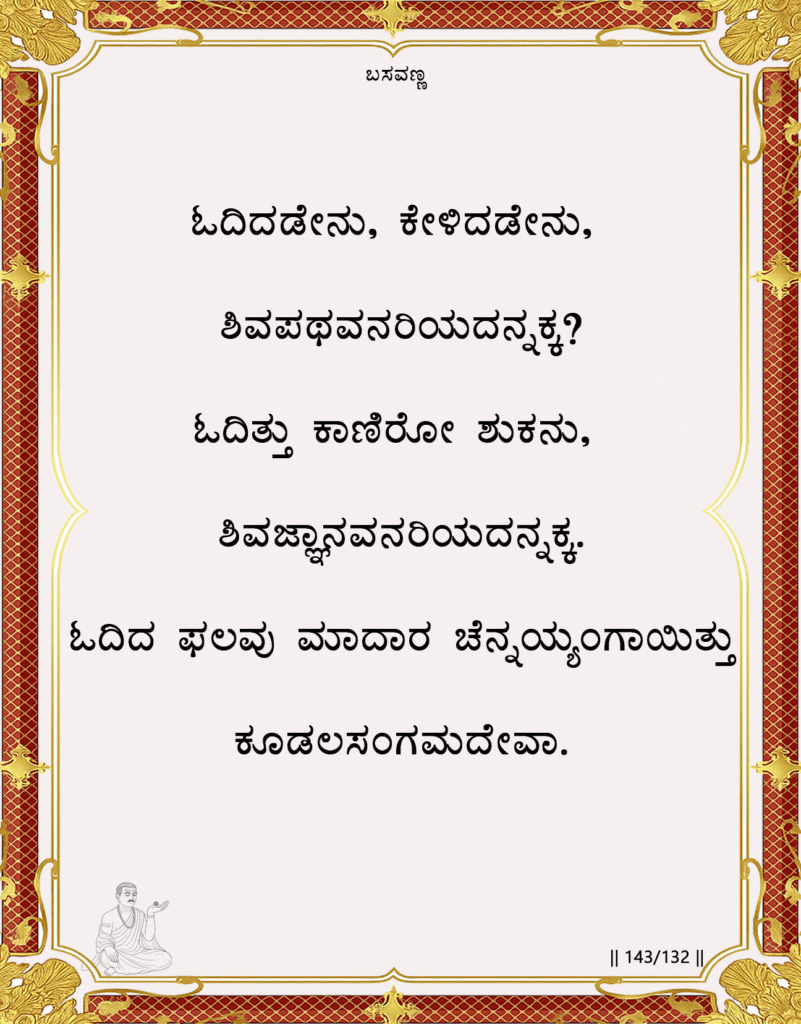
What use is reading?
What use is listening,
if the feet do not walk the path of Shiva?
Shuka, the great sage,
read and recited endlessly
yet without the inner essence,
what did all that learning bring?
But Chennayya the cobbler
his simple learning blossomed,
for he recognized the Living Lord within.
O Kudalasangamadeva!
Basavanna contrasts mere scriptural study with direct inner realization. Even the exalted sage Shuka gained nothing from learning when it lacked inner devotion and lived experience. But Chennayya, a humble cobbler, found true spiritual fulfillment because he turned knowledge into inner awakening. The Vachana teaches that spiritual worth is not measured by caste, profession, or scholarship, but by one’s capacity to internalize and live the truth of the Divine.
Spiritual Context
Core Spiritual Principle: True spirituality is measured by embodied realization and lived virtue, not by scholarly knowledge or ritual proficiency. The goal is to become a living temple, not a library of scriptures.
Cosmic Reality Perspective: The non-dual truth (Linga) is not a concept to be studied but a living presence to be realized within the heart and expressed through every action. It is the “Living Lord within” (Jangama Linga), which is accessible only through direct experience, not intellectual abstraction.
Historical Reality (Anubhava Mantapa Context): This is a radical assault on the Brahminical monopoly of spiritual authority based on birth and mastery of sacred texts. By elevating Chennayya, a cobbler from an “untouchable” caste, above the legendary sage Shuka, Basavanna dismantles the entire hierarchical structure of 12th-century society and establishes a new paradigm where spiritual authority comes from anubhava (experience), not apaurusheya (impersonal scriptural knowledge).
Interpretation
“What use is reading? What use is listening…?”: This opening challenges the very foundation of traditional learning paths (Shravana and Manana). It implies that these are useless, even dangerous, if they become ends in themselves and do not lead to the third stage: Nididhyasana (constant meditation and lived embodiment).
“Shuka, the great sage… what did all that learning bring?”: Shuka, the son of Vyasa and a revered sage in Hinduism, is the ultimate symbol of scriptural mastery. Using him as an example of failure is a devastatingly powerful rhetorical move. It signifies that even the most perfect knowledge is inert (Jada) if it is not fused with devotion and transformed into living wisdom (Jnana).
“But Chennayya the cobblerhis simple learning blossomed…”: Chennayya represents Kayaka and Dasoha. His “simple learning” was the direct, unmediated realization of the Divine in the midst of his worldly, “impure” labor. The “blossoming” signifies the organic, living quality of a truth that is lived. His recognition of the “Living Lord within” is the keyhe did not know about God, he knew God.
Practical Implications: The seeker must prioritize the application of wisdom over the accumulation of knowledge. Every piece of spiritual understanding must be tested in the laboratory of daily life. The quality of one’s awareness and integrity in action is the true measure of spiritual progress.
The Cosmic Reality
Anga (Human Dimension): The physical body and mind engaged in the world. For Shuka, it was a vessel for storing information. For Chennayya, it was a sacred instrument for expressing devotion through his craft (Kayaka). The “feet” symbolize this Anga’s duty to “walk the path.”
Linga (Divine Principle): Kudalasangamadeva as the “Living Lord Within.” This is not a static idol or a textual concept, but a dynamic, immanent presence that permeates all of creation, accessible through sincere service and love.
Jangama (Dynamic Interaction): The act of “walking the path” and “recognizing” the Living Lord. It is the seamless fusion of the Anga with the Linga, where every action becomes a prayer and every moment becomes an opportunity for darshan (sacred seeing). Chennayya’s life itself was the Jangama.
Shatsthala
Primary Sthala: Prasadi. This stage is defined by the reception of grace (Prasada), which is what Chennayya embodies. His realization is not a personal achievement but a divine gift that blossoms when the heart is pure and the actions are righteous. He embodies the grace that Shuka, for all his learning, failed to receive.
Supporting Sthala: Bhakta. The Bhakta is the devotee who reads and listens. This Vachana serves as a crucial warning and guide for the Bhakta, urging them not to get stuck in the preliminary phase of devotion but to let it mature into the lived grace of the Prasadi.
Practical Integration
Arivu (Awareness Practices): Practice mindfulness-in-action. While working, periodically ask: “Am I aware of the sacred presence within this moment and this action?” Shift from thinking about divinity to perceiving it directly in the sensory field.
Achara (Personal Discipline): Commit to integrity. Let your inner values perfectly align with your outer actions. Avoid the hypocrisy of possessing spiritual knowledge that does not transform your character.
Kayaka (Sacred Action): Imbue your daily work with the consciousness of offering. Regardless of your profession, see it as Chennayya saw his cobblingas a service to the Divine and a field for realizing the “Living Lord within.”
Dasoha (Communal Offering): Share the fruits of your labor and your lived wisdom, not your theoretical knowledge. Offer practical help and embody the virtues you speak of.
Modern Application
“Spiritual Consumerism” and “Intellectual Spiritual Bypassing.” The obsession with consuming spiritual content books, podcasts, courses without any real commitment to inner transformation or ethical living. Using complex philosophies to appear enlightened while avoiding the hard work of healing one’s own trauma and negativity.
This Vachana calls for an end to spiritual materialism. It urges us to shift from being consumers of wisdom to being embodiments of it. True growth is measured by increased compassion, patience, and presence in our daily interactions, not by the number of books we’ve read or the teachers we’ve followed.
Essence
A library of sacred lore,
A heart with a bolted door.
The cobbler’s hand, the simple seam,
Holds the living, flowing stream.
The Deeper Pattern (The Subtle Body): This Vachana illustrates the principle of Quantum Decoherence vs. Coherent Integration. Shuka’s vast knowledge existed as a collection of un-integrated, “decoherent” information packets. Each scripture was a separate quantum state that never collapsed into a single, lived reality. Chennayya’s simple learning, however, achieved quantum coherence. His single-pointed devotion acted as an observer, collapsing all potential states of knowledge into one manifested reality: the Living Lord. His consciousness became a coherent laser beam of realized truth, while Shuka’s remained an incoherent flashlight beam of information.
In Simple Terms (The Gross Body): Reading about a recipe is not the same as tasting the food. Shuka spent his life reading the recipe, while Chennayya simply cooked the meal and ate it. Spiritual fulfillment comes from eating the meal, not from just analyzing the menu.
The Human Truth (The Causal Body): Your life is your ultimate spiritual text. Wisdom is not what you know, but what you live. The most profound understanding is worthless if it does not make you kinder, more present, and more authentic. The value of a path is proven by the quality of the person walking it.

Views: 0