Poetic Rendering

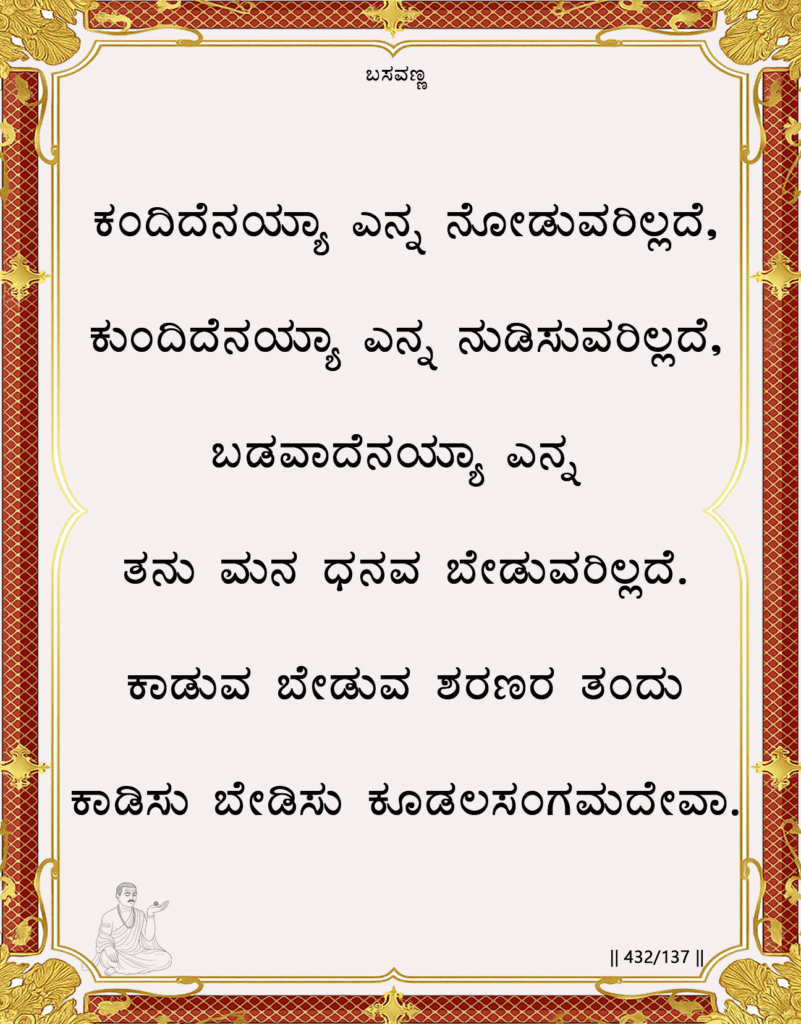
I wither, O Lord, with none to see me with
Your eyes.
I falter, O Lord, with none to speak
Your words with me.
I am poor, O Lord, with none to seek my body, mind, or wealth in Your service.
Send to me Your Sharanas,
let them test me, let them ask of me,
O Koodalasangamadeva!
This vachana reveals a profound and counter-intuitive stage of spiritual maturity. It is not a cry of loneliness for human company, but a lament of a soul that feels useless to the Divine cause. Basavanna articulates that the highest form of wealth for a devotee is to have their entire being their body, mind, and possessions sought after and utilized by the community of enlightened beings (Sharanas). True poverty is not a lack of resources, but the absence of an opportunity to offer oneself in service to truth.
Spiritual Context
Core Spiritual Principle: The culmination of devotion is not in receiving blessings but in becoming a blessing for others. The most sought-after spiritual state is to be a useful instrument in the divine work, where one’s entire existence is consumed in the service of truth.
Cosmic Reality Perspective: In the non-dual system, the Linga (Divine) expresses itself dynamically through the Jangama (the moving, realized community). For an individual Anga to remain unused by this divine expression is to be cut off from the living flow of grace. To be “used up” by the Sharanas is to achieve the ultimate purpose: to become one with the divine activity.
Historical Reality (Anubhava Mantapa Context): This Vachana is the philosophical bedrock of the Anubhava Mantapa’s communal economy. It inverts worldly values, defining wealth not as hoarding but as the capacity to give, and status not as being served but as being found worthy of service. It forges a society where every member’s highest aspiration is to be of use to the collective spiritual endeavor.
Interpretation
“I wither… with none to see me with Your eyes.”: This is the pain of a love that cannot be shared. To be “seen with Your eyes” means to be recognized and engaged by someone who perceives the Linga within you. Without this sacred mirroring, the soul feels its growth stunted.
“I falter… with none to speak Your words with me.”: This laments the absence of Satsangha (holy company). Spiritual truth is deepened and tested in dialogue with other seekers. The “words” are not casual talk but the shared language of the path that sustains and sharpens understanding.
“I am poor… with none to seek my body, mind, or wealth in Your service.”: This is the core of the teaching. “Wealth” here includes everything one is and has. True poverty is the state where these resources lie fallow, unused for the divine purpose. The devotee’s riches are their body for service (Kayaka), their mind for wisdom, and their material assets for Dasoha.
“Send to me Your Sharanas, let them test me, let them ask of me…”: This is a plea for the ultimate validation: to be tested and found useful. “Testing” is not a punishment but a graceit purifies the offering and proves its worth. The devotee yearns to be trusted with the needs of the enlightened.
Practical Implications: The seeker is guided to actively seek opportunities for selfless service, especially towards those more advanced on the path. The measure of spiritual progress becomes one’s willingness to be used up, to have one’s time, energy, and resources consumed for a cause greater than oneself.
The Cosmic Reality
Anga (Human Dimension): The individual who has overcome the ego’s desire to possess and be important. This Anga is a purified instrument, yearning to be wielded by a divine hand.
Linga (Divine Principle): Koodalasangamadeva as the ultimate source and owner of all. The devotee’s plea acknowledges that the Sharanas and the resources to be offered all belong to the Linga.
Jangama (Dynamic Interaction): The community of Sharanas represents the active, organizing intelligence of the Linga in the world. Their act of “asking” and “testing” is the divine mechanism through which the individual Anga is purified, integrated, and made meaningful.
Shatsthala
Primary Sthala: Aikya. This Vachana is the very essence of Dasoha. It is the stage where the understanding of “everything is God’s” matures into the passionate desire to “return everything to God” through service to His representatives.
Supporting Sthala: Sharana. One must first be a stable refuge for oneself (a Sharana) before one can become a reliable refuge and resource for others. This Vachana represents the natural outflow of the Sharana’s statea desire to extend that refuge to the entire community.
Practical Integration
Arivu (Awareness Practices): Meditate on the feeling of being an “unused instrument.” Contemplate the ways you hoard your time, energy, or resources. Cultivate an inner attitude of being a trustee, not an owner, of all that you have.
Achara (Personal Discipline): Practice proactive giving. Do not wait to be asked. Regularly audit your possessions, skills, and time, and ask, “How can this be of better service to my spiritual community or a higher cause?”
Kayaka (Sacred Action): Perform your work with the explicit intention that its fruits support spiritual growthyour own and others’. See your job as a means to fuel the divine work in the world.
Dasoha (Communal Offering): Make yourself available. Explicitly offer your skills and resources to your community. Be the person others can rely on, and see this not as a burden but as the highest privilege.
Modern Application
The “self-care” culture turned inward, leading to spiritual emptiness; the hoarding of resources (from money to attention); and a deep-seated sense of purposelessness despite material abundance.
This Vachana offers a cure for existential malaise: find a cause greater than yourself and give everything to it. It redefines success as usefulness, not wealth. It teaches that the way to find yourself is to lose yourself in service, and that the most profound fulfillment comes from being a vital, trusted part of a meaningful collective endeavor.
Essence
To see, to speak, to serve with all I own,
For this, my heart makes its deepest moan.
Not wealth, nor peace, nor bliss I seek,
But usage, till my being is spent and meek.
The Deeper Pattern (The Subtle Body): This Vachana describes a spiritual system striving for Maximum Entropy Transfer. A closed system (a self-centered life) has low entropy and leads to stagnation (“withering”). Basavanna’s plea is to become an open system, where his personal energy, resources, and consciousness (his internal low entropy) can be freely transferred and dissipated in service to the larger, ordered system of the Sangha. This flow of energy and resources increases the overall order (negentropy) of the spiritual community while giving his own existence its highest meaning. His “poverty” is a state of low thermodynamic potential, and he yearns for the Jangama to create a gradient that allows for a flow, making him a functional part of the cosmic engine.
In Simple Terms (The Gross Body): A tool feels no pride in its sharpness, only sorrow in its idleness. A river is not impoverished by giving its water to the ocean; it is fulfilled. Basavanna feels like a pristine, sharpened tool left in a drawer, or a river blocked from its sea. His wealth is his potential for use, and his poverty is the dam that blocks its flow.
The Human Truth (The Causal Body): The soul’s final and most profound desire is to be consumed in a purpose that outlasts it. We are not here to be happy, but to be useful. Our deepest poverty is not having nothing to give, but having no one to receive our gift. The ultimate fulfillment is to be so trusted that you are entrusted with the needs of the sacred.

Views: 2