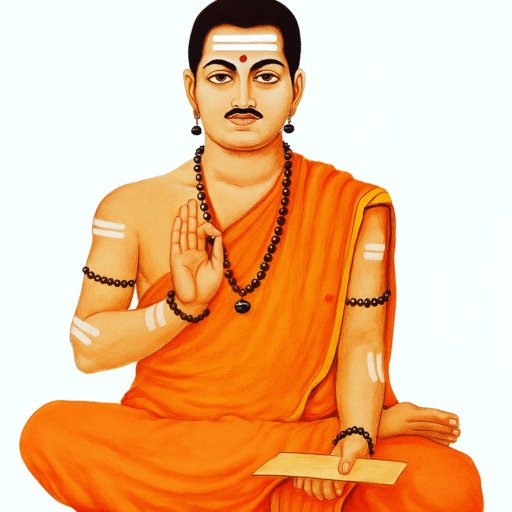

Poetic Rendering

My father is Madara Chennayya,
my elder is Dohara Kakkayya.
My younger is Kannayya,
my brother is Kinnari Bommayya.
O Koodalasangayya, tell me
who then is left as my kin?
The poet declares his true family: Madara Chennayya (a cobbler) is his father, Dohara Kakkayya (a tanner) is his elder, Kannayya (a weaver) is his younger, and Kinnari Bommayya (a musician) is his brother. He then asks Kudalasangama Deva who, after this, remains to be claimed as his kin, implying the old, birth-based family is now irrelevant.
Spiritual Context
Core Spiritual Principle: One’s true identity and kinship are defined solely by spiritual affinity and shared devotion to the Linga, not by the accident of birth. The Sangha (spiritual community) is the only family, and its members are bound by consciousness, not blood.
Cosmic Reality Perspective: The Linga, as the formless Divine consciousness, resides equally in all beings. To recognize hierarchy or superiority based on the body (Anga) is a fundamental error in perceiving cosmic reality. This vachana is a lived expression of the non-dual truth.
Historical Reality (Anubhava Mantapa context): This is perhaps the most politically and socially radical of Basavanna’s vachanas. It was a direct, public, and intentional repudiation of the caste system. By naming specific individuals from “untouchable” castes as his closest kin, Basavanna enacted the philosophy of the Anubhava Mantapa, creating a new social order based on spiritual meritocracy.
Interpretation
1. “My father is Madara Chennayya…” : The “father” represents the source of one’s spiritual life and values. By choosing a cobbler, Basavanna honors the dignity of labor (Kayaka) and states that his spiritual lineage comes from the wisdom of the oppressed, not from Brahminical texts.
2. “…my elder is Dohara Kakkayya.” : The “elder” signifies a guide and respected authority. A tanner, considered ritually impure, is elevated to this position, shattering the concept of ritual purity and impurity.
3. “…my younger is Kannayya…” : The “younger” represents one’s responsibility to nurture and protect. In embracing a weaver, he extends the family to include the artisan class, affirming that the community is a web of mutual care.
4. “…my brother is Kinnari Bommayya.” : A “brother” is an equal, a companion on the path. A musician-saint represents the equality of all in the joy of devotion and the arts as a path to God.
5. “O Koodalasangayya, tell me who then is left as my kin?” : The final question is a rhetorical triumph. It is not a query but a declaration. He has so completely filled the roles of family with his spiritual kin that the biological family of his birth holds no claim over his identity anymore.
Practical Implications: For a seeker, this means actively transferring one’s primary sense of belonging to the spiritual community. It involves seeing fellow devotees as one’s true family, offering them the loyalty, love, and support one would offer blood relatives, and dissolving prejudices based on social background.
The Cosmic Reality
Anga (Human Dimension): The human being liberated from the confines of a socially constructed identity (Brahmin, Shudra, etc.). The Anga is reborn into a new, expansive identity defined by its relationship to the Linga and the Jangama.
Linga (Divine Principle): Kudalasangama Deva as the ultimate witness and sanctifier of this new kinship. The Lord is the central point around which this new, casteless family orbits.
Jangama (Dynamic Interaction): The Jangama is dynamically embodied by each of the named Sharanas. They are not static symbols but the living, moving proof that the Divine flows freely through all human vessels, irrespective of caste. The community itself is the active, living Jangama principle.
Shata Sthala
Primary Sthala: Sharana. This vachana is the lived reality of the Sharana stage. A Sharana is one who has taken refuge in the Sangha. Here, Basavanna demonstrates this refuge so completely that his entire social identity is reconfigured around it.
Supporting Sthala: Aikya. The vision of a unified, casteless society where all are equal siblings in the spirit is a reflection of the non-dual state of Aikya manifesting at the social level.
Practical Integration
Arivu (Awareness): Cultivate the awareness that the Linga within you is identical to the Linga within every other being. Consciously challenge your own subconscious biases and preferences based on social status, wealth, or background.
Achara (Personal Discipline): Make it a personal discipline to treat everyone in the Sangha with the same respect and affection you would show your immediate family. Share meals and break bread with all, without discrimination.
Kayaka (Sacred Action): Honor all forms of honest labor. See the cobbler, the sweeper, and the CEO as equal participants in the cosmic dance of Kayaka, each offering their unique service.
Dasoha (Communal Offering): This vachana is the ultimate Dasoha the offering of one’s entire social identity for the sake of building a divine community. Your Dasoha is to actively build and protect this egalitarian fellowship.
Modern Application
While formal caste may be outlawed, modern society is deeply fractured by classism, racism, political tribalism, and systemic inequality. We still largely operate within inherited social silos and harbor unconscious prejudices that prevent genuine, universal brotherhood.
This vachana liberates by offering a vision of a chosen family. It calls us to consciously build communities based on shared values, spiritual aspiration, and mutual respect, rather than inherited identities. It gives us the courage to transcend the “family” of our birth be it national, racial, or economic and to claim a wider, more inclusive kinship with all of humanity.
Essence
My father mends the sole,
My brother tans the hide.
My kin are those whose hearts are whole,
With whom in God I now abide.
Metaphysically, this vachana enacts the dissolution of Upadhis (limiting conditionings). The Upadhis of caste and birth are consciously negated and replaced by the single, unifying Upadhi of being a “Sharana of Kudalasangama.” This is a practical application of the neti-neti (not this, not this) principle, leading to the discovery of the true Self that is beyond all social constructs.
Our most profound identities are not given to us by history or society; they are chosen by our hearts and convictions. The family that truly defines us is the one we consciously build with those who share our deepest values and our journey toward truth. This is the foundation for a truly free and unified human society.

Views: 6