Poetic Rendering

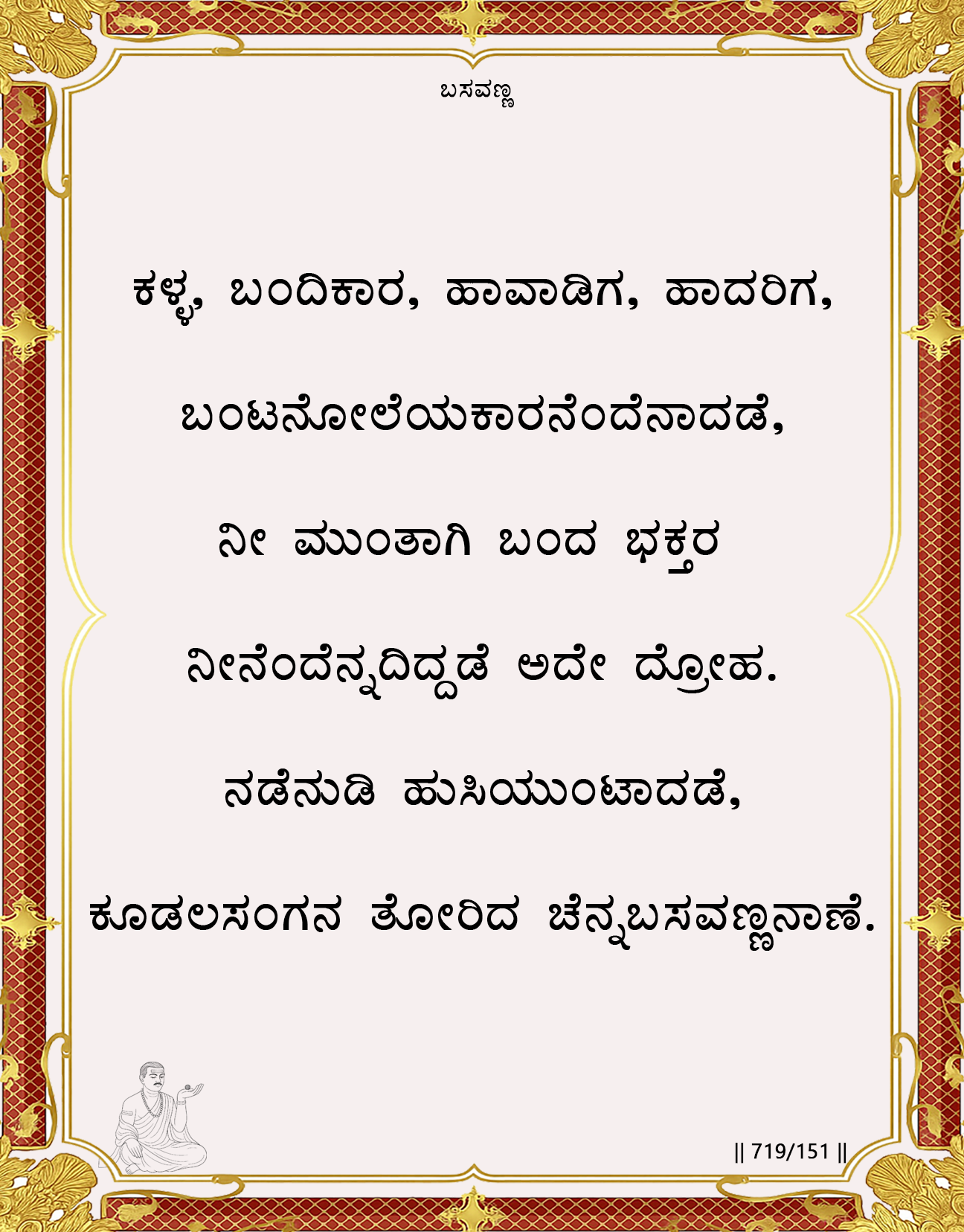
The thief, trapped by his fate,
the snake-charmed man lost in worldly lures,
the warrior who walks between truth and danger
in all of them, the Linga burns quietly within.
If I fail to see Your form in them,
if I do not bow to the Linga in their anga,
tell me, Kudalasangamadeva
whose fault is it but mine?
For the true companion of the Lord
dwells even in those we call fallen;
this hidden truth,
Chennabasavanna has made known
that he who sees You in all
is the one whose eyes have truly opened.
In this vachana, Basavanna teaches that the divine presence (the Linga) dwells equally in every human beingeven in those whom society condemns, such as thieves or those misled by worldly temptations. Just as a snake is charmed and loses awareness of its own nature, people too can be drawn away from their inner divinity. If we fail to recognize the same divine light in them that shines within us, it is not their mistake but our own blindness. True spiritual vision sees the Linga in all beings without distinction.
Spiritual Context
Core Spiritual Principle: The ultimate test of spiritual realization is the capacity to perceive the undiminished divine presence in every being, without exception. Judgment and condemnation of others are signs of one’s own un-purified perception.
Cosmic Reality Perspective: In the non-dual reality of Shivayoga, the Linga is the sole, all-pervading consciousness. It cannot be absent from any part of creation. The thief, the charmed man, and the warrior are all temporary roles (vasanas) played by the same divine actor. To see the role and not the actor is the fundamental error of ignorance (avidya).
Historical Reality (Anubhava Mantapa Context): This Vachana is the logical culmination of the Lingayat social revolution. It demolishes the final fortress of hierarchy: moral and spiritual judgment. By stating that the Linga resides even in the thief, it completes the rejection of caste-based purity and establishes a community founded on radical, divine inclusivity, where the focus is on one’s own perception, not the other’s status.
Interpretation
“The thief, the snake-charmed man, the warrior… in all of them, the Linga burns quietly within.”: Basavanna deliberately chooses figures society scorns or fears. The “thief” acts from inner poverty; the “snake-charmed man” is deluded by worldly magic (maya); the “warrior” is bound by duty and violence. Yet, the divine spark (Linga) is untouched by these temporary conditions, “quietly burning” as their essential nature.
“If I fail to see Your form in them… whose fault is it but mine?”: This is a profound admission of responsibility. Spiritual failure is redefined not as a lack of mystical experience, but as a failure of compassionate perception. The “fault” is a flaw in one’s own spiritual vision, a cataract of judgment on the eye of the soul.
“Chennabasavanna has made known that he who sees You in all is the one whose eyes have truly opened.”: This credits Chennabasavanna with crystallizing this ultimate insight. “Eyes have truly opened” signifies the dawn of jñana-drishti (wisdom-vision). It is the final healing of the divided gaze that sees “self” and “other,” “pure” and “impure.”
Practical Implications: The seeker is called to practice seeing the Linga in everyone, especially in those they dislike, fear, or judge. The central spiritual practice becomes the cultivation of this unifying vision, where every encounter is an opportunity to bow to the Divine within the other.
The Cosmic Reality
Anga (Human Dimension): Every individual human form, without exception. Each Anga is a temporary vessel for the Linga, regardless of the vessel’s apparent cleanliness or corruption.
Linga (Divine Principle): Koodalasangamadeva as the immutable, all-pervading consciousness that is the true substance of every Anga.
Jangama (Dynamic Interaction): The dynamic is the act of seeing and honoring. The true Jangama is not just the wandering saint, but the sacred relationship of recognition that flows between one Anga and another when both are seen as manifestations of the same Linga.
Shatsthala
Primary Sthala: Aikya. This Vachana describes the perceptual state of the Aikya stage. Union is not just an internal feeling but an all-encompassing way of seeing the world. When one sees the Linga in all, one is living the reality of Aikya.
Supporting Sthala: Sharana. The Sharana, by taking refuge in the Linga, implicitly takes refuge in all that contains the Linga. This Vachana reveals the fullest implication of what it means to be a Sharana.
Practical Integration
Arivu (Awareness Practices): Practice “Linga Darshan” with every person you meet. Silently acknowledge, “The same Linga that is in me is in you.” Do this especially with difficult people.
Achara (Personal Discipline): Discipline the mind to withhold judgment. When a critical thought about another arises, immediately counter it with the remembrance: “The Linga resides within them too.”
Kayaka (Sacred Action): Let your work be an offering to the Divine in others. Serve your customers, colleagues, and clients as if you are serving the Jangama itself.
Dasoha (Communal Offering): Extend your service and compassion without discrimination. The community of the Divine includes everyone. The highest Dasoha is to affirm the divine worth of those whom society has cast out.
Modern Application
Cancel culture, political and social polarization, online shaming, and the pervasive habit of reducing individuals to their worst actions or opinions. The deep-seated “us vs. them” mentality.
This Vachana offers the only true antidote to a fractured world. It teaches that social healing begins with perceptual healing. It does not ask us to condone harmful actions, but to separate the action from the actor’s inherent divinity. It is a call to build a society based on the unshakeable recognition of shared sacredness, which is the only foundation for lasting justice and peace.
Essence
In thief, in fool, in foe, in friend,
The self-same light, without an end.
The fault is mine, the vision blurred,
To not see God in all, absurd.
The Deeper Pattern (The Subtle Body): This Vachana describes the achievement of Non-Dual Perception, which is a state of Quantum Coherence in Consciousness. The ordinary mind operates by collapsing the wave function of every person it meets into a definite, limited state: “thief,” “enemy,” “sinner.” This is decoherence. The awakened sight maintains the superposition. It sees the classical, manifested role (the thief) while simultaneously perceiving the quantum potential of the divine ground state (the Linga). This is a coherent perception that does not reduce the other to a single narrative. The “fault” is the habitual decoherence caused by the ego’s need to label and separate.
In Simple Terms (The Gross Body): A stained-glass window may be covered in dirt or mud, obscuring its colors and design. An ignorant person sees only the dirt and judges the window as worthless. A person with “opened eyes” knows that the dirt is temporary and superficial, and that the brilliant, light-filled image within remains perfectly intact, waiting to be revealed. Basavanna commands us to see the eternal stained-glass of the Linga in every human window, regardless of the dirt.
The Human Truth (The Causal Body): The way you see others is the clearest reflection of your own spiritual state. If you see sin and separation everywhere, you are projecting your own inner division. If you see divinity everywhere, you are abiding in your own. The final spiritual practice is to clean the lens of your own perception until you can no longer find anyone who is not God.

Views: 0