Poetic Rendering

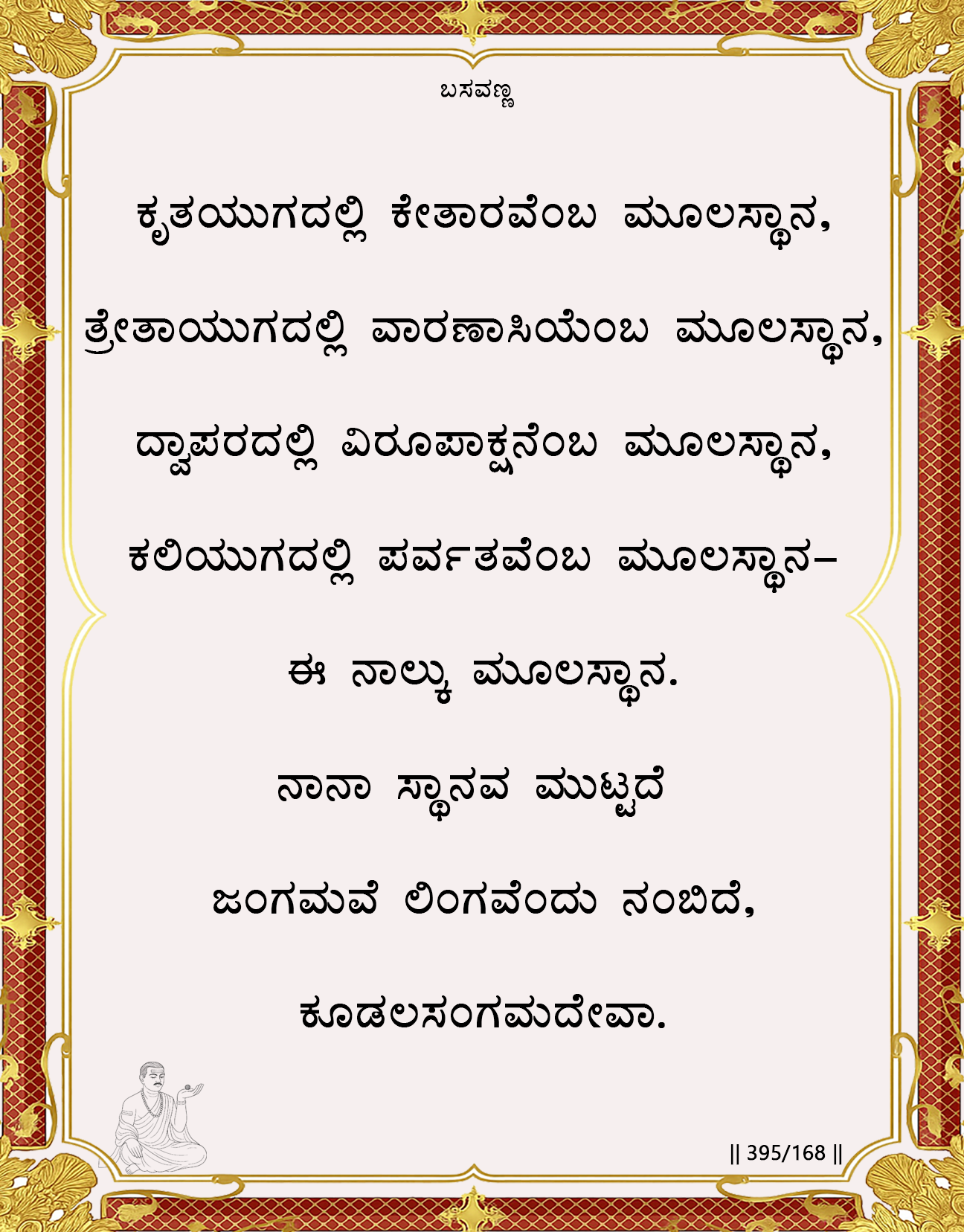
In Satya Yuga, they sought Kedar;
in Treta, they journeyed to Varanasi;
in Dvapara, Virupaksha was hailed as the root of holiness;
and now, in Kali Yuga, they climb Śrishaila’s mountain shrine.
But what use is wandering to stone and hill,
what gain in touching distant places,
if the heart remains untouched?
For me, O Kudalasangamadeva,
the living Jangama is the true temple,
the embodied Lord before me
there lies my pilgrimage,
there lies my worship
This vachana declares that true pilgrimage is not found in traveling to distant sacred sites but in recognizing and serving the divine in living beings. Basavanna rejects the external, era-specific forms of worship tied to holy places and emphasizes inner transformation and devotion to the living Jangamathe embodied presence of God in the devotee. He teaches that spiritual merit does not come from touching stones or mountains, but from touching the heart with devotion, humility, and service. For Basavanna, the living human form carrying the divine is the ultimate temple and the true path to Kudalasangamadeva.
Spiritual Context
Core Spiritual Principle: The divinity of dynamic consciousness over static form. God is not to be found in a place, but in a presence. The most sacred pilgrimage is the movement of reverence towards the divine consciousness alive in a human being, which shatters the duality between the worshipper, the worshipped, and the place of worship.
Cosmic Reality Perspective: This vachana embodies the ultimate non-dual realization of Shiva-Shakti. The static temples and mountains represent Shiva as the transcendent, unmoved principle. The Jangama represents Shakti as the dynamic, immanent, and moving expression of that principle. Basavanna declares that to worship the moving, living Shakti (the Jangama) is to directly worship Shiva, for they are inseparable. The formless is perfectly accessible through the form that is conscious of it.
Historical Reality (Anubhava Mantapa Context): This is a radical democratization and internalization of spiritual authority. It dismantles the entire economy of pilgrimage controlled by priestly classes and redirects spiritual energy and resources back into the community. The true “tirtha” (crossing-place) is not a geographic location but the human heart, and the true “priest” is any enlightened sharana. This empowered the common devotee, making God immediately accessible in their midst.
Interpretation
“In Satya Yuga… in Treta… in Dvapara… and now, in Kali Yuga…” By listing the holy sites of each age, Basavanna does not deny their historical significance but relativizes them. He shows that external forms of worship are conditional and change with time (yuga-dharma), implying they are not the eternal truth.
“But what use is wandering to stone and hill… if the heart remains untouched?” This is the core critique. The physical journey is futile if it does not catalyze an inner, psychological transformation. The “stone” is the inert object; the “heart” is the living subject. Spirituality must transform the subject.
“For me… the living Jangama is the true temple, the embodied Lord before me” This is the revolutionary declaration. The “Jangama” is both the wandering monk and, esoterically, the dynamic divine principle moving within all. To see the “embodied Lord” in the Jangama is to perceive the Linga not as a stone on a body, but as the very life-force (prana) and consciousness of the devotee.
Practical Implications: The practitioner’s primary focus must shift from external pilgrimages to the sacred duty of perceiving the divine in every human encounter, especially in fellow sharanas. Service (dasoha) to the community becomes the highest form of pilgrimage.
The Cosmic Reality
Anga (Human Dimension): The Anga is re-purposed. Its feet need not wander; its eyes are to see the Divine in the neighbor; its hands are to serve the living temple. The pilgrimage of the Anga is an inward journey of perception and service.
Linga (Divine Principle): The Linga is dynamized. It is not confined to a fixed point in space (a temple) but is a mobile, conscious presence. It is “Koodalasangamadeva”the union (sangama) that happens in the immediate moment (koodala) within the living being (deva).
Jangama (Dynamic Interaction): The Jangama is the central reality. It is the perpetual pilgrimage of God among humanity. The Jangama is the bridge that makes the transcendent immanent. The act of honoring the Jangama is the dynamic that sustains the world.
Shata Sthala
Primary Sthala: Sharana (Total Refuge) The speaker has taken total refuge not in a place, but in a principlethe principle that God is found in the living Jangama. This is the essence of the Sharana stance: a total reorientation of one’s spiritual compass away from all externalities to the living truth.
Supporting Sthala: Pranalingi (One for whom Linga is Life-Breath) The vachana points towards the Pranalingi stage, where the Linga is so internalized that it becomes one’s very life breath. The Jangama is the external manifestation of this stagea person for whom the Linga is not an external symbol but the animating core of their being, making them a “living temple.”
Practical Integration
Arivu (Awareness Practices): Practice seeing the “Jangama” in everyone you meet. Cultivate the perception that the person before you is a moving temple, a manifestation of the divine consciousness. Let this perception govern your thoughts and interactions.
Achara (Personal Discipline): Let your personal discipline include honoring the living. This could be as simple as a conscious greeting, a respectful attitude, and a commitment to non-harm, seeing each being as a sacred site.
Kayaka (Sacred Action): Let your work be an offering to the “living temple” of society. Whether you build, heal, teach, or clean, see your labor as maintaining the sanctity of the collective human temple.
Dasoha (Communal Offering): This is the ultimate expression of this vachana. The community itself is the pilgrimage circuit. Serving the community (sangha) is the highest worship. Organize and participate in acts of service that nurture the collective body of the Jangama.
Modern Application
We live in an age of spiritual tourism and destination worship. People travel vast distances to sacred sites, often treating them as items on a checklist, while remaining disconnected from their families, communities, and inner selves. This external seeking can be a form of escapism that avoids the harder work of inner transformation and building sacred community locally.
This vachana liberates us from the need for expensive, time-consuming pilgrimages. It reveals that the most profound spiritual work is right where we are. It calls us to invest our reverence, service, and resources into our local communitiesto see our neighbors, colleagues, and even adversaries as “living temples.” This transforms everyday life into a continuous pilgrimage and builds heaven on earth in our immediate surroundings.
Essence
To Kedar, Kashi, in ages past,
To sacred hills, their fate was cast.
But stone stays stone, and hill stays still,
Unless the heart does God’s will.
My temple walks, it breathes, it sees,
In every Jangama, Koodalasangama, at ease.
The Deeper Pattern: This vachana describes a fundamental shift from a geodesic to an ontological understanding of the sacred. A geodesic view locates sacredness in specific coordinates of spacetime (latitude/longitude of a temple). Basavanna proposes an ontological view where sacredness is a quality of conscious, enlightened being. The “pilgrimage” is therefore not a movement through space, but an elevation in the level of consciousnessfrom perceiving inert matter to perceiving conscious divinity.
In Simple Terms: It is the difference between traveling to a famous art museum to see a masterpiece locked in a climate-controlled room, and realizing that the living, breathing artist is standing right in front of you, capable of creating infinite new masterpieces. The museum (stone temple) contains a dead artifact of past genius; the artist (Jangama) is the living source of genius itself.
The Human Truth: The universal human instinct is to project divinity onto distant, idealized objectsmountains, statues, faraway cities. This allows us to adore God without the challenging demand of adoring the difficult person next to us. The timeless truth here is that God is not distant. The ultimate test and fulfillment of our spirituality is to recognize the divine in the immediate, the human, and the dynamicto find the infinite temple in the finite, living human being.

Views: 0