Poetic Rendering

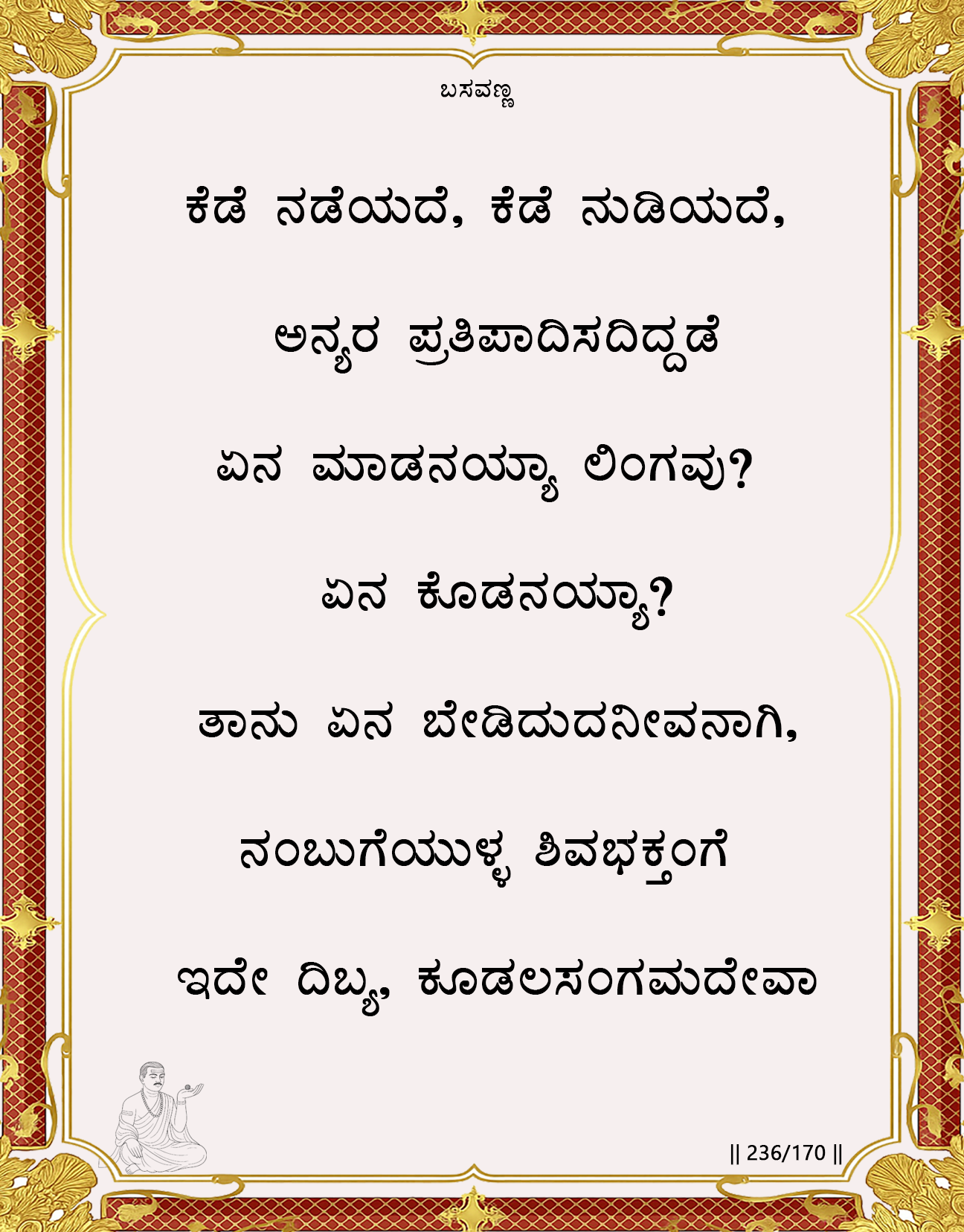
If my steps stray in action,
if my words stray in speech,
if my mind belittles another
what can the Linga do for me?
How can grace descend
when I myself am divided
one thing in deed, another in speech,
yet another in thought?
Whatever I may ask,
it bears no fruit unless
my whole being stands united
in the vow of true devotion.
Only the one whose body, speech, and mind
move as one in Shiva’s path
is worthy of Your blessing,
O Kudalasangamadeva.
This vachana teaches that spiritual progress depends on the alignment of thought, speech, and action. Basavanna emphasizes that no ritual, symbol, or divine presence can help a person who lives in inner contradictionacting one way, speaking another, and harboring judgment in the heart. Merely asking for blessings or possessing the Linga is futile when the self remains fragmented. True devotion arises when the entire being moves in harmony, free from hypocrisy and contempt toward others. Only such integrated sincerity allows one to receive the grace of Kudalasangamadeva.
Spiritual Context
Core Spiritual Principle: Integral Unity as the foundation for grace. Spirituality is not an addition to life but the seamless integration of all its dimensions. The fragmentation of the inner being (body, speech, mind) creates a barrier that divine grace cannot cross. Wholeness is not the goal but the prerequisite for the journey.
Cosmic Reality Perspective: This vachana reflects the non-dual state of Shiva, who is absolute integrity and consciousness. The human being, as a manifestation of Shakti, must mirror this integrity. When thought, word, and deed are in conflict, Shakti is at war with itself, creating dissonance that prevents resonance with the unified field of Shiva-consciousness. The “threefold dharma” is the practical application of non-duality.
Historical Reality (Anubhava Mantapa Context): In a social context rife with ritualistic hypocrisywhere priests performed perfect rituals while upholding caste-based contemptthis vachana was a revolutionary ethical standard. It defined the Lingayoga path as one of radical self-accountability and integrity. It ensured that the community of sharanas was built on trust and authenticity, where a person’s inner state was reflected in their outer conduct.
Interpretation
“If my steps stray in action (deed)…” This refers to Kaya Kriya (bodily action). Action that is not aligned with divine will (e.g., harmful, greedy, or lazy conduct) creates negative karma and disrupts the physical foundation of practice.
“…if my words stray in speech…” This refers to Vacha Kriya (speech action). Lying, gossiping, or harsh speech creates vibrational pollution and breaks the integrity between the inner and outer world.
“…if my mind belittles another…” This refers to Mana Kriya (mental action). Contempt or judgment is the most subtle and insidious fracture, as it corrupts the very source of intention and separates the self from the divine presence in others.
“what can the Linga do for me?” This is a statement of spiritual law, not a limitation of God. The Linga is the conduit of grace, but a fractured instrument cannot conduct the current. The problem is not with the power source but with the wiring.
“Only the one whose body, speech, and mind move as one… is worthy of Your blessing.” This defines the qualified recipient. “Worthiness” here is not a moral judgment but a statement of functional readiness, like a radio being tuned to the correct frequency to receive a broadcast.
Practical Implications: The practitioner must engage in constant self-auditing. Before acting, speaking, or even entertaining a thought, one must check for alignment with the core principles of truth, non-harm, and devotion. Spiritual practice begins with this moment-to-moment integration.
The Cosmic Reality
Anga (Human Dimension): The Anga is the triad of body, speech, and mind. Its sacred purpose is to function as a unified vehicle for the Divine. When these three are misaligned, the Anga is like a chariot with wheels pulling in different directionsit goes nowhere.
Linga (Divine Principle): The Linga is the absolute standard of unity and coherence. It is the state of perfect integration. It can only reflect itself in a consciousness that has achieved a corresponding degree of inner unity.
Jangama (Dynamic Interaction): The Jangama is the active, moment-to-moment practice of creating alignment. It is the process of “tuning” the body, speech, and mind. A true Jangama (the moving devotee) is one whose very existence demonstrates this threefold unity in action.
Shata Sthala
Primary Sthala: Sharana (Total Refuge) The vachana describes the essential qualification of the Sharana. Taking refuge means offering one’s entire being without reservation or hidden fragmentationto the Divine. A divided heart cannot take total refuge.
Supporting Sthala: Maheshwara (Lord of the Cosmic Play) Understanding and mastering this threefold dharma is the work of a Maheshwara. This stage involves conscious lordship over one’s entire being, skillfully orchestrating thought, word, and deed to consciously participate in the divine play, rather than being a victim of one’s own contradictions.
Practical Integration
Arivu (Awareness Practices): Practice the “Threefold Check”: Before any significant action, pause and observe if your intended action, the words you would use, and the feeling in your heart are in harmony. This builds the muscle of inner integration.
Achara (Personal Discipline): Make truthfulness (satyam) and non-harm (ahimsa) your core disciplines, applying them equally to your thoughts, your words, and your actions. A disciplined mind is the key to unifying the other two.
Kayaka (Sacred Action): Let your work be a field for practicing this unity. Do your job with full mental presence (mind), skillful effort (body), and honest communication (speech). This turns profession into a spiritual practice of integration.
Dasoha (Communal Offering): Build a community that values and supports this integrity. Encourage an environment where members gently help each other see their own contradictions, fostering collective growth towards wholeness.
Modern Application
Modern life is characterized by profound fragmentation. We cultivate a curated image on social media (speech) that conflicts with our private actions (deed), while our inner world is filled with anxiety, judgment, and comparison (mind). This leads to existential stress, inauthenticity, and a feeling of being spiritually blocked despite various practices.
This vachana provides the ultimate antidote to modern fragmentation: the practice of radical integrity. It teaches that the path to peace and grace is not another technique, but the courageous work of aligning our digital persona, our professional life, and our private thoughts into a single, truthful expression. This integration is the very foundation of mental health and spiritual progress.
Essence
The straying step, the lying tongue,
The mind that does another wrong.
A fractured self, a blocked-up door,
Can grace, then, enter any more?
But when the three are made as one,
The sacred work is well begun.
The Deeper Pattern: This vachana describes a fundamental principle of systems theory: a system (the human being) must achieve a sufficient degree of internal coherence (subsystem alignment) to successfully interface with a larger, more complex system (the Divine). The dissonance between misaligned thoughts, words, and deeds creates destructive interference patterns that cancel out the signal of grace. Integration creates constructive interference, amplifying the signal and allowing for a stable connection.
In Simple Terms: It is like a three-person team trying to row a boat across a river to a destination (the Linga). If one rows forward, one backward, and one is busy criticizing the others, the boat spins in circles. Only when all three row in unison, with synchronized strokes and a shared purpose, does the boat move directly and efficiently toward the goal. The river (grace) supports the journey, but it cannot row the boat for you.
The Human Truth: The universal human struggle is the inner conflict between what we know, what we say, and what we do. This conflict is the primary source of guilt, shame, and a sense of spiritual inadequacy. The timeless truth here is that God is not found by adding something new, but by subtracting the divisions within. The most profound spiritual practice is to become whole, to heal the rift between the person we pretend to be and the person we actually are, and in that wholeness, we find that grace was waiting for us all along.

Views: 0