Poetic Rendering

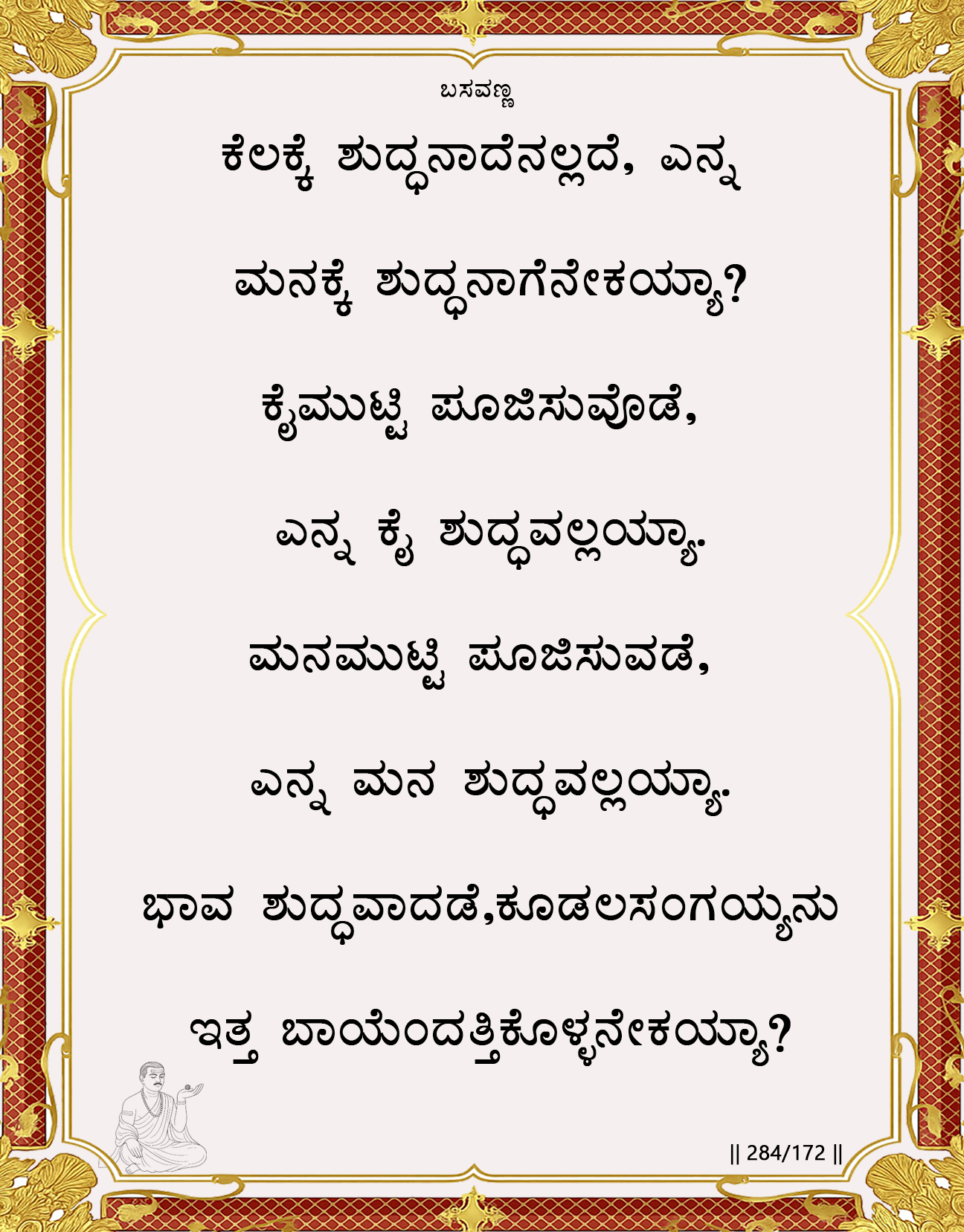
Though my hands are clean,
why is my mind still impure?
Touching the Linga with these hands
does not make the hands holy.
Touching with the mind alone
does not make the mind pure.
Only when the whole being
body, mind, and breath
turns stainless in truth,
will You, Kudalasangamadeva,
call us close and lift us up.
This vachana reveals that purity is not achieved through external cleanliness or ritual contact with the Linga, but through inner transformation. Basavanna rejects superficial spirituality, insisting that merely touching sacred objects or performing devotional acts cannot cleanse a mind still filled with impurity and fragmentation. True sanctity arises only when one’s entire being thought, emotion, intention, and action aligns in sincerity and truth. When such inner wholeness is cultivated, divine grace naturally draws the devotee nearer, for Kudalasangamadeva responds not to ritual gestures, but to authentic inner purity.
Spiritual Context
Core Spiritual Principle: The non-transferability of purity. Purity (shuddhi) is a quality of consciousness, not a substance that can be transmitted by contact. Spiritual practice is the alchemy of transforming the very substance of one’s being, not the performance of rituals that leave the core self unchanged. Grace meets wholeness, not ritual.
Cosmic Reality Perspective: This vachana addresses the relationship between the gross (sthula) and subtle (sukshma) bodies. The “clean hands” represent the purified gross body. The “impure mind” represents the unpurified subtle body (the realm of thoughts, desires, and samskaras). Shiva (Linga) is the transcendent reality that encompasses and transcends both. For union to occur, all layers of the seeker’s being must be purified and aligned; a purified gross body alone is insufficient to bridge the gap to the Divine.
Historical Reality (Anubhava Mantapa Context): This is a direct critique of ritualistic Brahminism, where physical purity codes (bathing, avoiding pollution) were paramount. Basavanna declares these external observances spiritually futile if the inner landscape of the mind remains cluttered with ego, desire, and duality. It reinforces the Lingayoga path as one of radical inner work, where the real battle is against internal impurities, not external pollutants.
Interpretation
“Though my hands are clean, why is my mind still impure?” This is the central, painful self-inquiry. It acknowledges the disconnect between external conformity and internal reality, which is the root of spiritual hypocrisy.
“Touching the Linga with these hands does not make the hands holy.” This deconstructs the magical or transactional view of worship. The Linga is not a talisman that confers holiness by touch. The power of the symbol lies in its ability to reflect the state of the worshipper.
“Touching with the mind alone does not make the mind pure.” This also cautions against a purely mental or intellectual spirituality. Just imagining or thinking about God is not enough if those thoughts are not backed by a transformed character and purified emotional substance.
“Only when the whole being… turns stainless in truth, will You… call us close and lift us up.” This is the resolution. “Whole being” implies the integration of body, vital energy, mind, and intellect. “Stainless in truth” means a state free from the stains of ego, deceit, and division (ashuddhi). This integrated purity is the true magnet for grace.
Practical Implications: The practitioner must focus on achieving inner coherence. The practice is not just meditation or ritual, but the continuous effort to align one’s actions, words, and thoughts with the highest truth one perceives, thereby forging an undivided consciousness.
The Cosmic Reality
Anga (Human Dimension): The Anga is the complete psycho-physical instrument that must be tuned as a single unit. A fragmented Anga (clean body, dirty mind) is like a broken radio; it cannot receive the clear signal of the Divine, no matter how close it is placed to the source.
Linga (Divine Principle): The Linga is the pure, unwavering signal of divine consciousness. It is “Koodalasangamadeva” the union that happens only when the receiving instrument is fully attuned. It does not “lift up” the seeker; it is the seeker’s own integrated purity that allows them to rise to its frequency.
Jangama (Dynamic Interaction): The Jangama is the process of “turning stainless.” It is the dynamic, active purification and integration of all aspects of the self. This is the true “prayer” not a request spoken by a divided self, but the very act of becoming whole, which is itself the answer.
Shata Sthala
Primary Sthala: Sharana (Total Refuge) The vachana describes the ultimate meaning of taking refuge. It is not a partial offering (“my hands but not my mind”). To be a Sharana is to offer one’s entire, undivided being” body, mind, and breath” as a single, integrated offering to the Divine.
Supporting Sthala: Prasadi (Recipient of Grace) One becomes a true Prasadi when this inner work is accomplished. Grace is not a reward but the natural consequence of having prepared a vesselan integrated consciousness capable of containing it without breaking or corrupting it.
Practical Integration
Arivu (Awareness Practices): Practice observing the inner schism. Notice when your actions are correct but your mind is resentful, or when you speak kindly but harbor judgment. This awareness of fragmentation is the first step toward integration.
Achara (Personal Discipline): Let your discipline be to heal this split. If you perform a ritual, ensure your mind and heart are fully present in it. If you cannot, it is better to sit silently and work on unifying yourself than to perform the ritual with a divided heart.
Kayaka (Sacred Action): Use your work to practice inner unity. Bring your full, undivided attention to your labor. Let the work itself be a meditation that unifies body, mind, and spirit in a single, purposeful flow.
Dasoha (Communal Offering): In community, help each other strive for this integrity. Create a culture where people are supported in being their whole, authentic selves, without the pressure to perform a superficial piety that hides inner fragmentation.
Modern Application
We live in a culture of performative wellness and curated personas. We maintain a “clean” external image on social media while our inner world is filled with anxiety, comparison, and unresolved trauma. We engage in wellness rituals (yoga, meditation) as another form of performance, often without addressing the deep divisions within. This leads to a sense of emptiness and inauthenticity.
This vachana offers a path to profound authenticity. It liberates us from the tyranny of spiritual performance and calls us to the more demanding, but ultimately fulfilling, work of inner integration. It teaches that the goal is not to look holy, but to be whole. Peace and grace are the natural states of a unified being.
Essence
The hands are washed, the rite is done,
But still the mind obscures the sun.
No touch, no thought, can make one pure,
Until the self is whole and sure.
Then, not by asking, but by being,
Comes the grace that sets hearts freeing.
The Deeper Pattern: This vachana describes the quantum principle of entanglement as a spiritual law. For a system (the seeker) to become “entangled” or united with another system (the Divine), it must first achieve a state of internal coherence. A system in a state of decoherence (fragmented mind and body) cannot form a stable quantum bond with anything. The “stainless truth” is the state of maximum internal coherence, which then allows for a non-local connection (grace) to be established.
In Simple Terms: It is the difference between a choir singing in unison and one where each singer is on a different page. The unified choir produces a harmonious sound that can fill a cathedral and move listeners to tears. The disordered choir produces only noise. The conductor (God) responds to the unified choir, not because of a preference, but because that is the only sound that can truly reach and harmonize with the divine frequency.
The Human Truth: The fundamental human suffering is the feeling of being divided against our selves knowing what is right but doing what is easy, wanting peace but cultivating anger. The timeless truth here is that God is not found by adding a new layer to this divided self, but by healing the divisions within. The most powerful prayer is not a request spoken by a fractured being, but the silent, powerful act of that being becoming whole. In that wholeness, the separation from the Divine collapses.

Views: 2