
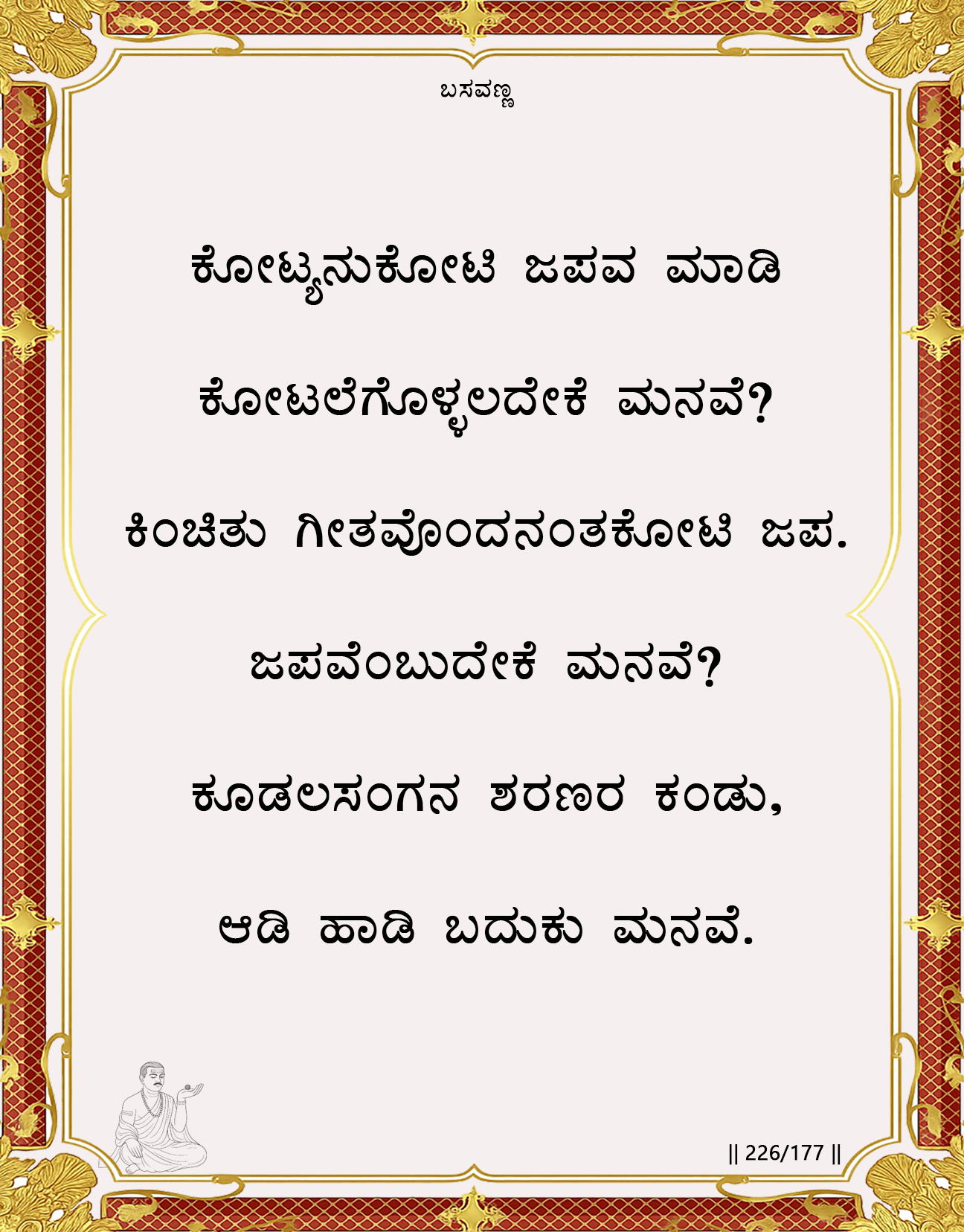
Poetic Rendering

Why weary yourself, O mind,
with crores upon crores of chants?
One song of love, sung with your whole being, outweighs endless repetition.
What is chanting, O mind, without feeling?
See the sharanas of Koodalasangama they sing, they dance, they live
and their very breath becomes prayer.
In this vachana, Basavanna dismantles the notion that spiritual merit increases through sheer volume of recitation. He reveals that chants without feeling are empty echoes sound without resonance. True prayer arises not from the tongue but from the heart that burns with love, transforming every breath into remembrance. The sharanas embody this living devotion: their singing, their movement, their very way of being flows naturally as worship, without strain or calculation. For Basavanna, spirituality becomes authentic only when devotion permeates life itself, turning existence into a continuous, effortless offering to Kudalasangamadeva.
Spiritual Context
Core Spiritual Principle: The primacy of bhava (feeling/essence) over kriya (ritual action). True devotion is a state of being, not a performance. When the heart is fully engaged, every action becomes worship. The goal is to infuse life itself with the quality of prayer, moving beyond segmented spiritual practice to a holistic, lived spirituality.
Cosmic Reality Perspective: This vachana distinguishes between Shakti as mere repetitive motion (mechanical chanting) and Shakti as conscious, loving energy (living prayer). The former is inert and does not resonate with the dynamic, conscious Shiva. The latter, where Shakti is fully awakened and lovingly oriented toward Shiva, creates a harmonious union. The sharanas embody this state where Shakti (their life energy) is in constant, joyful communion with Shiva.
Historical Reality (Anubhava Mantapa Context): This vachana champions the ecstatic, participatory devotion of the Lingayoga path over the dry, priestly recitations of Vedic ritualism. It validates the community’s expressive practicessinging, dancing, and composing vachanasas superior forms of worship. It democratizes spirituality, making it accessible to all who can love deeply, regardless of their capacity for complex ritual or scriptural memorization.
Interpretation
“Why weary yourself… with crores upon crores of chants?” This questions the economy of spiritual merit based on quantity. It exposes the ego’s tendency to seek achievement and accumulation even in devotion.
“One song of love, sung with your whole being, outweighs endless repetition.” This establishes the new economy based on quality and integrity. “Whole being” (sarvanga bhakti) implies the dissolution of the separation between the chanter and the chant. The offering is not the sound, but the self through the sound.
“What is chanting, O mind, without feeling?” This identifies the missing element: bhakti bhava. Without the emotional and intentional core, words are empty shells, devoid of the power to connect with the Divine.
“See the sharanas… their very breath becomes prayer.” This presents the ideal. For the realized sharana, the distinction between sacred and profane collapses. Life is not punctuated by prayers; life is prayer. The “breath” signifies the most fundamental, involuntary life process, indicating a devotion that is as natural and essential as living itself.
Practical Implications: The practitioner is encouraged to focus on the depth and sincerity of their practice rather than its duration or volume. The aim is to bring heartfelt presence into every action, gradually blurring the line between formal worship and daily life until all of life is a sacred offering.
The Cosmic Reality
Anga (Human Dimension): The Anga is the instrument that must be tuned to the frequency of love. When it performs rituals mechanically, it is out of tune. When it acts with full feeling and integration, it becomes a perfect resonator for the divine.
Linga (Divine Principle): The Linga is the essence of love and consciousness. It is not deafened by loud repetition but is moved by the authentic cry of the heart. It responds to the song, not the singer’s tally of songs.
Jangama (Dynamic Interaction): The Jangama is the state where the Anga and Linga are in constant, dynamic communion. It is not a scheduled meeting but an ongoing relationship. The “living prayer” is this uninterrupted Jangamathe flow of life itself as a dialogue with the Divine.
Shata Sthala
Primary Sthala: Sharana (Total Refuge) The vachana describes the lived reality of a Sharana. Taking refuge means offering one’s entire life every song, every step, every breath as prayer. It is the total immersion of the self in the divine milieu.
Supporting Sthala: Pranalingi (One for whom Linga is Life-Breath) The image of breath as prayer perfectly captures the Pranalingi stage. The Linga is no longer an external object of worship but has become as intimate and essential as the breath itself, the very source and substance of life.
Practical Integration
Arivu (Awareness Practices): Practice infusing mundane activities with loving awareness. While washing a dish, feel it as an act of service; while walking, feel it as a circumambulation of the divine. Let the feeling of devotion be the background of all awareness.
Achara (Personal Discipline): Let your discipline be to cultivate a heartfelt connection in your formal practices. Chant one mantra with full feeling rather than a hundred mechanically. Quality of attention is the true discipline.
Kayaka (Sacred Action): Re-consecrate your work. See your labor not as a job but as an offering of your skills and energy to the Divine. Let the quality of your work be an expression of your love.
Dasoha (Communal Offering): Create communities that celebrate this living devotion. Gatherings should be spaces for heartfelt singing, sharing, and service, where the collective energy itself becomes a powerful, living prayer.
Modern Application
We live in a culture of productivity and optimization that has infected spirituality. People track their meditation minutes, count their mantras, and pursue spiritual practices as another form of achievement. This leads to “burnout” in practice and a disconnect between spiritual routine and the rest of life, which remains un-sacralized.
This vachana liberates us from spiritual performance anxiety. It invites us to shift from “doing” spirituality to “being” spiritual. It shows that the path is about falling in love with the Divine and letting that love inform every moment. This makes spirituality a joyful, sustainable, and deeply integrated way of life, not another item on a to-do list.
Essence
A crore of chants, a weary mind,
A single song, with heart aligned.
Not in the count, the merit lies,
But in the truth that in it flies.
So let my life, not just my word,
Become the sweetest prayer heard.
The Deeper Pattern: This vachana describes the difference between digital and analog signaling in spiritual communication. Mechanical chanting is like a digital signal: it has the correct data (the words) but can be cold, discrete, and lacking in the rich, continuous waveform of feeling. The “living prayer” of the sharana is an analog signal: a continuous, warm, rich wave of conscious love that carries the essence of the message perfectly. The Divine, as a field of consciousness, resonates with the analog signal of heartfelt presence, not the digital data of empty repetition.
In Simple Terms: It is the difference between a child robotically saying “I love you” a thousand times because it was programmed to do so, and a child looking into its mother’s eyes and saying “I love you” once with all its heart. The latter communicates the entire universe of the sentiment; the former is just noise.
The Human Truth: We often confuse effort with essence and quantity with quality. We believe that if we just do more, we will be more spiritual. The timeless truth here is that God seeks our heart, not our resume. The most profound connection is made in the depth of a single, authentic moment, not in the accumulated weight of a million hollow ones. True devotion is the art of turning our entire existence into one continuous, loving look toward the Divine.

Views: 1