Poetic Rendering

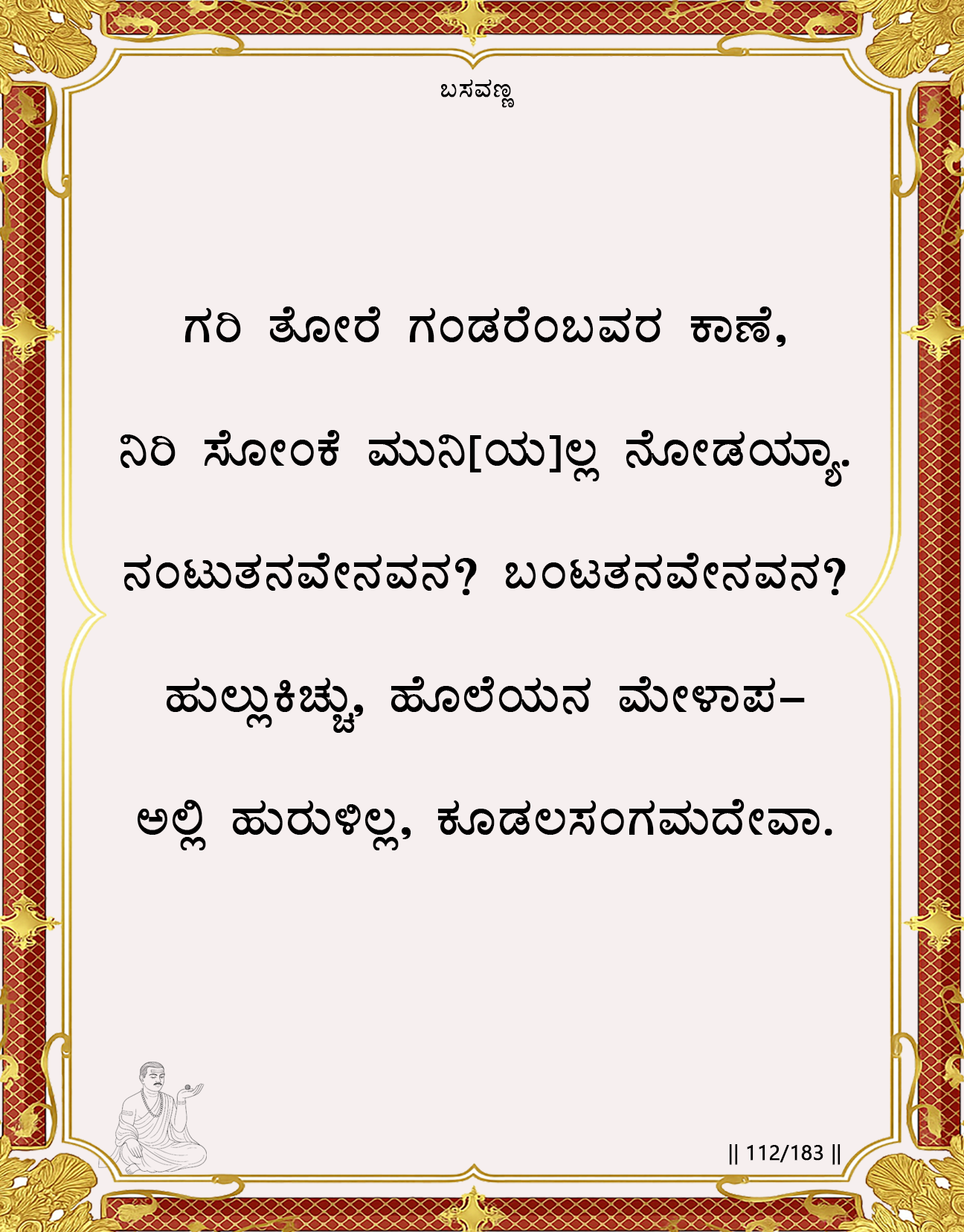
If a man trembles at the feather of an arrow,
can he be called a warrior?
If a shadow flickers on water,
does it ever speak?
What worth is such bravery?
What worth is such relationship?
It is like the heat that rises
from burning dry grass
a flash, then gone.
Such bonds hold no truth,
O Kudalasangamadeva.
Basavanna exposes the hollowness of superficial strength and shallow relationships using two sharp images: the coward who recoils from an arrow’s feather, and the mute shadow dancing on water. Both symbolize that which appears real but contains no substance. Likewise, human alliances built on fear, convenience, ego, or pretense lack the fire of true commitment; they flare like burning grass and vanish without trace. Real spiritual life, Basavanna teaches, demands courage rooted in truth and relationships anchored in authenticity only such integrity can stand before Kudalasangamadeva.
Spiritual Context
Core Spiritual Principle: Authenticity as the foundation of spiritual strength. On the path, what matters is not the appearance of bravery or community, but the inner reality of unwavering commitment and truth. Superficiality, in any form, is a veil over consciousness that prevents the realization of the Real.
Cosmic Reality Perspective: This vachana distinguishes between the sthula (gross) and sukshma (subtle) aspects of energy. The “feather” and “shadow” represent gross, insubstantial forms. The “burning dry grass” is a sudden, rajasic flare of energy without a sattvic (sustaining) core. True spiritual strength is like the steady, immense heat of the sun (Shiva)constant, reliable, and life-giving, not a momentary flash.
Historical Reality (Anubhava Mantapa Context): In building the Lingayoga community, Basavanna needed to ensure its resilience. This vachana served as a filter, distinguishing between those who were attracted to the revolution for ego or convenience and those who were committed to its spiritual and ethical core, even in the face of persecution. It fostered a culture of radical honesty and depth over mere social belonging.
Interpretation
“If a man trembles at the feather of an arrow, can he be called a warrior?” The “feather” represents a minor, non-lethal test. True courage (dhairya) is tested not in the absence of fear, but in facing what is truly fear some the ego’s dissolution. Fleeing from a “feather” reveals a fundamental lack of spiritual fortitude.
“If a shadow flickers on water, does it ever speak?” A “shadow” has form but no substance; it is dependent and ephemeral. This symbolizes relationships or spiritual identities that are mere reflections, lacking the inner voice (vak) of authentic truth. They are mute because they have nothing real to say.
“It is like the heat that rises from burning dry grass a flash, then gone.” Dry grass has no inner moisture or life; it burns quickly and leaves only ash. This represents passions, commitments, or spiritual fervor that is not rooted in the deep, moist soil of sustained practice and inner transformation. It is excitement, not devotion.
Practical Implications: The practitioner must constantly test their own motivations and commitments. Is my courage based on a desire to look strong, or on an inner conviction? Are my relationships based on mutual growth and truth, or on convenience and shared delusion? The path demands a ruthless commitment to what is real.
The Cosmic Reality
Anga (Human Dimension): The Anga must transform from being “dry grass” (prone to quick, egoic flares) and a “shadow” (a dependent image) into a substance of enduring qualitylike seasoned wood that burns long and steady, or a solid form that casts its own shadow.
Linga (Divine Principle): The Linga is the true “Warrior,” the unwavering reality that does not flicker. It is the source of the authentic “voice” that the shadow lacks. It is the eternal fire, not the temporary flash.
Jangama (Dynamic Interaction): The Jangama is the process of moving from insubstantiality to substance. It is the act of facing the “arrow” of self-truth, of finding one’s own voice beyond borrowed beliefs, and of building relationships that are like slow-burning embers, not grass fires.
Shata Sthala
Primary Sthala: Sharana (Total Refuge) The vachana defines the quality of a true Sharana. Taking refuge is an act of ultimate courage and authenticity. It is a commitment that must be more substantial than a “shadow” and more enduring than a “grass fire.”
Supporting Sthala: Maheshwara (Lord of the Cosmic Play) To understand this distinction between the real and the illusory in human character and relationship is the perspective of the Maheshwara. This stage involves seeing the cosmic play of authenticity and hypocrisy and learning to navigate it with wisdom.
Practical Integration
Arivu (Awareness Practices): Practice “Shadow Observation.” Observe your reactions to small irritations (the “feathers”). Observe the quality of your interactions: are they deep and meaningful, or are they fleeting and superficial (“shadows”)? This awareness is the first step toward cultivating substance.
Achara (Personal Discipline): Cultivate “Slow-Burning” disciplines. Choose practices that build endurance and depth over time (like sustained meditation or study) rather than those that offer quick, intense experiences. Apply this to relationships by investing time and truthful communication.
Kayaka (Sacred Action): Engage in work that has lasting value and integrity. Avoid projects that are merely for show or that flare up and die quickly. Build something substantial.
Dasoha (Communal Offering): Build a community that values depth and authenticity. Encourage members to be real with each other, to support each other’s genuine growth, and to gently challenge posturing and hypocrisy, creating a collective “fire” that burns steadily.
Modern Application
We live in a culture of “influencers” and curated online personas (“shadows”), where outrage is often performative (“burning grass”) and relationships are often transactional and digital. This leads to a deep sense of emptiness, loneliness, and a lack of resilience when faced with real-world challenges.
This vachana is a powerful call to authenticity in a synthetic world. It liberates us from the exhausting work of maintaining a facade. It invites us to invest in a few deep, true relationships and to cultivate an inner strength that doesn’t need to be proclaimed. It leads to a life of genuine connection and resilient peace.
Essence
To fear a feather, to boast a name,
Is a warrior’s lie, a hollow flame.
A shadow’s dance, a grass-fire’s flash,
A bond that breaks in a moment’s crash.
Grant me, O Lord, the strength that’s true,
And relationships that I can count on, like You.
The Deeper Pattern: This vachana describes the difference between high-entropy and low-entropy states in a psychological system. The “shadow” and “grass fire” represent high-entropy states: energy is dispersed, chaotic, and short-lived. Authentic courage and deep relationships are low-entropy states: energy is coherent, focused, and sustainable. Spiritual progress is the journey from a high-entropy, disordered consciousness to a low-entropy, integrated one.
In Simple Terms: It is the difference between a firecracker and the sun. The firecracker (the grass fire) makes a loud noise and a bright flash (superficial bravery, intense but fleeting passion) and is then gone. The sun (authentic strength, divine consciousness) burns silently, consistently, and gives life-sustaining energy forever. One is an event; the other is a state of being.
The Human Truth: We are often seduced by the dramatic and the immediate, mistaking it for strength and connection. The timeless truth here is that what is real is often quiet, steady, and built over time. The spiritual path is not about spectacular experiences but about the quiet cultivation of an authentic self that can stand firm in truth and form bonds that nothing can break. This is the only strength that endures.

Views: 2