Poetic Rendering

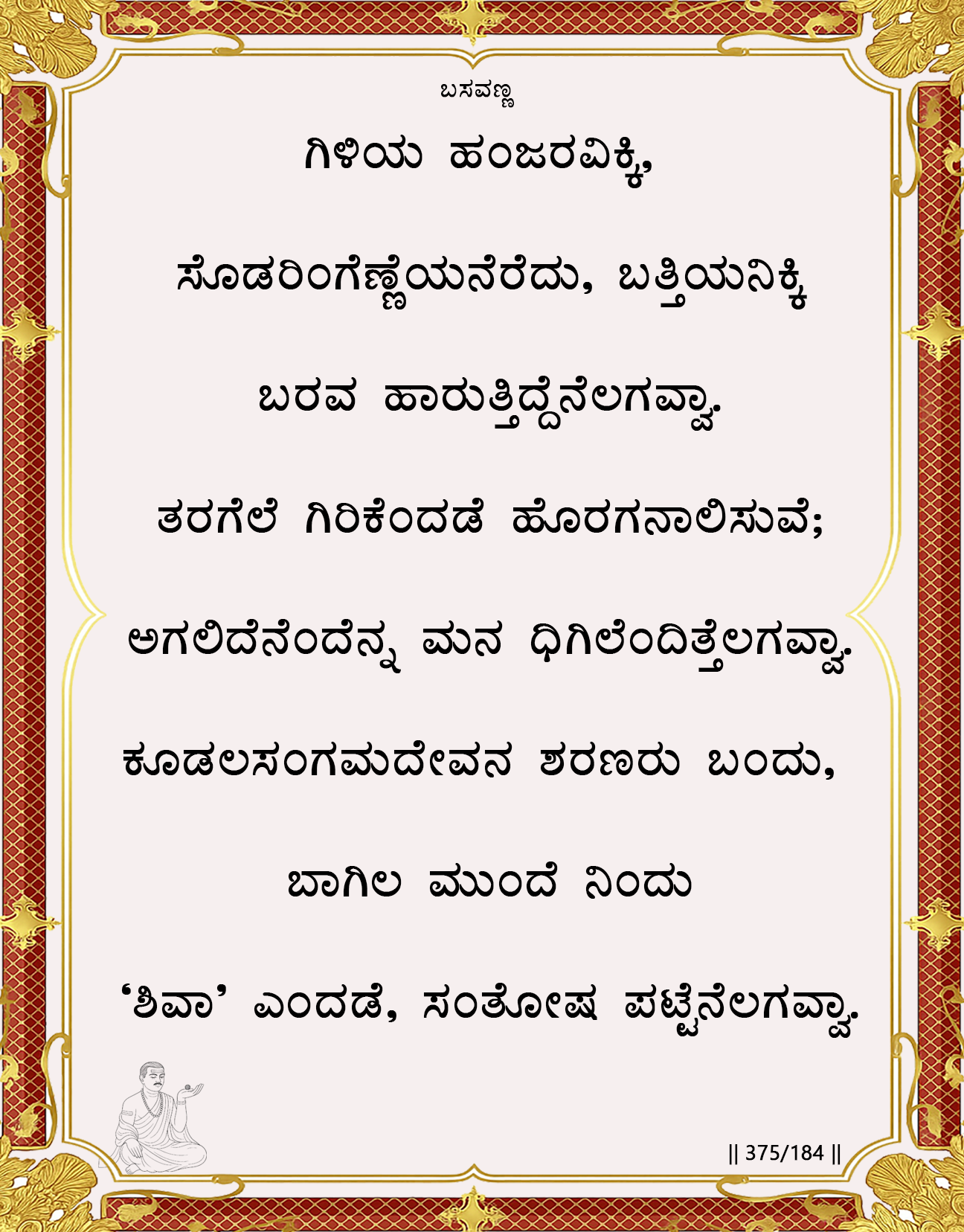
Within the cage where the parrot dwells
I poured oil into the waiting lamp,
set the wick,
and sat in stillness for Your coming.
Like a dry leaf lifted by a restless wind,
I had wandered far
scattered in mind,
lost in my own driftings.
But when the sharanas, companions of Kudalasangamadeva,
cried out “Shiva!” in their ringing call,
my heart flared awake
like a lamp that suddenly catches flame,
though moments before it lay cold and forgotten.
Basavanna portrays the human seeker as a caged parrot preparing a lamp symbol of readiness while waiting for divine grace. Yet despite this preparation, the mind remains like a dry leaf, scattered and directionless. The turning point arrives when the sharanas invoke “Shiva,” awakening him from inner drift. Their presence and their call ignite the dormant lamp within, showing that grace often arrives not directly but through the company of the enlightened. True awakening is sparked by satsanga the living touch of those already aflame with Kudalasangamadeva’s light.
Spiritual Context
Core Spiritual Principle: The indispensability of sacred company (Satsanga) for ignition. Personal preparation is necessary but insufficient. The final leap from preparation to illumination often requires the catalytic presence of those who are already awake. Their consciousness serves as a live wire that transmits the divine current to the prepared but inactive seeker.
Cosmic Reality Perspective: This vachana illustrates a key dynamic in the Shiva-Shakti relationship. The individual Shakti (the seeker) has the potential (the oil and wick) but lacks the initiating spark. The collective Shakti of the enlightened sangha, which is already in union with Shiva, carries that spark. When they chant “Shiva!”, it is the unified Shakti of the community invoking and channeling Shiva’s conscious energy, which then ignites the individual Shakti, bringing it to life.
Historical Reality (Anubhava Mantapa Context): This vachana is a theological foundation for the very existence of the Anubhava Mantapa. It explains why Basavanna placed such emphasis on community. It wasn’t just a philosophical club; it was a crucible of spiritual energy, a collective “lamp-lighter.” It ensured that the Lingayoga path was not a lonely, intellectual pursuit but a transmitted, living experience nurtured in community.
Interpretation
“Within the cage where the parrot dwells I poured oil… set the wick…” The “cage” is the body. The “parrot” is the soul (jiva) that can be trained to repeat the Divine name. The “oil” is the fuel of sincere practice and desire. The “wick” is the disciplined mind and heart. This is the stage of personal preparation.
“Like a dry leaf lifted by a restless wind, I had wandered far…” This admits the limitation of preparation alone. Without the flame, the seeker remains “dry” lacking the juiciness (rasa) of divine connection and is tossed by the winds of distraction (vikshepa).
“But when the sharanas… cried out ‘Shiva!’… my heart flared awake” This is the climax. The cry of “Shiva!” is not just a word; it is a potent sound-vibration (nada) charged with the realized consciousness of the sharanas. It strikes the prepared wick of the seeker’s heart and ignites it.
“like a lamp that suddenly catches flame, though moments before it lay cold.” The transformation is instantaneous and grace-driven. It is not a gradual process but a quantum leap from potentiality to actuality, from seeking to finding.
Practical Implications: The seeker must actively seek out the company of the sincere and the realized. While personal discipline is essential, one should not underestimate the transformative power of being in a charged spiritual environment. Participation in collective prayer, chanting, and service is not secondary; it is a primary means of receiving grace.
The Cosmic Reality
Anga (Human Dimension): The Anga is the fully prepared lamp cleaned, filled with oil, and with a trimmed wick. Its role is to be ready and receptive. Without the spark, it is a monument to potential, but not a source of light.
Linga (Divine Principle): The Linga is the eternal, uncreated flame. It is the source of the spark and the nature of the light itself.
Jangama (Dynamic Interaction): The Jangama is the spark the living transmission from the enlightened community to the prepared individual. It is the dynamic event of satsang, where the divine name, carried on the breath of a true sharana, becomes the conduit for grace.
Shata Sthala
Primary Sthala: Prasadi (Recipient of Grace) The entire experience described is that of a Prasadi. The seeker has done the work of preparation (the Bhakta stage) and is now in a state of receptive waiting. The ignition of the heart is the definitive moment of receiving grace.
Supporting Sthala: Bhakta (Devotee) The preparatory work pouring the oil, setting the wick, the sincere longing is the work of the Bhakta. This stage is essential, for a lamp cannot be lit if it is not first prepared.
Practical Integration
Arivu (Awareness Practices): Consciously approach satsang (spiritual gatherings) with the intention of being “ignited.” Sit not as a critic or spectator, but as a prepared lamp, open and receptive to the transformative energy of the collective devotion.
Achara (Personal Discipline): Your daily discipline is the “preparation of the lamp.” Regular meditation, study, and ethical living are the “oil” and “wick.” Do this diligently, but do not be discouraged if the “flame” feels distant; your job is to be ready.
Kayaka (Sacred Action): See your work as part of your preparation. The integrity and mindfulness you bring to your labor is the “purified oil” that will fuel the eventual flame of divine consciousness in your heart.
Dasoha (Communal Offering): Understand that your presence in a spiritual community can be the “spark” for others. By practicing sincerely and participating joyfully, you contribute to the collective energy that has the power to ignite fellow seekers.
Modern Application
In our individualistic and often virtual spiritual seeking, we try to “do it ourselves” through apps, online courses, and books. While valuable, this can lead to a state of being a “prepared but unlit lamp” knowledge able but lacking the transformative fire of direct transmission and communal energy, leading to stagnation.
This vachana liberates us from the isolation of self-help. It calls us to find our “sangha,” our spiritual community. It assures us that we don’t have to generate the flame by our own willpower; we simply need to prepare ourselves and then place ourselves in the company of those who carry the fire. This makes the spiritual journey a shared, supported, and far more joyful endeavor.
Essence
The cage, the oil, the wick were set,
A waiting lamp, a timeless debt.
My mind a leaf, in wind-tossed flight,
Until the saints cried out in light.
One “Shiva!” rang, so clear and true,
And my cold heart flared into You.
The Deeper Pattern: This vachana describes a system achieving criticality through an external neutron source. The prepared seeker is a mass of fissile material (uranium-235)it has the potential for a chain reaction (illumination) but requires a neutron source (the satsang) to initiate it. Once the first neutron (the cry of “Shiva!”) strikes, it triggers a self-sustaining chain reaction of divine awareness within the seeker.
In Simple Terms: It is like a field of dry wood that has been carefully gathered and stacked. It has the potential for a great fire, but it remains cold. A single spark from a neighboring fire is all it takes to set the entire pile ablaze. The sharanas are that neighboring fire, and their sacred call is the spark.
The Human Truth: We often feel that our spiritual efforts are in vain because we don’t feel an immediate, constant flame. The timeless truth here is that our work is not wasted; it is the essential preparation. The flame often comes from an unexpected source a word from a friend, the energy of a gathering, a moment of shared devotion. We must do our part and then remain open, trusting that grace will find its way to ignite us through the sacred company we keep.

Views: 0