Poetic Rendering

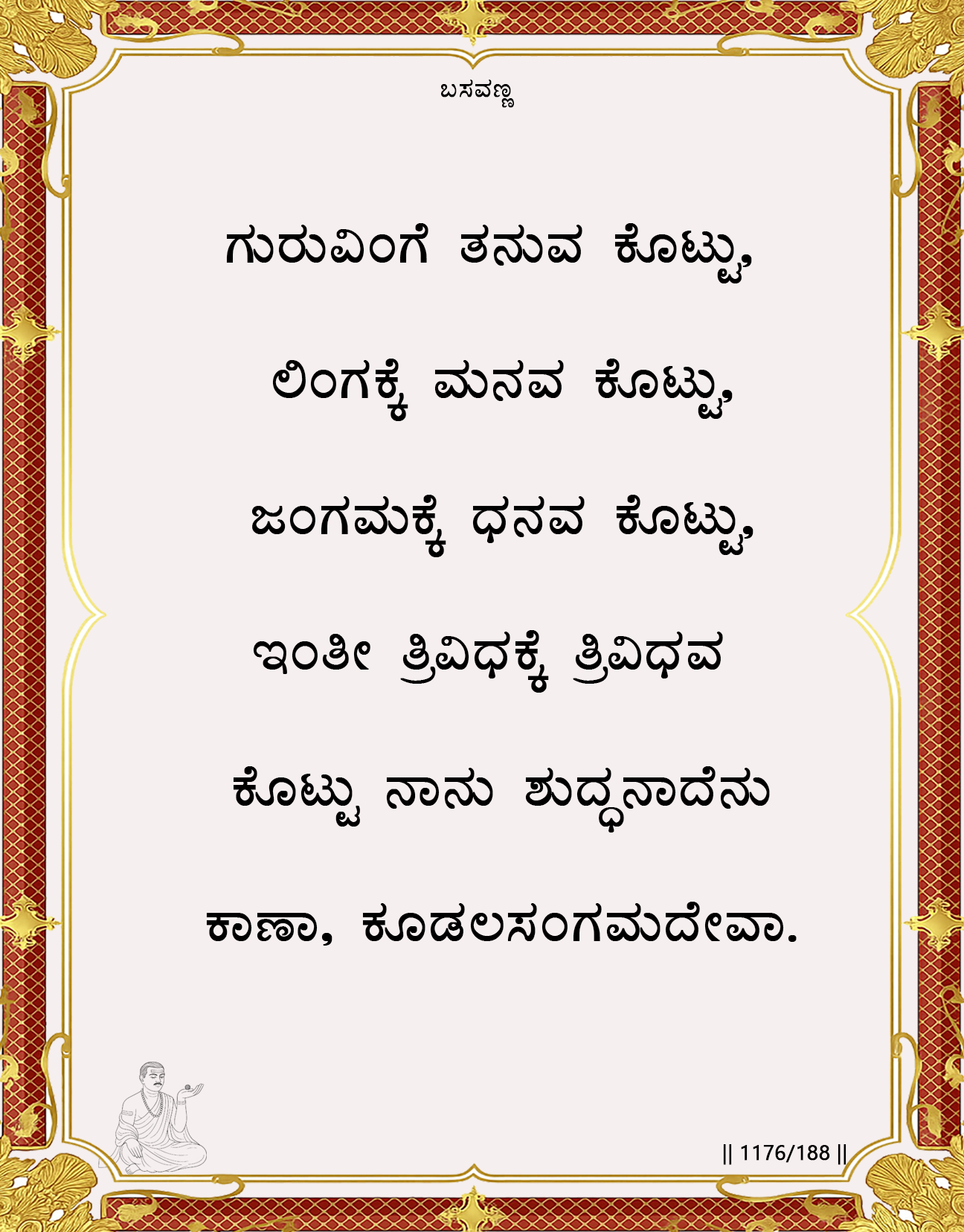
To the Guru, I surrender this body
let every act learn its rightful way.
To the Linga, I surrender my mind
let every thought fall into sacred stillness.
To the Jangama, I surrender my wealth
let what I hold flow toward the living divine.
Thus, in this threefold offering
of body, mind, and earthly treasure,
my being is washed clean, made whole,
O Koodalasangama.
Basavanna reveals the complete spiritual alignment of human life through a threefold offering: the body to the Guru, the mind to the Linga, and material resources to the Jangama. Each part of our existence finds its true place when offered to its divine counterpart, producing total inner purity and wholeness. This triadic surrender marks the transformation of ordinary living into a sacred, integrated path of liberation.
Spiritual Context
Core Spiritual Principle: Holistic surrender as the path to purity. Liberation is not achieved by rejecting the world but by sanctifying every aspect of one’s being through conscious offering. Body, mind, and wealththe primary sources of egoic identity and bondageare purified not by abandonment but by being dedicated to their divine counterparts.
Cosmic Reality Perspective: This vachana describes the perfect alignment of the individual Trinity (Body-Mind-Wealth) with the Cosmic Trinity (Guru-Linga-Jangama). The Guru represents the guiding power of divine wisdom (Shakti as teacher), the Linga represents the absolute, static reality (Shiva), and the Jangama represents the dynamic, manifest divine in the world (the moving Shiva-Shakti union). Offering each human aspect to its cosmic counterpart creates a state of resonant harmony with the structure of reality itself.
Historical Reality (Anubhava Mantapa Context): This vachana is the practical, operational manual for a Lingayoga sharana. It provided a clear, threefold discipline for community members: obey the Guru’s guidance for ethical conduct (Achara), focus the mind on the Ishta-Linga (Arivu), and contribute one’s wealth to the community and its wandering mystics (Dasoha). This framework ensured the community’s spiritual, intellectual, and economic cohesion.
Interpretation
“To the Guru, I surrender this body let every act learn its rightful way.” The Guru is the embodied representative of the divine will and tradition. Surrendering the body means allowing one’s actions to be guided by wisdom and discipline, transforming instinctual behavior into conscious, righteous conduct (Kayaka).
“To the Linga, I surrender my mind let every thought fall into sacred stillness.” The Linga is the formless absolute. Surrendering the mind means offering all mental activity thoughts, emotions, identifications to the divine consciousness, resulting in the inner silence (mano-nasha) that is true meditation.
“To the Jangama, I surrender my wealth let what I hold flow toward the living divine.” The Jangama is God in the form of the moving, serving, and often needy world. Surrendering wealth (Dasoha) dismantles the ego of ownership and transforms material possession into an instrument of compassion and communal sustenance.
“Thus, in this threefold offering… my being is washed clean, made whole…” The result of this complete offering is purnatva (wholeness). The fragmented self, torn between different desires and attachments, is integrated. Purity (shuddhi) is not a state of sterile emptiness but of perfect, harmonious function.
Practical Implications: The practitioner must actively practice this threefold surrender in daily life. Before acting, consult the inner Guru (conscience/teachings). During mental turmoil, offer the thoughts to the Linga. When managing resources, consciously dedicate them to the service of life (Jangama).
The Cosmic Reality
Anga (Human Dimension): The Anga is the triad of body, mind, and wealth. In its unoffered state, it is a source of bondage. Through surrender, it becomes a sacred instrument the body as a vehicle of service, the mind as a temple of silence, and wealth as a flow of grace.
Linga (Divine Principle): The Linga is the central axis of this trinitarian reality. It is the silent witness that receives the mind and the ultimate source to which the Guru points and the Jangama manifests.
Jangama (Dynamic Interaction): The Jangama is the active principle that makes the offering dynamic and complete. It is the Guru’s guidance in action, the flow of wealth in service, and the proof that the surrendered mind is not inert but engaged in the world with sacred purpose.
Shata Sthala
Primary Sthala: Sharana (Total Refuge) This vachana is the explicit formula for what it means to be a Sharana. Taking refuge is not a vague sentiment but this precise, threefold action of surrendering body, mind, and wealth.
Supporting Sthala: Aikya (Union) The state of being “made whole” through this offering is the culmination of the path, Aikya. When nothing of the separate self remains neither its actions, its thoughts, nor its possessions only union with the Divine exists.
Practical Integration
Arivu (Awareness Practices): Use this vachana as a daily mantra and checklist. Upon waking, consciously reaffirm: “My body is for righteous action (Guru), my mind is for stillness (Linga), my resources are for service (Jangama).”
Achara (Personal Discipline): Structure your discipline around these three pillars: physical discipline (service, yoga) under the Guru’s guidance, mental discipline (meditation) focused on the Linga, and financial discipline (tithing, simplicity) oriented toward dasoha.
Kayaka (Sacred Action): See your work as the simultaneous offering of body (labor) and wealth (the fruit of labor) to the Jangama (the community/world), performed under the principles taught by the Guru.
Dasoha (Communal Offering): This vachana is the philosophical basis for Dasoha. Organize the community’s economic life around this principle, ensuring that collective resources are managed as an offering to support the Jangamas and serve all members.
Modern Application
Modern life is characterized by fragmentation: we train our bodies in gyms without spiritual purpose, fill our minds with information without stillness, and chase wealth without a higher goal. This leads to existential dissonance, stress, and a feeling of meaninglessness despite material comfort.
This vachana provides a powerful template for integration in the modern world. It shows how to unify our fitness, our mindfulness practice, and our career into a single, sacred purpose. It liberates us from the anxiety of ownership and the tyranny of a restless mind by providing a clear, actionable path to offer everything we are and have to a reality greater than ourselves.
Essence
The body to the Guide’s command,
The mind to You, in stillness stand.
The wealth I own, to Life I stream,
A threefold flow, a single theme.
Thus offered whole, from stain set free,
My shattered self returns to Thee.
The Deeper Pattern: This vachana describes a complete system transfer. The individual’s operating system (ego), which controls three core subsystems (Physical Actuators/Body, Central Processing Unit/Mind, and System Resources/Wealth), is decommissioned. Control of each subsystem is then handed over to a higher, divine network: the Body to the Guru (Divine Administrator), the Mind to the Linga (Divine OS Kernel), and Wealth to the Jangama (Divine Network Resource Manager). This results in a perfectly optimized, secure, and purpose-driven system, free from the viruses of desire and the corruption of selfishness.
In Simple Terms: It is like a river finding its way to the ocean. The river (the individual) has three attributes: its water (wealth/resources), its flow (body/action), and its course (mind/direction). By offering its flow to follow the terrain (Guru), its water to the sea (Jangama), and its very identity to the ocean (Linga), the river ceases to be a separate entity and becomes one with the vastness. It loses nothing but its limitations.
The Human Truth: True freedom arises not from trying to control our bodies, minds, or possessions, but from releasing the illusion that they are truly ours to hold. This conscious and joyful surrender dissolves the root of human suffering. When we offer our body, mind, and wealth to the sacred symbolized as Guru, Linga, and Jangama our ordinary existence is alchemized into a divine expression. In this transformative trinity, the seeker becomes a living bridge between earth and heaven. The path forward is not in constructing external temples of stone, but in awakening as temples of living, radiant awareness.

Views: 0