Poetic Rendering

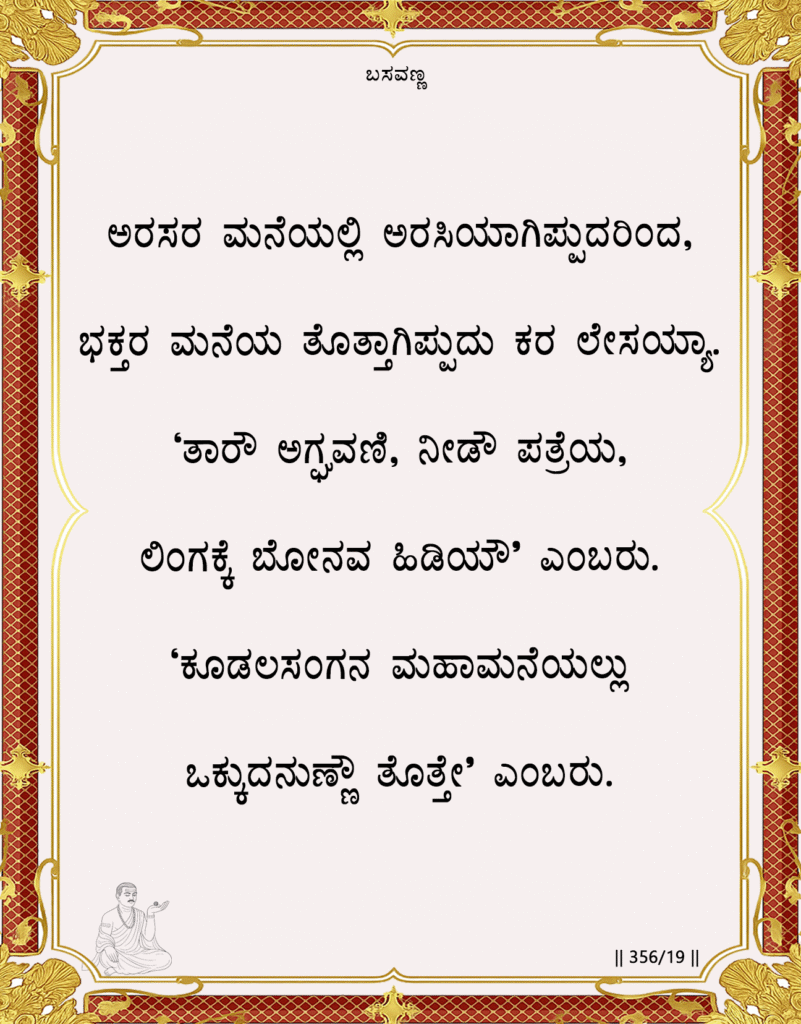
It is no great honor to be queen in a king’s house.
Greater by far to be a
servant in a bhakta’s home.
In royal courts they cry,
“Bring vessels, fetch gifts,
prepare the offering for the Linga.”
But in the great house of
Koodalasangama
they say, “Come, eat, share, be one of us.”
This vachana performs a radical alchemy on the very concept of honor and status. Basavanna, who himself served as a minister in a royal court, declares that the highest nobility is not found in palaces but in the humble homes of devotees. He contrasts the transactional, hierarchical world of kings where even worship is a command with the egalitarian, compassionate world of the Śharaṇa Saṅgha. True honor, he reveals, is not in being served, but in serving; not in commanding rituals, but in sharing a meal. This is the practical manifestation of the non-dual truth: in the eyes of God, all are equal, and the greatest power is the power of selfless love.
Spiritual Context
Core Spiritual Principle: True honor and status are defined by one’s proximity to the Divine, which is found not in worldly power but in selfless service and egalitarian fellowship. The hierarchy of the spirit inverts the hierarchy of the world.
Cosmic Reality Perspective: The Linga, as all-pervading consciousness, sees no distinction between a queen and a servant. The world of kings and queens (Maya) is an illusion of separation. The Sangha, where all share equally, is a conscious reflection of the non-dual reality.
Historical Reality (Anubhava Mantapa context): This vachana is a direct critique of the feudal and caste-based society of 12th-century India. It embodies the revolutionary social experiment of the Anubhava Mantapa, where a queen (as a devotee) and a servant would sit together and share food, their worldly status rendered meaningless before their shared identity as Sharanas.
Interpretation
1. “It is no great honor to be queen in a king’s house.” : This immediately devalues the highest worldly status. The “queen” is a symbol of ultimate worldly privilege, yet it is declared spiritually insignificant.
2. “Greater by far to be a servant in a bhakta’s home.” : This establishes the new hierarchy. “Servant” represents humility and selfless action (Kayaka). The “bhakta’s home” is the Sangha. Honor is now measured by one’s capacity to serve within the community of the enlightened.
3. Contrast: “Bring vessels, fetch gifts…” vs. “Come, eat, share, be one of us.” : The Royal Court: Worship is a transaction . It is hierarchical (commands), external (vessels, gifts), and maintains separation. The king commands, the servant obeys. The House of Koodalasangama: Worship is a transformation . It is egalitarian (an invitation), internal (sharing a meal symbolizes oneness), and dissolves separation. The call is to unity and participation.
Practical Implications: The seeker must actively re-evaluate their sources of self-worth. Pride in social status, wealth, or power must be surrendered. True spiritual progress is measured by one’s humility, willingness to serve, and ability to see the divine equality in all members of the community.
The Cosmic Reality
Anga (Human Dimension): The human being shedding the egoic identity of “queen” or “king” to embrace the humble, functional identity of a “servant” within the cosmic order.
Linga (Divine Principle): Kudalasangama Deva as the principle of absolute equality and the source of the unifying command: “Come, eat, share.” The Linga is the host of the cosmic feast.
Jangama (Dynamic Interaction): The Jangama is the living Sangha itself the “house of Koodalasangama.” It is the dynamic, practical context where the theory of non-duality is lived out through the daily acts of sharing food (Dasoha) and breaking bread together, erasing all man-made distinctions.
Shata Sthala
Primary Sthala: Sharana. This vachana describes the lived reality of the Sharana, whose identity is so merged with the Sangha that worldly status becomes irrelevant. The Sharana finds their “honor” in this shared identity.
Practical Integration
Arivu (Awareness): Cultivate awareness of the ego’s attachment to status and recognition. In every situation, ask: “Am I acting from a desire for honor, or from a desire to serve and unite?”
Achara (Personal Discipline): Practice humility as a conscious discipline. Perform menial tasks willingly. Actively seek out the company of those whom the world considers “lowly,” and learn to serve them.
Kayaka (Sacred Action): Let your work be an act of service to the community, not a means for personal aggrandizement. Offer the fruits of your labor to the communal well-being.
Dasoha (Communal Offering): Actively participate in and organize community meals where all are welcome regardless of background. Ensure that your home and your heart are places where the invitation “come, eat, share” is genuinely extended to all.
Modern Application
Our society is obsessed with status, influence, and wealth the modern “kingdoms” of corporate titles, social media followers, and net worth. We constantly seek to be “queens” and “kings” in these domains, leading to anxiety, isolation, and a deep sense of competition and inequality.
This vachana liberates by offering a new metric for a successful life: the depth of our community and the generosity of our service. It calls us to find our “true nobility” not in being served, but in serving; not in building walls to protect our status, but in building tables where all are invited to share. It is the path from a life of lonely competition to one of connected, purposeful belonging.
Essence
A crown of gold, a throne’s high seat,
Are empty honors, cold and fleet.
But in the house where all are one,
The servant’s role is nobly won.
Metaphysically, this vachana enacts the dissolution of Ahamkara (ego). The “queen” is the Ahamkara in its most inflated state. The “servant” is the ego in a state of surrender, ready to be a instrument of the Divine will. The “house of Koodalasangama” represents the consciousness where the individual ego has dissolved into the cosmic “I” of the Linga, which expresses itself as universal, non-discriminating love (Dasoha).
The most meaningful and honorable life is not one of commanding others, but of serving a purpose greater than oneself. Our legacy is not measured by what we accumulated, but by what we shared; not by how many served us, but by how many we made feel welcomed, fed, and included. True community is the ultimate wealth.

Views: 4