Poetic Rendering

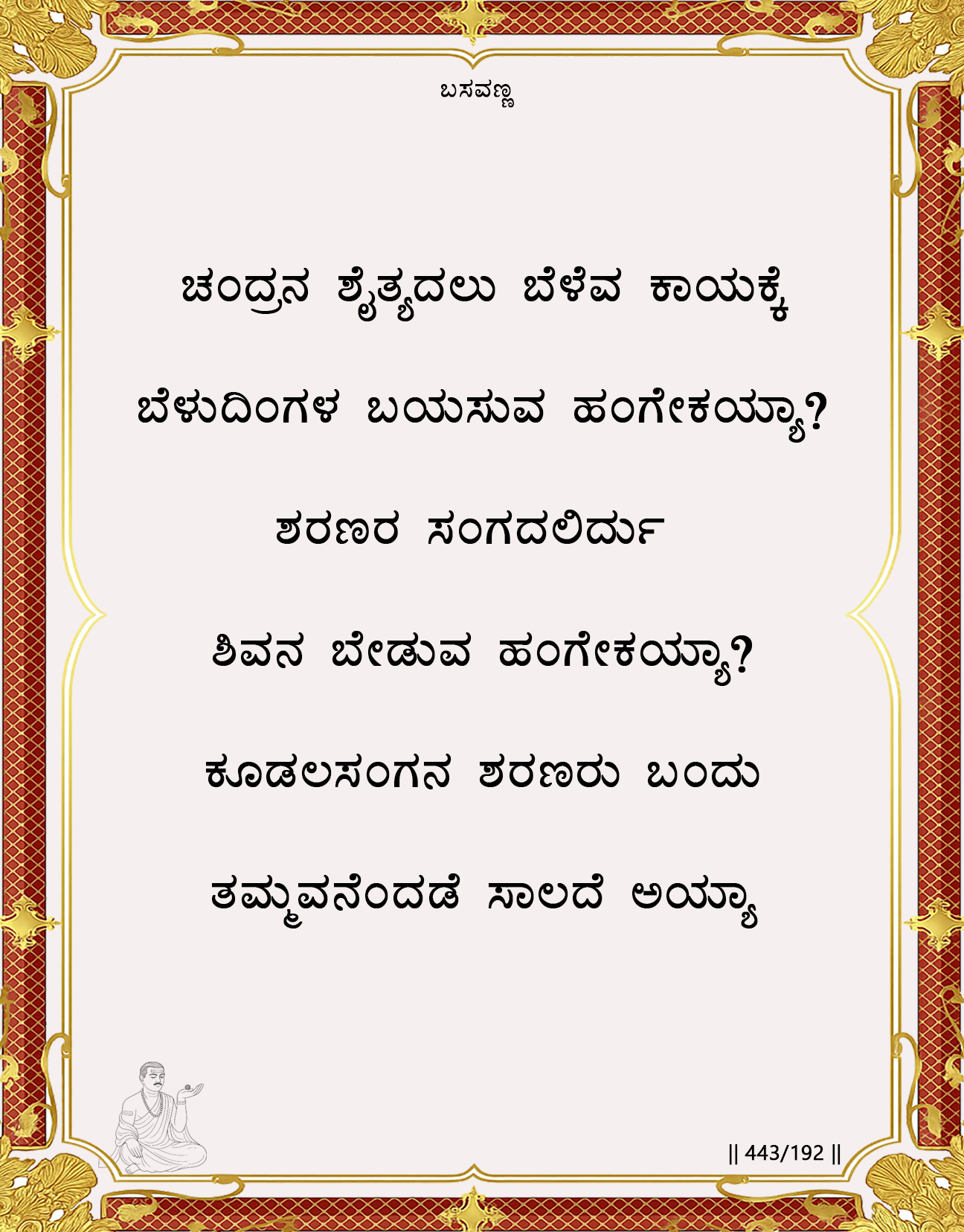
The cool moonlight that ripens my Kayaka
why should I crave a brighter moon?
In the company of sharanas,
where the Linga flowers in my very palm,
why should I wander elsewhere in search of Shiva?
When Koodalasangama himself
the Lord who arrives here,
the Lord who merges now
stands beside me in this living practice,
what more need I ask for?
In this vachana, Basavanna affirms that the practice of Kayakagazing upon the Linga in one’s own palmis already radiant with divine presence, just like moonlight sufficient unto itself. He rejects the restless search for external gods or added spiritual embellishments, declaring that in the company of the sharanas and the lived experience of Linga-consciousness, Shiva is already fully present. Koodalasangama, the ever-arriving and ever-merging divine, stands with the devotee in the very act of practice. Therefore, nothing more is needed true fulfillment is already here, now, within.
Spiritual Context
Core Spiritual Principle: The sufficiency of the present moment and the chosen path. When practice (sadhana) is engaged with full presence and within a genuine community (satsang), God is not a distant goal but an immediate presence. The seeker’s journey ends where it began, discovering that what was sought was always the seeker’s own true nature, revealed through the sacred means.
Cosmic Reality Perspective: This vachana embodies the non-dual realization of Shiva-Shakti. The “moonlight” is Shiva’s conscious grace. The “ripening crop” and the “palm” are Shakti, the receptive world and the individual. The vachana declares that Shakti does not need to become Shiva; it is already perfectly illuminated by Shiva in every moment. The “merging” is not a future event but a present, continuous reality (Koodala-Sangama).
Historical Reality (Anubhava Mantapa Context): This vachana represents the fruition of the Lingayoga path. It validates the community’s core practices Kayaka (sacred labor visualized as worship) and Satsang (the company of sharanas)as complete in themselves. It was an empowering message that the common householder, through their dedicated practice within the community, could achieve the highest realization without needing to abandon their life for the forest or seek esoteric, external initiations.
Interpretation
“The cool moonlight that ripens my Kayaka why should I crave a brighter moon?” The “moonlight” is the grace that sanctifies ordinary work. It is “cool,” indicating a peaceful, non-sensational, yet utterly transformative presence. To ask for a “brighter moon” is the ego’s desire for more intense experiences, which only distracts from the perfection of what is already given.
“In the company of sharanas, where the Linga flowers in my very palm, why should I wander elsewhere in search of Shiva?” The “palm” is the locus of one’s own action and offering. The Linga “flowering” there signifies the divine manifesting in and through one’s own life and work. The satsang provides the nurturing environment for this flowering. To “wander elsewhere” is the fundamental error of seeking.
“When Koodalasangama himself… stands beside me in this living practice, what more need I ask for?” This is the climax. God is not a static entity but the very process of “arriving” and “merging” (Sangama) in the “now” (Koodala). When this is directly perceived as one’s lived reality, the seeking mind, which operates on lack, dissolves into the fullness of being.
Practical Implications: The practitioner is called to deep contentment (santosha) with their path. The focus should be on fully inhabiting the present practice with total faith, rather than doubting its efficacy and looking for “better” or “higher” teachings. The goal is to recognize the divine in the here and now.
The Cosmic Reality
Anga (Human Dimension): The Anga is the ripened field and the open palm. It is no longer a seeker but a fulfilled manifestation. Its every action is already divinely illuminated and purposeful.
Linga (Divine Principle): The Linga is the ever-present moonlight and the companion “standing beside.” It is not separate from the practice or the practitioner but is the very substance and context of it all.
Jangama (Dynamic Interaction): The Jangama is the “living practice” itself the seamless flow where the human and the divine are in constant, dynamic union. It is the end of the subject-object relationship in devotion.
Shata Sthala
Primary Sthala: Aikya (Union) The speaker’s voice is that of one established in Aikya. The questions are rhetorical because the separation that would motivate seeking has vanished. The devotee and God are “standing beside” each other as one reality.
Supporting Sthala: Pranalingi (One for whom Linga is Life-Breath) The imagery of the Linga “flowering in my very palm” indicates the Pranalingi stage, where the Linga is not an external object but the animating life force expressing itself through one’s very being and actions.
Practical Integration
Arivu (Awareness Practices): Practice “Nowness Meditation.” In every moment, especially during work or community interaction, affirm: “This is it. The divine is fully present here. This activity is the ‘merging.'” Use this to cut the habitual thought of seeking something else.
Achara (Personal Discipline): Let your primary discipline be the cultivation of contentment (santosha) with your path. Resist the spiritual temptation to constantly seek new methods or teachers. Go deeper into the practice you have.
Kayaka (Sacred Action): Perform your work with the unwavering conviction that it is already perfect and complete as a divine offering. See your labor not as a means to an end, but as the very expression of the union you seek.
Dasoha (Communal Offering): Foster a community culture that values depth and stability over novelty. Celebrate members who embody this deep contentment and whose presence itself reminds others of the sufficiency of the path.
Modern Application
We live in a culture of spiritual consumerism and endless self-improvement, constantly bombarded with new techniques, retreats, and teachers promising a “brighter moon.” This leads to a “seeker” mentality that is perpetually dissatisfied, hopping from one practice to another without ever taking root and bearing fruit.
This vachana is the ultimate antidote to spiritual restlessness. It liberates us from the exhausting chase and allows us to settle deeply into our chosen path. It teaches that enlightenment is not about acquiring something new, but about recognizing the sacred perfection of the present moment, our current practice, and our immediate community. This brings profound peace and stability.
Essence
The moon that lights my work is full,
No brighter light my soul can pull.
The Linga blooms right in my hand,
No other God I need demand.
For You are here, where I now stand,
So what to ask? I understand.
The Deeper Pattern: This vachana describes a system that has achieved homeostatic equilibrium with its energy source. The seeker (the system) was once in a state of seeking, trying to optimize its connection to the source (God). Now, the connection is perfectly calibrated; the input (divine grace/moonlight) exactly matches the system’s capacity to receive and utilize it (the ripening crop). The system has stopped trying to “optimize” further because it recognizes it is already operating at maximum, effortless efficiency. The question “what more?” is the sound of a system in perfect balance.
In Simple Terms: It is like a plant that has found the perfect spot in the garden. It receives the right amount of sun and rain. It does not waste energy trying to grow legs to search for a sunnier location; it simply puts all its energy into flowering right where it is. Basavanna is that plant, and his practice of Kayaka within the satsang is that perfect spot.
The Human Truth: We are conditioned to believe that more more knowledge, more experience, more possessions will make us happy. The timeless truth here is that fulfillment is found not in addition, but in subtraction of the seeking mind. When we stop asking for “more,” we discover the shocking and beautiful truth that we were already complete. The kingdom of heaven is indeed within.

Views: 0