Poetic Rendering

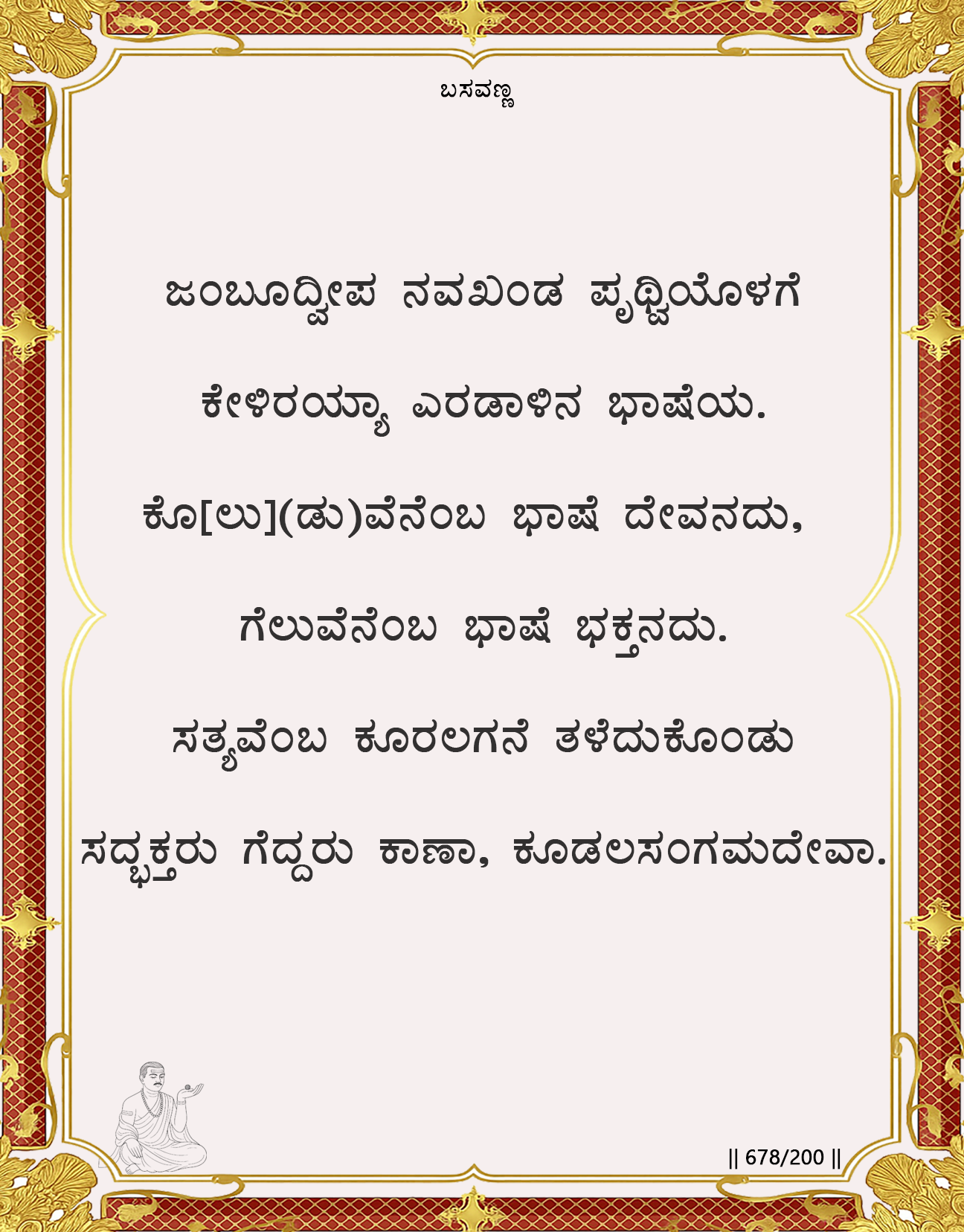
Across Jambudweepa
this land of nine vast divisions
people speak of two sovereign powers:
one that frightens with the cry,
“You will be destroyed!”
and another that rises with the vow,
“I shall prevail in truth.”
The first belongs to the false gods of fear,
to the outward rituals emptied of essence,
to the voices that seek the divine outside
and threaten life in the divine’s name.
But the second voice
the vow of the bhakta
is born of seeing the One Reality
that permeates all existence,
unseen yet ever-present.
When the seeker discerns truth from illusion,
the eternal from the fabricated,
the inner from the outward show
that moment the devotee triumphs.
Thus the bhakta stands victorious,
O Kudalasangamadeva,
for he has conquered not the world,
but the falsehood that
once covered his own eyes.
Basavanna contrasts the outward, fear based religions of Jambudweepa which proclaim divine punishment and rely on external forms with the inner vision of the true bhakta, who realizes the one all-pervading reality. He says there are two “voices” in the world: one that threatens destruction and one that vows inner victory through truth. When a seeker learns to distinguish illusion from reality and recognizes the divine within all, that clarity itself becomes the triumph. Thus, the true devotee wins not by force, but by seeing the eternal truth of Kudalasangamadeva.
Spiritual Context
Core Spiritual Principle: The primacy of inner, truth-based realization over external, fear-based dogma. The spiritual path is a fundamental choice between two orientations: one that sees God as a separate, punishing entity, and one that realizes God as the non-dual reality of one’s own being and all existence. The latter leads to sovereignty and fearlessness.
Cosmic Reality Perspective: This vachana distinguishes between a dualistic and a non-dual understanding of Shiva. The “voice of fear” arises from a dualistic perspective where God (Shiva) is a distant king and the soul is a sinful subject. The “voice of truth” arises from the non-dual realization that the individual soul (Shakti) is not separate from the divine source (Shiva). The victory of the bhakta is the victory of non-dual consciousness (advaita) over the illusion of separation (dvaita).
Historical Reality (Anubhava Mantapa Context): This vachana is a powerful summation of the Lingayoga critique of the prevailing religious orthodoxy of its time. It positions the Lingayoga path as the path of fearless, internal truth (sthitaprajna) against the Brahminical religion of ritual purity, apocalyptic threats, and social control. It was a call to intellectual and spiritual independence, empowering individuals to seek God within rather than through priestly intercession.
Interpretation
“one that frightens with the cry, ‘You will be destroyed!'” This voice operates through bhaya (fear) and bhoga (reward/punishment). It keeps the seeker in a child-like state of dependency and externalizes the divine, making it a object of transaction.
“another that rises with the vow, ‘I shall prevail in truth.'” This voice operates through shraddha (faith) and jñana (knowledge). It is an internal declaration of sovereignty and self-responsibility. The “I” here is the higher Self (Atman), identifying with the eternal truth.
“the first belongs to the false gods of fear, to the outward rituals emptied of essence…” Basavanna explicitly links the voice of fear to empty ritualism (karma-kanda) and the “false gods” of sectarian religion that promote division and dogma.
“the second voice… is born of seeing the One Reality that permeates all existence…” This voice is the fruit of direct experience (anubhava). It is not a belief but a perception of the divine substratum (Brahman) in everything.
“the devotee triumphs… for he has conquered not the world, but the falsehood that once covered his own eyes.” The victory is entirely internal. The enemy is not another religion or person, but one’s own ignorance (avidya). The battle is one of perception.
Practical Implications: The practitioner must constantly examine their own motivations and beliefs. Is my spirituality based on fear of hell or desire for heaven? Or is it based on a sincere love for truth and a desire for self-knowledge? The path requires cultivating the courage to move from the former to the latter.
The Cosmic Reality
Anga (Human Dimension): The Anga is the battlefield where this choice is made. Its senses are bombarded by the “voice of fear” from society and tradition. Its intellect and heart must be strong enough to discern and choose the “voice of truth.”
Linga (Divine Principle): The Linga is the “One Reality” itself. It is not a God that threatens, but the silent, pervasive truth that the bhakta vows to realize.
Jangama (Dynamic Interaction): The Jangama is the active process of choosing truth over fear, moment by moment. It is the living out of the vow “I shall prevail in truth” through thought, word, and deed.
Shata Sthala
Primary Sthala: Maheshwara (Lord of the Cosmic Play) To see this grand dichotomy playing out across humanity and to understand the mechanics of both voices is the perspective of the Maheshwara. This stage involves a masterful understanding of the spiritual dynamics of the world.
Supporting Sthala: Sharana (Total Refuge) The one who makes the inner vow and takes their stand on the side of truth, rejecting the voice of fear, is the Sharana. Taking refuge is this conscious choice for the path of inner truth.
Practical Integration
Arivu (Awareness Practices): Practice “Voice Discernment.” Notice the voices in your own mind and in the media/community around you. Which is the voice of fear and control? Which is the voice of love, truth, and empowerment? Consciously align your attention with the latter.
Achara (Personal Discipline): Let your discipline be rooted in self-understanding and love for truth, not in fear of divine punishment. Inquire into the truth of your own nature rather than blindly following rules.
Kayaka (Sacred Action): Let your work be an expression of the “vow to prevail in truth.” Act with integrity and fearlessness, not motivated by the fear of losing your job or status. Dasoha (Communal Offering): Build communities that empower individuals to seek inner truth, free from dogmatic threats and control. Foster an environment where the “voice of truth” is nurtured and celebrated.
Modern Application
We are surrounded by “voices of fear”: fundamentalist religions threatening hell, media amplifying threats, advertisers cultivating insecurity, and political ideologies based on us-vs-them hatred. This creates anxious, conformist, and often hostile societies.
This vachana is profoundly relevant. It liberates us from the pervasive culture of fear. It provides a clear criterion for evaluating spiritual and ideological messages. It calls us to a spirituality of fearless self-inquiry and empowers us to build our lives on the solid ground of inner truth, rather than the shifting sands of external threats and promises.
Essence
One voice cries “You’ll be destroyed!”
By fear and ritual, it’s employed.
One vows “In truth, I shall prevail!”
A sight that makes all falsehood pale.
The bhakta wins this inner war,
And sees You, Lord, as never before.
The Deeper Pattern: This vachana describes the evolutionary leap from a threat-based behavioral model to a consciousness-based operating system. The “voice of fear” is like the primitive operating system of the reptile brain, governing behavior through punishment and reward. The “voice of truth” is the advanced operating system of awakened consciousness, which operates on self-awareness, intrinsic motivation, and the recognition of unified field reality. The bhakta is one who has successfully upgraded their internal OS.
In Simple Terms: It is the difference between a slave and a sovereign. The slave obeys because of the master’s whip (the voice of fear). The sovereign acts from their own inherent authority and understanding of the law of the land (the voice of truth). Basavanna calls every human to spiritual sovereignty, to stop being a slave to external threats and to rule the inner kingdom based on the divine law of truth.
The Human Truth: We are often trapped by fear of death, judgment, and social exclusion. This fear is the primary tool of control for many institutions. The timeless truth here is that our ultimate freedom lies in confronting and transcending this fear by realizing our true, deathless nature. The path of the bhakta is the courageous journey from being a subject of fear to becoming a sovereign of truth.

Views: 0