Poetic Rendering

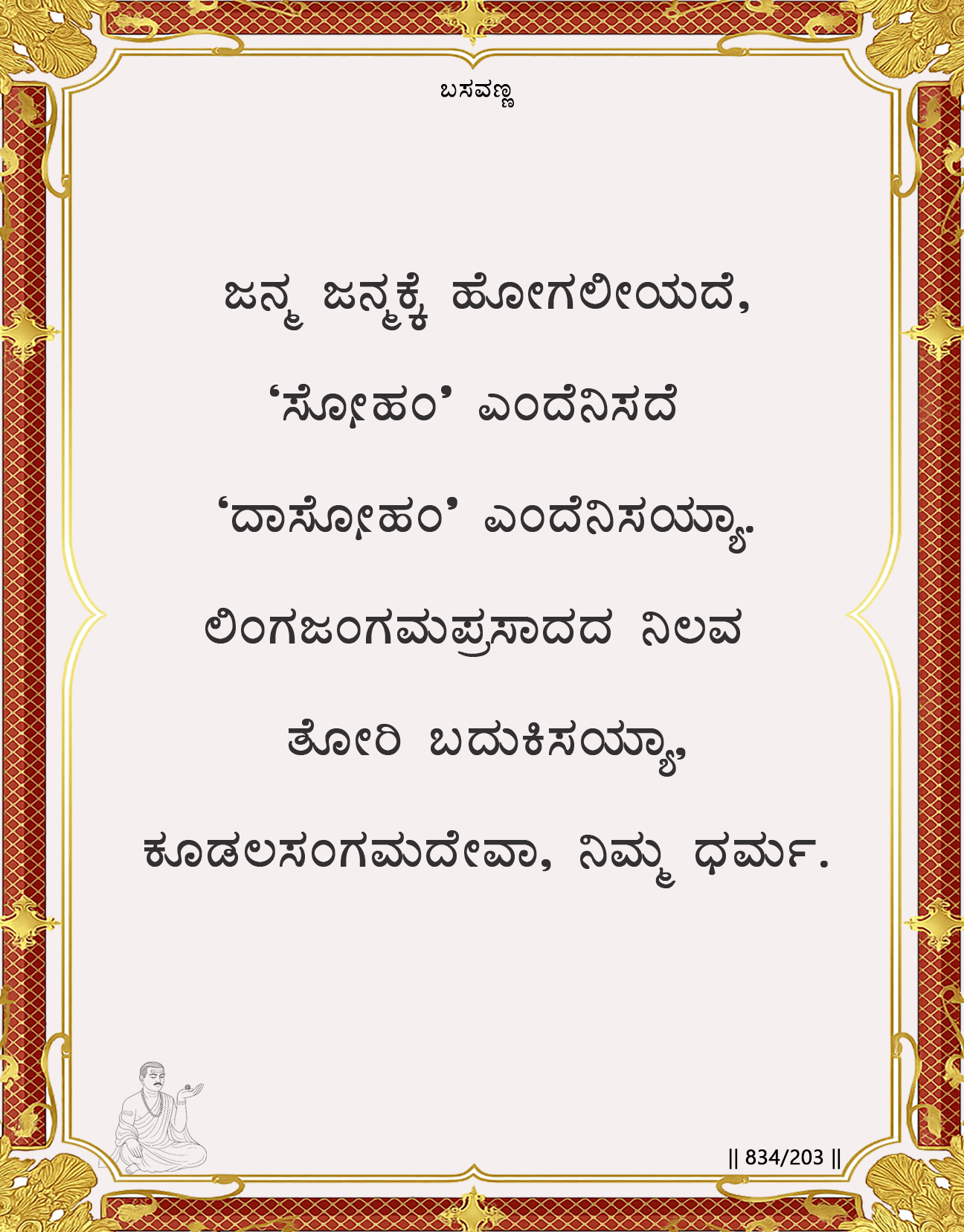
Birth after birth,
let me not be cast away, O Lord
for in this rare human form
You have given the bridge
from form to the formless,
the chance to merge
into Your everlasting consciousness.
Let me not miss this sacred opportunity.
And in that journey,
let no pride swell within me
let me never whisper,
“I am That.”
Instead, let my heart breathe only:
“I am Yours,
Your servant alone.”
Hold me fast, Kudalasangamadeva,
in the grace of Linga and Jangama
where humility opens the gate,
and the self finds its true home
in You.
Basavanna prays that across lifetimes he may not lose the rare human birth the only state where one can cross from form into the formless and realize the divine. Begging not to be turned away from this opportunity, he also asks to be protected from the subtle spiritual arrogance that declares “I am That.” True realization, he teaches, is grounded in humility and devotion, expressed through the attitude “I am Yours.” By the sustaining grace of Linga and Jangama, the seeker’s ego dissolves, and the path to union with Kudalasangama remains pure and open.
Spiritual Context
Core Spiritual Principle: Humility as the final safeguard on the path to union. The highest realization is not an achievement for the ego to claim, but a state of grace to be received. The declaration “I am That” can become a subtle form of ego-inflation if not rooted in the devotional surrender of “I am Yours.” The latter ensures that even in union, the relationship of love and service remains, preventing a fall into spiritual pride.
Cosmic Reality Perspective: This vachana navigates the delicate relationship between non-dual realization (advaita) and devotional relationship (dvaita). From the absolute perspective, the soul and God are one (“I am That”). But from the relative perspective of the journey, the soul is a servant of God (“I am Yours”). Basavanna prioritizes the devotional stance as the safer and more fruitful path, ensuring that the realization of oneness does not corrupt the individual will but transforms it into an instrument of divine love.
Historical Reality (Anubhava Mantapa Context): This vachana served as a crucial corrective within the Lingayoga community, balancing the lofty non-dual philosophy with the core practice of devotion (bhakti). It prevented scholars and advanced practitioners from developing spiritual elitism. It constantly reminded everyone that the path was founded on grace and service, not on personal attainment, thus preserving the community’s ethos of equality and humility.
Interpretation
“Birth after birth, let me not be cast away, O Lord ” This expresses the urgency (mumukshutva) of spiritual seeking. It acknowledges the law of karma and the fragility of the human opportunity, showing deep reverence for the gift of a human life.
“for in this rare human form You have given the bridge from form to the formless…” The human body is not a prison but a sacred vehicle (sadhana-sharira). It is the only state with the self-reflective consciousness necessary to consciously seek and realize God.
“let me never whisper, ‘I am That.’ Instead, let my heart breathe only: ‘I am Yours, Your servant alone.'” This is the vachana’s revolutionary heart. “I am That” can be a statement of the ego claiming Godhood. “I am Yours” is the soul surrendering to God. The latter is considered a higher realization because it contains love, relationship, and the bliss of service, which are absent in a mere intellectual declaration of identity.
“Hold me fast… in the grace of Linga and Jangama ” The Linga (the divine goal) and the Jangama (the path and the community) are the twin anchors that keep the seeker from drifting into the delusion of self-sufficiency.
Practical Implications: The practitioner must cherish the human opportunity and use it diligently. More importantly, they must vigilantly watch for any trace of spiritual pride, constantly reaffirming their role as a servant of the Divine. The attitude of surrender is to be valued even above the experience of non-dual bliss.
The Cosmic Reality
Anga (Human Dimension): The Anga is the “bridge.” Its highest purpose is to be a conscious, humble vehicle for the crossing. Its greatest failure would be to mistake itself for the destination.
Linga (Divine Principle): The Linga is the “formless” far shore and the grace that builds and sustains the bridge.
Jangama (Dynamic Interaction): The Jangama is the act of crossing the bridge with humility. It is the lived practice of devotion that ensures the Anga reaches the Linga without the Anga’s ego claiming the achievement for itself.
Shata Sthala
Primary Sthala: Prasadi (Recipient of Grace) The entire vachana is a prayer from the Prasadi, who understands that every step from valuing the human birth to achieving final humility is dependent on divine grace.
Supporting Sthala: Aikya (Union) The vachana points toward a mature Aikya, where union is experienced not as the ego’s victory but as the soul’s joyful and eternal service to the Lord. It is a union infused with relationship, not a blank oneness.
Practical Integration
Arivu (Awareness Practices): Contemplate the preciousness of human life and the danger of spiritual pride. Use the mantra “I am Yours” as a constant inner reminder to counteract any arising sense of egoic ownership over spiritual experiences or knowledge.
Achara (Personal Discipline): Let your primary discipline be the cultivation of humility. Actively seek out situations that keep you humble. Serve others without recognition.
Kayaka (Sacred Action): Perform all actions as a service to the Divine. See yourself as an instrument, not as the author, of your work.
Dasoha (Communal Offering): In community, celebrate humility above all other spiritual accomplishments. Create an environment where the simple, sincere devotee is honored more than the eloquent scholar or the charismatic speaker.
Modern Application
In modern spirituality, there is a prevalent focus on “self-realization” and “claiming your power,” which can easily devolve into a fortified spiritual ego. The statement “I am God” is often misunderstood and used to justify egoic impulses, leading to what is sometimes called “spiritual bypassing.”
This vachana is an essential antidote. It liberates us from the trap of the “spiritual ego.” It teaches that the goal is not to become a god, but to become a perfect servant of God. This path of devotion and humility is psychologically healthier, more grounded, and leads to a life of genuine compassion and service, free from the isolation and arrogance that can accompany a misunderstood non-duality.
Essence
This human life, a bridge so rare,
To cross from form to Your pure air.
But let no pride this truth distort,
To say “I’m You” in shallow sport.
I am Your servant, this I know,
And in that truth, I truly grow.
This vachana describes the final, critical protocol for a successful system merger. The individual system (Anga) is preparing to merge with the universal network (Linga). The vachana warns against a “hostile takeover” where the individual system, upon sensing the merger, declares “I am the network!” This is a catastrophic error that corrupts the merger. The correct protocol is a “graceful integration,” where the individual system requests: “I am yours to be integrated. Please absorb me according to your will.” This ensures a seamless, stable, and functional union where the individual’s unique pattern serves the whole without asserting disruptive dominance.
It is the difference between a drop of water saying, “I am the ocean!” and the drop saying, “I belong to the ocean.” The first is a proud and ultimately meaningless statement from a separate drop. The second is a humble and true statement that leads to the drop’s joyful dissolution into the ocean’s vastness, where it actually becomes the ocean without ever having to boast about it.
Our ego constantly seeks to claim credit, even for its own dissolution. The timeless truth here is that the final surrender is the surrender of the very idea that “I” have achieved anything. The most profound freedom is found not in being God, but in being God’s devotee. In that stance of loving service, the separation vanishes naturally, and what remains is a union so intimate that the question of “who is who” becomes irrelevant, replaced by the simple, radiant fact of love.

Views: 0