Poetic Rendering

I am not this body
this fleeting house of bone and breath.
I am not the servant of time
whose days rise and fall like restless tides.
I am not the grain
that ripens only to wither back into dust.
Know this, O Kudalasangamadeva:
for the one who knows the Self,
death is but the moon’s dark night,
a brief eclipse in an unbroken sky.
And when the light returns
as surely as the crescent becomes full
that rising again is my great festival,
my homecoming into Your eternal radiance.
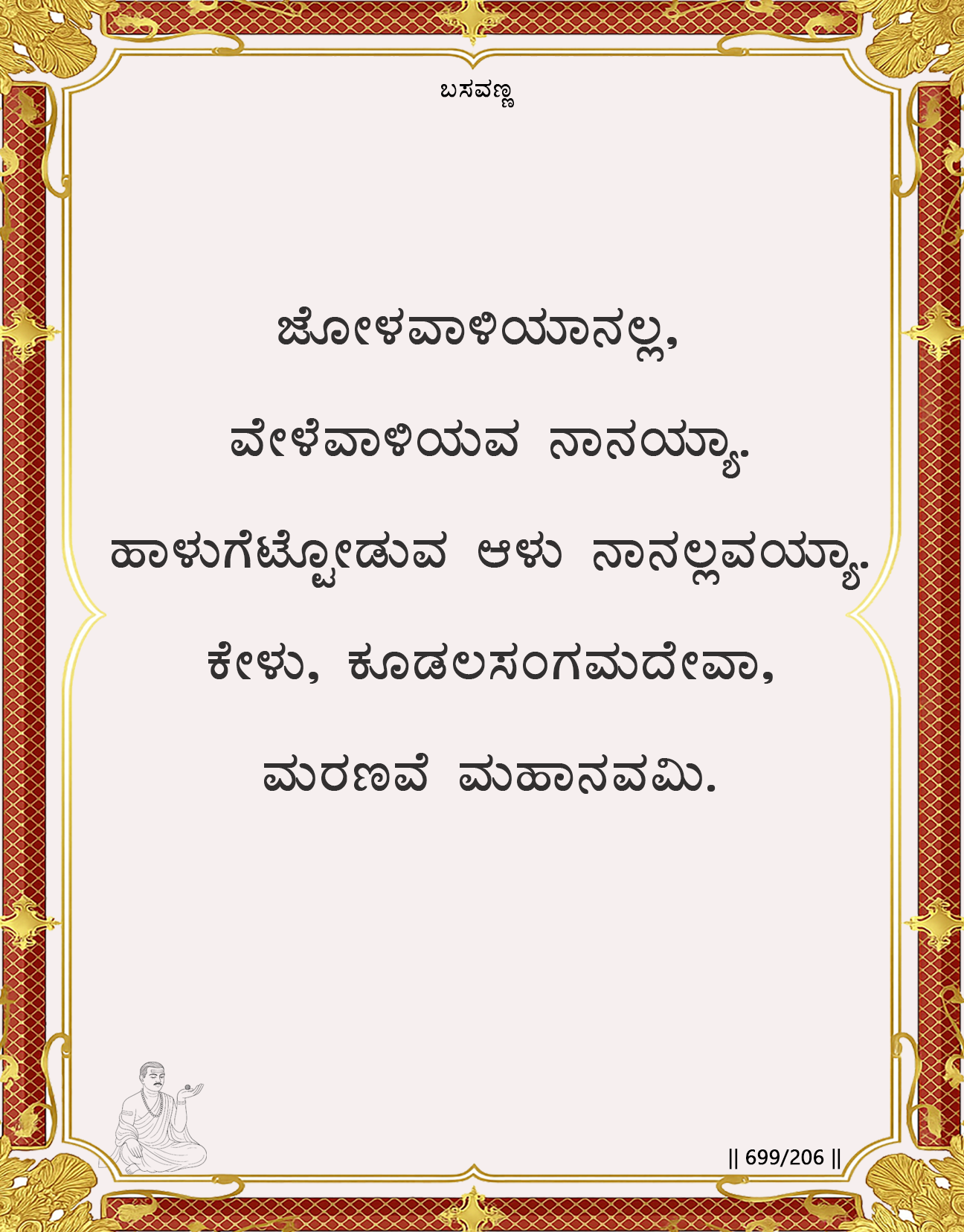
Basavanna declares he is not the perishable body, nor a slave to time, nor a life that ends with decay. For the realized one, death is only a passing dimming like the moon’s waning followed inevitably by a return of fullness. Thus, rebirth into divine light is not feared but celebrated as a joyful festival of return to Kudalasangama’s eternal presence.
Spiritual Context
Core Spiritual Principle: The fundamental error is identification with the ephemeral body and mind. Liberation is the firm knowledge (Jnana) that one’s true identity is the eternal, unchanging Self (Atman, synonymous with Linga). From this stabilized awareness, even death is perceived as a superficial event, not an existential threat.
Cosmic Reality Perspective: This is the non-dual experience of the cosmos as a continuous, luminous whole. Phenomena like birth and death are seen as rhythmic pulsations (Spanda) within the singular reality of Shiva-Shakti, much like the waning and waxing of the moon against the constant backdrop of the sky. The “sky” (Shiva) is untouched by the changing phases of the “moon” (the individual soul’s manifestation).
Historical Reality (Anubhava Mantapa Context): Basavanna offers a radical re-framing of samsara (the cycle of rebirth). In contrast to traditions that view rebirth as a failure or a prison to escape, here it is celebrated as a “festival” when one is consciously returning to the divine source. This transforms the existential fear of death into a confident anticipation of joyful union, empowering the common devotee.
Interpretation
“I am not this body… servant of time… grain”: This is a systematic process of negation (Neti Neti), discarding every layer of false identification gross physical form, the subtle body of temporal experience, and the causal body of latent tendencies to arrive at the pure “I”-consciousness.
“Death is but the moon’s dark night”: The moon analogy is profound. The dark moon is not the destruction of the moon, but a temporary alignment where its light is not visible from Earth. Similarly, death is not the annihilation of consciousness, but a temporary realignment where its manifestation in a particular form is no longer visible to others.
“That rising again is my great festival”: This is the ultimate expression of freedom. The soul, having realized its identity with the eternal, no longer experiences rebirth as a forced karmic sentence but as a voluntary, celebratory return to the lila (divine play) of manifestation in service of the Divine.
Practical Implications: The goal of Lingayoga is to realize this truth now, while embodied. By continually anchoring awareness in the Linga (the sky), one becomes a witness to the rising and falling of the body and mind (the moon’s phases), thereby attaining fearlessness and a profound, unshakable peace.
The Cosmic Reality
Anga (Human Dimension): The finite, time-bound persona that experiences itself as born, growing, decaying, and dying. It is the vehicle of experience, mistaken for the experiencer itself.
Linga (Divine Principle): The infinite, timeless, unconditioned Awareness that is the true substrate of all existence. It is the “unbroken sky” within which all forms appear and disappear.
Jangama (Dynamic Interaction): The entire cycle of life, death, and rebirth. For the unrealized, this is a source of dread (samsara). For the realized Sharana, this very process is sanctified, becoming a continuous, dynamic dance of return and worship a “festival” orchestrated by and for Koodalasangamadeva.
Shata Sthala
Primary Sthala: Aikya The vachana does not describe a seeker on the path but one who has arrived. The declaration “I am not this body” is the voice of accomplished union, where the sense of separate self has dissolved into the divine totality. The celebration of death as a festival is only possible from this stage of non-dual realization.
Supporting Sthala: Pranalingi This stage precedes Aikya, where the devotee’s life force (Prana) is so dedicated to the Linga that the distinction between living for the self and living for the Divine blurs. This total dedication prepares the ground for the final realization that even death is an act of offering and return to the Linga.
Practical Integration
Arivu (Awareness Practices): Practice “sky-like awareness.” Sit in meditation and observe thoughts, sensations, and emotions as passing clouds or changing phases of the moon, while identifying with the vast, unchanging awareness that contains them.
Achara (Personal Discipline): Consciously reframe your relationship with endings the end of a day, a project, a relationship. See them not as losses, but as the “dark moon” phase that naturally precedes a new beginning, a “festival of return” to a new expression of life.
Kayaka (Sacred Action): Perform your duties with the understanding that the actor (the small self) is temporary, but the action, when offered selflessly, is part of an eternal cycle. This detaches you from the fruits and the fear of the “death” of any particular endeavor.
Dasoha (Communal Offering): The community can support this awareness by celebrating life transitions not with fear but with spiritual understanding, reframing death as a sacred “homecoming” and supporting the bereaved with this cosmic perspective.
Modern Application
Contemporary culture is gripped by a terror of aging, decline, and death, leading to a frantic pursuit of youth, legacy, and material permanence. This denial of life’s natural cycle creates immense anxiety and a superficial existence that fails to confront the profound truth of impermanence.
This vachana offers the ultimate liberation from existential dread. By realizing our true nature as the eternal consciousness within which life and death occur, we can live with profound fearlessness. It allows us to engage with life fully, without the paralyzing shadow of its eventual end, and to see both life and death as sacred parts of a glorious, continuous festival of divine expression.
Essence
What dies was never me.
What returns was always You.
This coming, this going
is but Your single, endless breath.
This vachana describes a consciousness that has decohered from the localized, particle-like identity of the body-mind and has recohered with the field-state of universal awareness (Linga). From this field perspective, the “collapse” of the wavefunction (death of an individual form) is not an annihilation but a momentary return of energy to the potential state of the field, before it inevitably expresses itself again as a new waveform (rebirth). The festival is the joy of this perpetual, creative expression.
Imagine you are the ocean. A wave rises up (birth), plays on the surface for a time (life), and then subsides back into the depths (death). The wave was never a separate entity; it was always the ocean. From the ocean’s perspective, the subsiding of one wave is not a tragedy but a natural part of the rhythm that allows for the joyful rising of the next. You are the ocean, not the temporary wave.
The deepest human fear is the fear of non-existence. This vachana speaks to the universal longing for permanence and peace. It reveals that our true self is that permanence, and that peace is found not by avoiding the cycle of life and death, but by realizing we are the boundless space in which the entire cycle unfolds.

Views: 0