Poetic Rendering

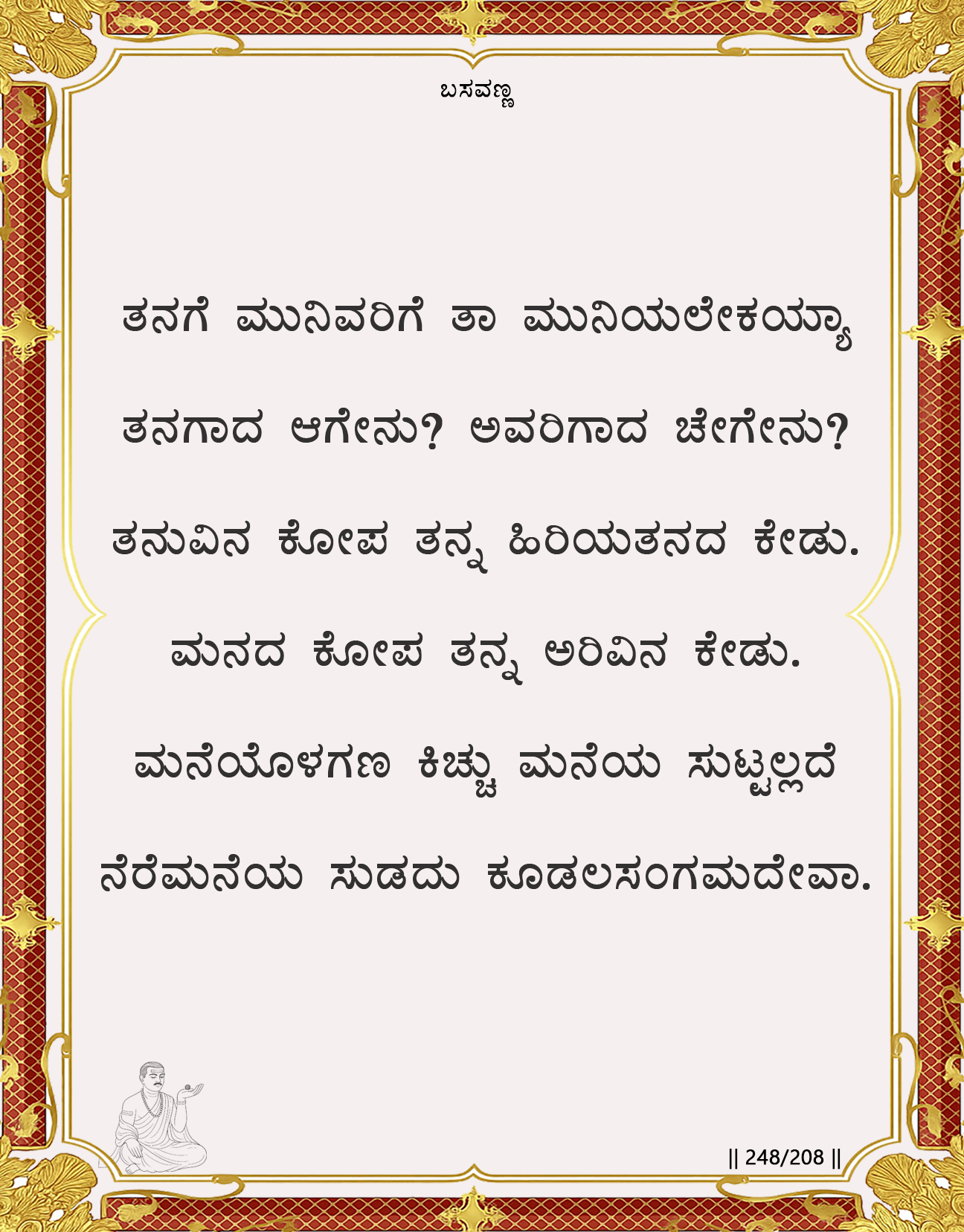
Why direct your fury at another, O fool?
What is your gain? What is their loss?
The body’s anger first burns your own dignity.
The mind’s anger first shatters your own inner peace.
A fire lit within one’s own house
will burn that house to ashes,
long before it touches the neighbor’s hut, O Koodalasangama!
In this vachana, Basavanna offers a masterful psychological and spiritual analysis of anger. He deconstructs the very logic of rage, revealing it as a self-destructive impulse that is fundamentally irrational. The primary victim of anger is never its intended target, but the one who harbors it. Using the powerful metaphor of a house fire, he illustrates that the flames of fury consume the vessel that contains them first scorching one’s dignity, peace, and wisdom long before they can affect anyone else. This is a teaching on radical self-responsibility and the preservation of one’s inner sanctum.
Spiritual Context
Core Spiritual Principle: Any emotion or action that disturbs the inner peace and clarity of consciousness is a form of self-betrayal and spiritual regression. The external world is a mirror; harming another in thought or deed is, first and foremost, a definitive act of self-harm, as it reinforces the illusion of a separate self and strengthens the very bonds (kleshas) that cause suffering.
Cosmic Reality Perspective: From the non-dual view, all is Shiva. Anger towards an “other” is a violent contradiction of this truth, a fragmentation of consciousness that creates a schism within the unified field of being. The resulting inner turmoil is the direct experiential consequence of living out this fundamental falsehood.
Historical Reality (Anubhava Mantapa Context): Basavanna’s community was a revolutionary social experiment that required profound emotional maturity to function. This vachana provides essential psychological training for the Sharanas, teaching them that social harmony begins with individual self-mastery. It is a practical guideline for resolving conflict by first managing one’s internal landscape.
Interpretation
“Why direct your fury at another, O fool? What is your gain? What is their loss?”: This is a logical deconstruction of anger’s premise. Basavanna questions its utility and exposes its irrational economy. It promises justice or relief but delivers only internal damage, offering no real “gain” and causing no definitive “loss” to the other.
“The body’s anger first burns your own dignity. The mind’s anger first shatters your own inner peace.”: This distinguishes between the physical and subtle effects. The body’s rage (clenched fists, heated speech) immediately compromises one’s outward composure and self-respect. The mind’s anger (resentment, ill-will) instantly destroys the subtle, precious atmosphere of inner tranquility, which is the foundation of spiritual practice.
“A fire lit within one’s own house…”: The “house” is the individual’s body-mind complex, the personal sanctuary for the indwelling Linga. Anger is not a weapon thrown out a window; it is a fire set in one’s own living room. The Linga (the resident deity) is the first to be threatened by the smoke and flames.
Practical Implications: The practice of Lingayoga demands constant vigilance over one’s emotional states. The Ishtalinga is not just an object of worship but a barometer of inner weather. Any disturbance in the mind-heart is a signal that one has moved away from the Linga’s peaceful center and must immediately engage in the Jangama process of return.
The Cosmic Reality
Anga (Human Dimension): The egoic persona that feels insulted, threatened, or wronged. It operates under the delusion that attacking an external object will solve an internal problem.
Linga (Divine Principle): The undisturbed, silent witness within. It is the peace that passeth understanding, the core of being that remains untouched by the drama of the mind, yet is obscured by the smoke of anger.
Jangama (Dynamic Interaction): The moment of conscious choice. It is the process of turning attention away from the external “cause” of anger and toward the internal “fire.” This act of turning inward is an appeal to the Linga for clarity and cooling grace, a movement that extinguishes the flames by depriving them of the fuel of identification.
Shata Sthala
Primary Sthala: Maheshwara This stage is characterized by a lordly discernment over the contents of one’s own consciousness. The vachanaist exhibits this “great” (maha) awareness by seeing the ultimate futility and self-destructiveness of anger, a passion that consumes the one who holds it. It is the application of Ishvara’s panoramic view to the microcosm of the mind.
Supporting Sthala: Bhakta The energy behind this teaching is the Bhakta’s passionate desire to protect the relationship with the Divine. Since God resides within, any inner turmoil is a desecration of the temple. The fervor that might have been wasted on external blame is redirected into fiercely guarding one’s own inner peace as an offering to the Beloved.
Practical Integration
Arivu (Awareness Practices): The moment anger arises, practice immediate recognition: “This is a fire in my house.” Feel the physical sensations (heat, tension) and the mental turbulence without acting on them. This separation of awareness from the emotion is the first step in putting out the fire.
Achara (Personal Discipline): Make a vow of non-violence (ahimsa) towards your own mind. Refuse to entertain violent thoughts or narratives about others, understanding that you are the first victim of this internal violence.
Kayaka (Sacred Action): If a conflict arises in your work, pause before reacting. Let your action be a response from a place of regained calm, not a reaction from the heat of anger. This ensures your Kayaka remains sacred and effective, not destructive.
Dasoha (Communal Offering): The greatest gift (dasoha) you can offer your community is a peaceful, non-reactive presence. By mastering this inner fire, you become a source of stability and clarity for others, helping to prevent conflicts from escalating.
Modern Application
We live in a culture of outrage on social media, in politics, in traffic. Anger is often misconstrued as passion, righteousness, or strength. This leads to chronic stress, broken relationships, and a collective atmosphere of hostility, all while achieving very little of substance.
This vachana provides a profound key to mental health and effective action. It teaches that true strength lies in emotional self-regulation. By understanding that anger primarily harms us, we are empowered to disengage from the cycle of outrage. This liberates immense energy that can be redirected into constructive problem-solving, compassionate dialogue, and the preservation of our own well-being.
Essence
The arrow of insult,
shot by another,
cannot pierce you
until you pick it up
and stab your own heart with it.
Anger is a catastrophic failure of the system to recognize its own boundaries. The individual consciousness (a localized waveform) mistakes itself as separate and attempts to correct an external “flaw,” not realizing that the energetic signature of the correction (anger) is a high-entropy, incoherent state that immediately destabilizes its own waveform integrity, causing internal “decoherence” long before it can affect the external target.
Imagine your mind is a clear, still pond. Anger is like throwing a heavy rock into it. The rock may be aimed at someone on the other side, but the first thing that happens is your own pond your peace and clarity is shattered by the ripples and mud you’ve churned up. The person on the other side might just get their feet wet, but you are left with a muddy mess.
The universal trigger for anger is a feeling of powerlessness or a threat to the ego. This vachana addresses the deep-seated human desire for agency and respect. It reveals that the most powerful and respectful act one can perform is to refuse to let external events dictate one’s internal state. True power is not controlling others, but mastering oneself.

Views: 1